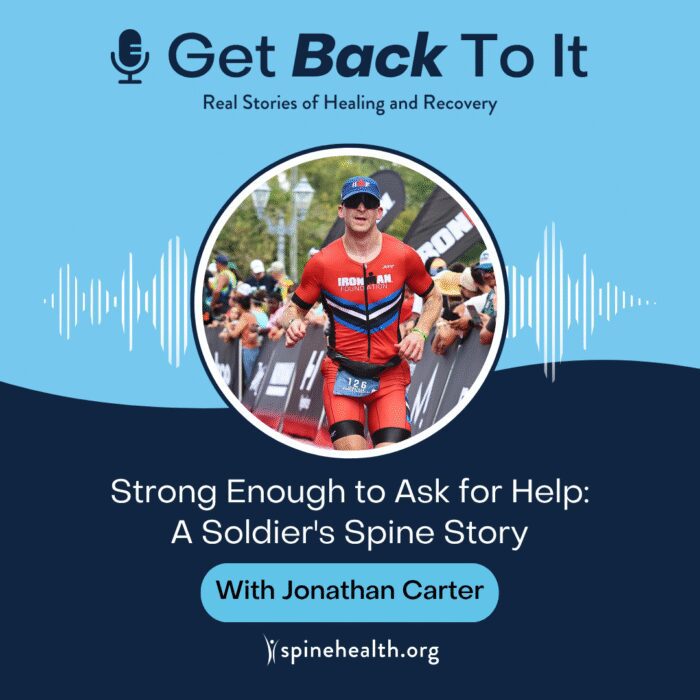
Strong Enough to Ask for Help: A Soldier’s Spine Story

Get Back to It w/ Jonathan Carter | Episode Transcript

Dr. Rita Roy: Hi everyone. I’m Dr. Rita Roy, CEO of the National Spine Health Foundation and host of the Get Back to It podcast. Here we share real stories of healing and recovery from people who’ve overcome spine problems and return to the lives they love. These success stories are powerful, inspiring, and sometimes unbelievable.

Let’s get back to it. At the Get Back to It podcast, our mission is to share the stories of spinal champions, individuals navigating spine conditions while striving for better quality of life. Today’s guest is Jonathan Carter, an army staff sergeant who began experiencing persistent shoulder blade pain in his early twenties.

What initially seemed like posture related strain gradually evolved into cervical degenerative disc disease with radiculopathy, ultimately requiring a two level cervical fusion. Jonathan’s story highlights, delayed diagnosis, the physical demands of military leadership and the discipline required to rebuild not just strength, but trust in your body.

Jonathan, thank you so much for being here today. Your spine issues didn’t begin with a dramatic injury, which I think makes your story really relatable for a lot of our listeners. Take us back to when you first noticed something wasn’t right.

Jonathan Carter: So it all started in early 2020. I was 23 on active duty as a junior soldier at the time, and I developed a persistent pain under my right shoulder blade.

It wasn’t sharp or dramatic, it just never really went away. Uh, at the time I, I chalked up a posture or a more s sedentary lifestyle that I’d been used to after the initial flurry of basic training and the technical training that followed. I found myself at a desk working long, high stress shifts on a watch floor.

I tried rest, physical therapy over the counter meds, um, but nothing really fixed it. It slowly became part of my everyday life and given how low impact my job at the time was compared to what a lot of more combat focused soldiers deal with every day, there just didn’t seem to be much reason for me to think that something more serious was going on.

Dr. Rita Roy: That’s a really important point, how easy it is to rationalize pain, especially when you’re young and active. When did you start to realize that this might be something more than just posture strain.

Jonathan Carter: By August of 2022, uh, things had definitely shifted. The pain started radiating from my lower neck, down both arms, and at its worse, it’d radiate up into my head.

I also noticed, uh, clumsiness in my hands, especially my left hand. Um, I was dropping things or kind of unintentionally tossing them as I was walking. At first, I wrote. Those off fatigue or distraction, and I didn’t really tell my doctors about it. In fact, it was only in retrospect, pretty recently even, uh, that I realized it was something that I should have brought up much sooner.

What really made it stop feeling normal at the time was the radiating pain. Up until then, I’d been told this was a soft tissue issue. So having symptoms show up in multiple places just didn’t add up. I was also worried about what a more serious diagnosis could mean for my military career, uh, which made it easier to dismiss.

Dr. Rita Roy: Jonathan, it sounds like you were really trying to manage this while also protecting your career, which so many people can probably relate to. So, so what did the next phase of treatment look like?

Jonathan Carter: Over the next couple of years, I was in and out of intensive physical therapy and relied on prescription muscle relaxers and anti-inflammatories just to get through the day in 2023.

I was fortunate, uh, and I had been stationed somewhere with good access to care and a leadership team that really supported me. Uh, some treatments helped, things like scraping, uh, helped reduce the tension and exercises from physical therapy. Let me function normally most of the time if I was careful about form.

Uh, the medication side was a little harder. Muscle relaxers affected my alertness at work. Uh, but through trial and error, I found something manageable. And the early MRI did show cervical disc degeneration at the time, but it wasn’t labeled as chronic. Uh, so our treatment stayed conservative

Dr. Rita Roy: and all of this was happening while you were taking on one of the most physically demanding leadership roles in the army.

Serving as a drill surgeon responsible for the training of new soldiers that could not have been easy.

Jonathan Carter: It was definitely hard at times. Uh, and that period lined up directly with my symptoms getting worse. Being a drill sergeant was very different than the wash floors I was used to. Um, it meant long days on my feet, constant movement, and honestly more pressure than I expected despite having some experience, some very stressful assignments Early on in my career, uh, we were a small team responsible for training hundreds of soldiers, and there just wasn’t much room to slow down.

I’ve never been someone who hides from things like this. Uh, even like hiding it from my junior soldiers, I’m usually pretty open with them. I think it’s important for the next generation to learn from our mistakes. Um, so, you know, I share what was going on with them and my colleagues, um, specifically about the pain I was dealing with.

Rather, it was hard to take the step back. I probably should have at the time. There’s a mystique where you’re expected to uphold as a drill sergeant. Um, but pretending to be fallible just doesn’t really help anyone. I found. Some of our workdays could stretch as long as 24 hours and sleep was hard to come by at times.

Looking back, I think the lack of recovery from long, frequent hours absolutely made my symptoms worse.

Dr. Rita Roy: It’s remarkable that you found a way to lean into in an endurance sport during all of this. Wow. You actually started competing in triathlons. Tell us about that.

Jonathan Carter: Sure. Uh, so while serving as a drill, I started endurance training, um, hoping that the structured, like mostly low impact work, um, that kind of goes into that sort of thing would help.

And more than anything, it also gave me kind of a sense of control, uh, when my body was feeling pretty unpredictable at the time. There were days I aggravated my symptoms, but overall, especially with swimming, I definitely felt better. Um, part of it was proving to myself and, you know, maybe a few coworkers too, that I was still capable and ready to perform, uh, even if I wasn’t lifting the big weights at PT or rocking during every field training.

Uh, endurance training also made me much more aware of my body day to day, and especially of tools like my Whoop band, which thanks dad for that one. Uh, and a Garmin watch giving me objective feedback throughout the training. That helped a ton. Uh.

Dr. Rita Roy: I’m just in awe of all that you are going through and, um, asking of your body and, um, and your mind and pushing through all of that, um, that sense of control that you described is so powerful.

Um, but in July of 2025, things took a pretty serious turn for you.

Jonathan Carter: They did. So, um, while I managed to kind of control my symptoms, uh, while I was on the trail as a drill, we call it, uh, after completing those two years, I was reassigned to serve as a platoon sergeant and an intelligence unit on the East Coast.

And shortly after that move, uh, I went to what should have been a, just a routine, you know, team event at a trampoline park. You know, I’m a little older than some of my soldiers, but the guy I was replacing was there and he’s older than me and he was having fun with him. So I figured I’d be okay, and it just didn’t occur to me.

Um, but anyways, two days later I woke up in like, some of the worst pain I’ve ever felt in my life. Uh, and I’m a little more scary even than that. I couldn’t lift my arm. My left arm that was is, uh, past like horizontal. It was completely different than anything I’d experienced before. It was frankly terrifying.

Uh, and I went straight to the er. I was outta work for the rest of the week and I was placed on a, like pretty heavy medication regime, including oxycodone and Valium, uh, which definitely came with its own challenges. Valium is now on the list of things I do and won’t take from the doctors anymore.

Dr. Rita Roy: Wow, that sounds so incredibly frightening, going from functioning to suddenly not being able to lift your arm, and that’s when imaging finally gave you some real answers.

Jonathan Carter: Yep, it did. And so while I was in the a ER, they took a new MRI. Um, and that new MRI confirmed degenerative disc disease, uh, with the cervical radial radial cappo. I can never pronounce this one right.

Dr. Rita Roy: Radiculopathy. I don’t even know why we use that word. We should just say nerve pain.

Jonathan Carter: So the, the cervical radiculopathy, uh, we’re gonna leave it with that, I guess.

Dr. Rita Roy: That sounds

Jonathan Carter: good. And, uh, after years of symptoms and limited results, uh, from the conservative treatment. It was a relief to finally have a name, even if I can’t pronounce it, um, for what was happening. And at the same time, you know, it was still stressful thinking about what it might mean for my career and my personal life.

Um, thankfully, you know, um, I was at my current duty station now and the orthopedic team here. Um, it’s just very, very well regarded. Um, a really good team, you know, and I was ready to stop spinning my wheels. So I spoke with some other soldiers and even actually a fellow firefighter. Um, around that time who’d gone through the surgery for similar issues twice.

Uh, and that perspective helped a lot. And so we moved quickly towards surgery after that.

Dr. Rita Roy: Having a name for what you’re experiencing after years of uncertainty, that’s huge. And especially when the news is hard and you’re faced with now the decision to have surgery after so many years of dealing with this.

Let’s talk about the surgery itself.

Jonathan Carter: Uh, sure. So on, uh, December 15th, 2025, I went, underwent a two level C five to C seven anterior cervical discectomy infusion. So I, I’d never had a major surgery before, you know, going into it, my biggest concern, um, from the research I’d done. Was the procedure itself and making sure it went well?

You know, my understanding was pretty much as long as you make it through the surgery itself. Okay. You know, and you do the right stuff for recovery, you’re, it’s pretty much smooth sailing. Um, you know, or as much as it can be after major surgery. I did have a lot of confidence that the surgical team, like I mentioned, um, I asked them a lot of detailed questions about their experience and outcomes.

Um, tons of questions. Um, and once I felt comfortable with them and with the surgery itself, what I ended up dreading wasn’t even the operation, it was the slow return to sport afterward. The pain following surgery was actually like even less than I expected. I, I still can’t quite believe that I didn’t feel and don’t feel any pain from the six screws they put into my vertebra or even the incision, um, which is still like pretty present on my neck right now.

What stood out more was the, the stiffness, um, a sore throat and muscle tension. I was on 30 days of convalescent leave from the Army, uh, largely home bound during that time. Thankfully I had family that flew in to, to help me out for the first couple weeks, which made a huge difference ’cause there’s, uh, you know, some weight restrictions on lifting and, you know, you’re supposed to kinda stay, not quite bedridden, but minimal exercise for the time.

Dr. Rita Roy: I, I, I just wanted to comment on that because, um, movement is good for you when you’re convalescing, but li limited movement with that A, C, D, F, right? And not lifting heavy objects and, and, uh, taking it easy, but walking is always good and walking is good for recovery. So that’s amazing that you had support, a support system around you.

Let’s talk a little bit about, um. Making the informed decision. Right. And it sounds like going in with information made a real difference to your mindset and your sense of confidence in how the surgery was gonna go. That has a lot to do with. How you do after surgery. And it, and it’s amazing because when people go into surgery with an expectation of what recovery is like, there are actually a lot of studies that show that that expectation can actually assist and aid in recovery.

Um, let’s talk about your, your recovery.

Jonathan Carter: Uh, sure. So, um, the arm and pain and the hand clumsiness resolved like very quickly. It’s hard, it’s still hard for me to kind of express, but. The tactile feeling in my hands is much stronger than it was, I think, previous to surgery. Um, but you don’t really lo realize it, I guess when you’re losing it before surgery, you know, ’cause it’s such a slow decline.

But once it comes back quickly, it’s definitely noticeable. Um, the muscle tension and headaches have taken a bit longer, uh, but physical therapy has helped with those a lot with the suboccipital, uh, muscles and everything. Uh, I started physical therapy in February, 2026. Uh, with the primary focus being on proper posture and a metered return to endurance sport, uh, nowadays I’m back to full-time work, uh, daily light workouts.

Rebuilding that full athletic capacity has been a bit more gradual. Um, like you said though, the walking during recovery has been, uh, super important. And so that kind of has led to now, I guess, future endeavors. Well, I think we’re gonna get into in a moment.

Dr. Rita Roy: Well, I just can’t believe you’re talking about February 26 then today is, you know, middle of March of 26, so that’s like five weeks ago.

That’s, and I’m looking at somebody at the screen, uh, who looks absolutely like the. Perfect picture of fitness and health and, uh, youth and vitality cannot, I cannot even believe that you just went through the surgery and you’re just coming out of physical therapy. It’s a absolutely incredible, it’s just absolutely incredible progress.

Such a short time. The days are long, I’m sure. The weeks are, the days are short, the weeks are long, and you’re not stopping here. So I hear, uh, that you are walking the country mile, which is a 100 mile ultra marathon. When is that going to happen and what does that say about where you are seeing yourself now in this recovery phase?

Jonathan Carter: Uh, yeah. So the, the country mile, um, like I said, it’s a hundred mile Ultra marathon. Um, it’s scheduled for April 3rd through fifth. It’s out on a strawberry farm. What’s

Dr. Rita Roy: sixth month?

Jonathan Carter: Yes. Yep. Coming up very soon.

Dr. Rita Roy: Wait, so your surgery was December, early December.

Jonathan Carter: Yeah, mid-December. December 15th. So it’s a very short turnaround.

So it’s months later in, in my defense it is. So it’s a hundred miles, but it’s a four mile loop and so you can stop and rest whenever you want. You could just like cut it kind of at any point. So that’s even

Dr. Rita Roy: miles kind of sounds long. Four months after surgery,

Jonathan Carter: you know, I have been walking like. Once I got out of the initial stages where even the walking was kind of limited, walking has definitely been a big thing for me.

Being, you know, I’m, I’m naturally pretty high energy, so it helps a lot. It helps clear my head, especially, um, you know, with work and everything. And I have a, a very nosy dog who likes to walk too. Um. Anyways, I’ve had a incredible team, you know, kind of help me get this far along, both on the medical and the personal side of things.

Um, they’ve been absolutely invaluable. And the ultra, as much as it is about, you know, trying to get a hundred miles, even if I don’t get 50 miles, you know, at the end of the day, it’s really kind of about rebuilding that trust in my body. Um, after the fusion surgery, there’s definitely the psychological piece, you know, learning that you’re not fragile, you know, the walking, like I kind of mentioned, served as a really healthy outlet for my energy so far.

Uh, which did dip really hard after surgery. Um, but even just these past maybe three, four weeks has come back up to kind of where it was before. Um, so you kind of have to learn how to, if you’re high energy like me, manage that, you know, while still staying within the bounds of, you know, my, like we call it a profile of the military, but my physical restrictions basically.

Yeah.

Dr. Rita Roy: It’s, it’s, it’s a really beautiful way to frame what you’re doing. And for those who do not know, I guess we can share that outside of your professional career, you are also an athlete and ambassador for the Ironman Foundation. Um, so that really does, you know, sort of. Your, um, endurance your love for endurance sport.

And so let’s, let’s just talk a little bit about how that experience has shaped the way that, that you show up in that role.

Jonathan Carter: Uh, you know, honestly, there’s probably too many ways to count right now. Um, as an Ironman Foundation Ambassador, you know, I of course compete in the Ironman triathlons. They consist of very long swims bikes, and run events.

Um, they’re all, that’s all completed back to back. If anyone’s not familiar, you know, the format of triathlon, uh, ambassadors. We take things like even a step further than your typical Ironman. Um, and we use our day-to-day training events and, you know, the race themselves, of course, to raise awareness and funds that help the Ironman Foundation support initiatives that break down barriers to sport, health and opportunity.

Um, we seek to empower underserved youth and community. Across the country this year. Our big initiative actually is the Swim Ready Program, um, which provides training to children who might not otherwise have access to safe swim training, uh, you know, where they reside or, you know, due to various factors.

Uh, with my diagnosis, um, and the surgery, it’s really changed how I think about resilience. Um, which is obviously a huge part of being a successful Ironman, or you know, really any kind of endurance athlete. As a career soldier, I’ve always believed in discipline and toughness and, you know, we really get that kind of instilled in us with being a drill sergeant.

Um, but resilience, you know, it also means recognizing when something isn’t right and slowing down early enough to protect long-term health. Uh, as I mentioned before, you know, I’ve always been open with my soldiers and, you know, my coworkers and family. Um, but now I, I definitely talk much more directly about the early warning signs, like persistent pain, numbness and changes in coordination.

Uh, you know, ignoring those or kind of writing them off like I did, it just doesn’t keep you in the fight the way many think it might. Do for you. You know, really it’s just kind of delays good decision making. Uh, and for anyone who thinks they’re too removed from the risk of traumatic injury or too fit for spine issues, you know, I was that person.

Um, it’s not toughness or even perfect preparation that protects you in the end, you know, like I, I’ve lifted throughout my career, but. My sister is on team USA for weightlifting top weight. You know, she’s taught me my form and stuff. I’m pretty good on top of that stuff. And you know, I ended up having back problems, you know, so really it’s recognizing the problems early, uh, and taking them seriously no matter how prepared you think you are, uh, when they started.

Dr. Rita Roy: That’s such an incredibly valuable message. Clearly one that you feel called to share. And we have an initiative called Operations Spine Strong. And it’s, um, it’s an initiative geared towards, um, service members. And one of the things in that initiative is really encouraging soldiers to recognize pain and do something about it.

Because I mean, there, there, there are times when you just sort of wait it out, see if it gets better, you know, it’s a temporary thing. You’ve, you know, pulled something, but. If it’s persisting for a long time, it, it could be the sign of something more serious. And when you delay treatment, you run the risk of permanent nerve damage, right?

You, you, you, you run the risk of limiting what your options are for recovery. So, you know, we wanna tell people don’t, don’t. Deny those symptoms and, and, uh, take care of it. Be, you know, before it becomes a long-term problem. And I think, you know, as you are sharing so honestly and, and, uh, vulnerably your story, um, you know, what, what would you want someone listening today to take away from your story?

Jonathan Carter: So I guess like for anyone listening, you know, I really can’t overstate, uh, that I had greatened taken really good care of myself up until my symptoms started. Um, I’ve always had a very athletic lifestyle. Parents made sure of that, but you know, I was also very vigilant to never, ever do it. Like I said, you know, my sister’s a weightlifter, you know.

So essentially a professional weightlifter. Uh, and she always taught me proper progression and form and all, everything. But, you know, and ample the importance of ample rest days even. Uh, I, I’d sought medical care early and regularly, you know, throughout the process. Um. But medicine, you know, and athletics too are, are their fields of analysis, I guess like any other, um, assessments are only as good as the data you have available to you and your care team at any given time.

And, you know, I’d say if I could go back to 2020, I would tell myself not to be afraid to share the coordination issues I was having, uh, to ask the doctors harder questions and push for better information. You know, whether that meant asking for a second MRI or just to have a, a second opinion, uh, on the existing imaging.

I hope listeners can take away that advocating for yourself doesn’t have to imply distrust in your doctors or your care team. Uh, it means partnering with them. The earlier you get accurate information, you know, the more you share ’em, no matter how an eyeing you think it might be, or you know, how in your head like I thought it was, uh, the better your chances of protecting your long-term health.

You know, if this, and if this conversation today kind of helps somebody recognize that sooner, uh, you know, it’ll all, it’ll all be worth it.

Dr. Rita Roy: Jonathan, your story is so amazing and your words of wisdom are just so on point. I feel like. You know, telling our, our listeners, we did not tell you to say any of these things because you’re telling the stories that we want to tell that you know, there’s good news out there in Spine Care.

Don’t ignore symptoms. Find a care team that you trust, you know, do your homework. So that you feel ready for what your recovery requirements are gonna be, surround yourself with a support team to get through it. It’s like you did all the right things. You’re the poster child of, of that success story, and I’m just, I’m so honored and delighted to be talking to you.

Not to mention that I thank you for your service. I mean, there’s that component on there that, um, you know, we so want to reach out to our, our, our military and veterans community because we know that spine conditions are prevalent and, you know, you put yourselves in unique situations, whether it’s, you know, rocking or, you know, heavy equipment that you’re carrying or.

In confined spaces for long periods of time or just all the different things that you demand of your body as an athlete soldier. And so we, we want to get the news out, um, to folks that are serving our country. We want to serve them as best we can. As well. And so I wanna talk a little bit about that, navigating that journey in the, in military medicine.

I loved what you said about, you know, asking, asking questions of your doctors doesn’t mean that you’re second guessing them. It means that you wanna learn more and you wanna know more. And many of the doctors who we work with will say they never feel, uh, bad. If a patient wants a second opinion, they encourage a second opinion.

’cause they want their patients to be. Confident in where they are. They, they want that, that doctor patient relationship that feels good for everybody and they wanna feel as good about it as you do. So, um, they highly encourage that to happen. What did that look like being an active duty, um, member of the military?

How did, how did you navigate, um, the sort of care pathways that you had available to you?

Jonathan Carter: So, um, I think the, the earliest that kind of outside provider started to come in was when I first was referred to pain management. Um, that was really, it was actually the, the first person to really realize, um, at least early on, like the, the root of the issues was a civilian pain management doctor.

And I was referred off post to them simply ’cause. While I had a, you know, a great team where I was, we didn’t have pain management, um, as part of our like, medical system on the base.

Dr. Rita Roy: Yeah.

Jonathan Carter: Um, so they referred me out for him and so that, you know, that was pretty typical just, you know, your specialty referral, but for getting the second opinion when it came to the surgery, you know, that was just a kind of like we said, you know, like.

Being comfortable enough with my provider to, to kind of partner up with them and despite, you know, the information they’d be giving me, say, you know, doc, I’d really appreciate it if we could, you know, farm these images out and just see, you know, what somebody else might have to say on it. So they referred me to a specialty clinic here in town, you know, somebody with a kind of similar education level to my own doctor and, you know, similar background.

And I mean, one factoid about, uh, Dr. Jackson, the doctor of my surgery is, you know, he, I think he says he does the surgery, but like. I think it’s 48 times a year or something about there, or you know, somewhere it’s right around like one a week, um, pretty close. So, you know, he’s pretty well practiced in it and.

I’ve found over the years, I guess, you know, being in involved with military medicine, you know, it’s usually not your care team that ever puts up the barrier. Sometimes it’s Tricare, you know, Humana, um, the, the back end of things. But, you know, as a drill, actually we saw this a lot with the soldiers. You know, you can work through most of those issues.

It might just take a bit of doing. So, you know, sometimes just that resiliency kind of, we talked about, I guess, um, being resilient when you’re dealing with, you know, the tricare, the financial side of that stuff. You know, as long as you, you stick with it and, and you work with your care team, you, like I said, it might take some doing, but you can usually get the to where you need to be in the end.

Yeah. You know, the system is not designed to let us down. It’s just maybe just a bit bureaucratic, you know, like all of government. Right.

Dr. Rita Roy: Yeah, and I think, you know, we, you say that so beautifully. You just, you know, keep the resilience and don’t give up. But I think, you know, one of the things, and to your credit is that, that’s especially hard to do when you’re in pain, right?

I mean, I think that’s one of the things that people feel is that I just want this to end. What do I need to do? Get it done right? And so, and yet it is your spine and. Oftentimes it’s, there’s not a one solution pathway that there’s, there’s there, there can be choices to be made. And so, you know, you’ve gotta kind of educate yourself on that.

You’ve gotta make sure you’re making the right decision, and that that takes some time and, and meanwhile you don’t feel good. So you’re, you’re sort of like, I don’t feel good. I just wanna get this done with someone, just fix it. But wait a second. I better make sure I’m doing the right thing because. Not gonna get more than maybe one or two shots on my spine.

So, you know, that, that, that just takes a bit. Yeah. It’s good for you. I mean, I’m just sticking with that. The surgeons that you met with when, so, so I guess the turning point for you to go from conservative treatment to surgery was, um, should we blame it on the trampoline?

Jonathan Carter: It was pretty much the trampolines.

I think so. ’cause there was no, I’ll tell you there, we um, even though I personally thought. Surely something, you know, more here is going on and you know, there there’s, for lack of a better phrase, like something kinetic or I guess more, you know, something hands-on we could do other than trying to just, you know, medicate the pain away, um, and beyond just like physical therapy, which I’d been doing for a couple of years at the time, you know, it was really just that, that not being able to lift the left arm, that was like a whoa.

You know, for me, and I, I think, you know, for the providers, um, ’cause up until, you know, they, the one thing my doctor always said is, you know, we won’t do surgery for the pain. ’cause you know, with the surgery there’s too high a chance that, you know, you come back out and you’re, you’re experiencing pain. But once there’s degradation, you know, of the.

Um, you know, of your control or your, your nerves or whatever, right? Yeah. Um, that tactile stuff, then, you know, that’s, that’s where we start to action it. Um, and that’s why I, you know, wish I’d been more upfront, I think about the, the throwing stuff. And even at the time when I first mentioned to him, I was still like, uh, I don’t know, maybe it’s still just in my head, but now post-surgery, I haven’t thrown a single thing, you know, I haven’t dropped anything like that.

And it’s like, oh, huh. I guess that was associated, you know, gosh,

Dr. Rita Roy: oh my gosh. Yeah. That, that radiculopathy pain, numbness, you know, weakness, that

Jonathan Carter: it’s a very, very unique feeling that I, like, I still. You know, the soldier’s asking, you know, what is nerve pain? What is the nerve? You know, aren’t the nerves, what’s in the pain?

Like, what’s the, and it’s still, I have a very hard time explaining to them, you know, quite what it felt like. Yeah. But I did know that when I started the, um, the Lyrica, ’cause even the, uh. The Gabapentin didn’t quite help, but the pre gaba did help quite a bit for me. Um, that once it went away, it was like, oh, I didn’t realize I wasn’t supposed to be feeling that.

Huh.

Dr. Rita Roy: Yeah.

Jonathan Carter: You know? Yeah.

Dr. Rita Roy: And was that, was that something that they talked about, um, that you would u you would have to take the medication for a long period of time or a short period of time, or what was the discussion around that?

Jonathan Carter: So, um. They, the hope was, I think, ’cause they didn’t really start giving me the gab pen until it was right after that incident at the trampoline park and after the week of, you know, oxycodone, um, the Vicodin, which, you know, they were supposed to, it was supposed to work as a muscle relaxer, but it just mentally had me all over the place.

So. After that appointment when I went back in to really see the specialty provider for the first time after like the ER visit, that’s where Gabapentin first came up. Um, and so we tried that. I think they titrated me to a slightly higher level. Um, but before, you know, it’s one of those weird things where, you know, you can raise the dose and it, it kind of works.

Conversely, I guess, you know, you guys would know more about that than me, right? So they switched me over to the pre gaba given that it does have a, you know, that one for one kind of relation to dose size or amount rather, I guess to strength. And that was like an overnight difference. I had poor sleep for as long as I could remember, and as soon as I started taking that, I was sleeping like a baby.

It was unreal. And it was, again, one of those things where it’s like I had no idea that that’s what was causing it. And for years I tried to figure out, like, and I’d do everything like, you know, lights off at six o’clock, no caffeine after two, you know. And it was just the chatter in my neck, I guess, you know, was keeping me up and I just could never really pin it down.

Dr. Rita Roy: Wow, that’s incredible. And so it just, you know, it was just such an insidious thing with you where it just kind of crept up over a lifetime almost like, almost like. Back to your teenage years, right? Is that, is that

Jonathan Carter: Al Almost, yeah, so even like when I was still in initial military training, um, there was one point where I was having some issues with my, my thumbs specifically.

Like they were both, and this is, maybe this, this is pure conjecture on my part. So anyone listening, if you’re like, that doesn’t make medical sense at all. I am not a doctor, so take this with a grain of salt. But, um, there, I woke up one day and I, I’d been having a lot of stress at the school. I wasn’t due very well at the language school, uh, at the time.

And all of a sudden my thumbs would start like popping out of like, like almost as if I had carpal tunnel. And when I went to stick my hand in my pocket or something. And then if I put my hand back by my back, like there’s a bunch of weird stuff. And they sent me to a specialist and they looked all at my muscles, like took a bunch of x-rays.

Dr. Rita Roy: Did they look at your neck at that time?

Jonathan Carter: They, they never looked at my neck. And so looking back, I think that was maybe the first instance of it now, knowing that it affected these fingers right of, of it. And it’s like, oh my, that was, you know, eight years ago. And so it just crept and crept and crept, you know, and it’s, and that, it’s just crazy.

Yeah. They never thought to look at the neck. Not once it was the wrists and the arms. And that was about the extent of it, because I had never had, you know, uh, super forceful. I mean, I did actually, I’d been hit by a car once or twice as a kid on the bike, but like never anything that sent me to the hospital right then, at least.

Yeah.

Dr. Rita Roy: Yeah. Well, I mean, the thing about degenerative disc disease is that, um. You know, it’s, it’s it, and we call it a disease. It’s really a condition where the discs, you know, get worn down. And d just depending on your anatomy, it d it doesn’t necessarily always require a surgery. So, you know, taking that conservative approach is the right thing.

You know, the, the, the question is how long, you know, if you’re taking medications and you’re taking very serious medications for that, um, how long will will that course of? You know, medication treatment, go on. And if you are a candidate for surgery and the surgery is gonna fix it and be definitive, maybe that’s, that’s a better course than, you know, repeated.

Jonathan Carter: Exactly right. Yeah. Sorry. I think to your last question, I never quite got there the. So the hope with the Lyrica is they only really started prescribing it to me that and the Gabapentin when they did that. Right. But when we already had moved, decided to move towards surgery and we were just kind of in that pre-operational window.

Dr. Rita Roy: Yeah.

Jonathan Carter: Um, and I did stop taking the Gabapentin or the pre gaba rather, I guess the Lyrica. Three or four weeks ago now, I think. Okay. And I’m never slept, still never slept better. I did go get a maloof pillow with a shoulder cutout that is also helping a ton with a little bit of shoulder soreness, um, because I, I kind of became a side sleeper through this whole process somehow.

But yeah, I’m now off those, and that was the, the goal with the surgery is. You know, especially ’cause there are side effects to the layer cut everything, especially interactions with other medications I already take, um, for a learning disability and stuff. Yeah. So it’s definitely much better. I’m, I’m glad we were able to do something like kind of once and for all and that was the decision too.

So when I got that second opinion on the surgery, the other surgeon wanted to do a hybrid procedure. Where they would fuse the, a single level and then do the, um, is it

Dr. Rita Roy: the disc replacement?

Jonathan Carter: Yeah, the thank you, the disc replacement at the the next level. But you know, the conversation was, you know, I guess the Discing Casino, they don’t last forever.

You know, the jury is still kind of out on, you know, for at least for each specific design, how long they do last. And I’m so young, you know, is it better to fuse now? And it’s, you know, it’s set for life or you know, do the replacement and maybe 15, 20 years from now, now I’m doing the fusion again anyways.

And I’m a little older, you know, recovery’s a little harder. And so we opted to just go with kind of the. The fusion just ’cause it had a longer track record kind of medically speaking of, and we know the outcome rate, like it’s, once it’s set, as long as there’s nothing that requires, you know, uh, rescission surgery, then you know, you’re pretty much good to go.

Dr. Rita Roy: Yeah. Yeah. That’s, that’s interesting that you were offered, um, those different treatment options and, and that’s good that you, you. Offered those options and you can, you can make a decision, uh, and a choice on what you wanna have, have done. Were those, um, was that, was that in military medicine or were those external?

Jonathan Carter: So the, the double fusion that came from Dr. Jackson, uh, my like normal provider for this, um, at the orthopedic health clinic here and, uh, on the base. The hybrid procedure. That was a civilian doctor that I’d been referred to.

Dr. Rita Roy: Mm-hmm.

Jonathan Carter: Um, who took a look and just based on, you know, his, his own practices kind of recommended that.

Dr. Rita Roy: Where what base are you on, Jonathan?

Jonathan Carter: Uh, so I’m here at Fort Gordon in Augusta, Georgia.

Dr. Rita Roy: Okay. All right, cool. That’s, that’s, that’s amazing. Where did you find your best sources of information when you were trying to learn about neck problems and neck conditions and. You

Jonathan Carter: know, honestly, so

Dr. Rita Roy: website along the way.

Jonathan Carter: So actually for, I’m, I’m a pretty, I wouldn’t say a super user. I’m a pretty heavy user of things like chat, GPT and given my like educational background growing up, um, I went to a great school, you know, I’ve always loved science and been good at. Kind of the, the scientific method, I guess. And I’m, I’m definitely a fact checker.

I’m a hardcore fact checker. Right. Um, due to my job, you know, it’s something I’ve become very good at. So I actually used chat GPTA fair bit to at least get me kind of like you would with like Wikipedia growing up. At least for me. You know, you’re writing a paper, you go a Wikipedia to find your sources, since you can’t Right.

Dr. Rita Roy: Though you weren’t, you weren’t supposed to, but we all did

Jonathan Carter: anyway. Yeah, you weren’t supposed to. Right. You know, same thing, kind of chat gt I’d have it kind of lead me in the right direction and then start looking at those sources. Um, unfortunately I had not came across the National Spine Health Foundation ahead of time and looking back, I really wish I had, um, I forget which episode it was, but I was listening to, to, uh, the young lady who came on the podcast just like this, and I listened to her story and I was like, oh my God.

A, this is the same things I was gonna say. So that’s not good. B, you know, I can’t believe how similar her experience was. And man, if I’d heard that like a couple years ago, that would’ve been very beneficial to know, you know, ’cause just ’cause. She had the same kinda cycle of delayed diagnosis and kind of second guessing yourself, you know, on the, because the nerve, it’s so hard, like I still can’t describe the nerve pain

Dr. Rita Roy: is it just kind of slowly comes on and then all of a sudden Yeah, things are,

Jonathan Carter: yeah.

You don’t realize it almost until it’s gone. What it was. Um, so it’s very, very difficult to, to pin down. But yeah, I wish I’d, I wish the National Spine Health Foundation had been one of those resources, but, um, it was usually, you know, friends who’d had the surgery. Like I said, I had that, I’m in a volunteer fire department.

One of my firefighter friends had the surgery twice. Yeah, so he’s got a vertical and uh, horizontal incision, and then it is in speaking of the incision, it is kind of funny after surgery when you’re walking around, you know, aside from the neck brace, it’s almost like a calling card, having the little incision and you will have folks come up to you, usually older folks.

They were like, oh, like when did you get it done? You know? And they know exactly what surgery you had just based on the location of the scar, which will eventually fade. I’m told

Dr. Rita Roy: it will.

Jonathan Carter: So it is funny, you know, there’s like, you get caught out from across

Dr. Rita Roy: the room. A hundred million Americans have a neck or back problem, and yet.

We don’t talk about it enough in our society. We don’t, we don’t hear about it. It’s not, it’s not in the vernacular, it’s not in the public conversation or the dialogue about health and wellness. And that’s what we’re here to do. We’re here to share these stories, to connect people and to talk more about, um, what, what, what you need to do.

And. I had a fusion, I put it off for 10 years. I didn’t wanna have back surgery because everything I heard was bad. And, you know, I remember going to my surgeon and I was getting foot drop at the time, so I was getting paralysis ’cause pain was not gonna be the motivator. I can put up a pain. But, um, you know, the, the paralysis that was freaking me out.

And, um, the surgeon said to me, we can fix bones. We can’t really fix nerves. So once that nerve is damaged. Gonna be tough to get nerve, you know, function back, but we can fix the bones, we can, you know, we can do the carpentry on that and, and, and save the nerve. So we gotta do that on you. And I, and I was like, oh man, that just resonated with me.

Um, so it

Jonathan Carter: was, yeah, I com I completely understand that. Um, so my mom, she’s been a hospice nurse for 20 years, you know, she was an ER nurse or a bit before that. You know, so medical community for a really long time, largely working with older patients, you know, shouldn’t be pretty savvy with the, the back stuff.

Um, and that was probably the biggest kind of blocking like issue between me and surgery at first was, you know, my parents, you know, being that I’m so young putting up a wall when I was talking to them about it because they didn’t think that it was, um. They didn’t quite understand what you just said about the, like once the nerves, you know, are impinged to a certain degree, even if you, you know, fix the restriction, you know, they might not recover.

And so that was the biggest thing I had to try and find evidence of and convince them like I was finding I was going on like NIHS and finding studies and stuff to refer ’em to. Yeah, to show, hey, like, no, I get it. Like it is a big step. But if we don’t act sooner than later, it might reach a point where even if we did.

It’s too late now. You know, there is a point where inaction is just as bad as. Anything else?

Dr. Rita Roy: Yeah, that, that’s such a good point. And so, kind of following that line, you know, we don’t think of young people getting spine conditions, right. And so I think that there can be a stigma around that. And so what would your advice be to young service members, um, or even athletes, young people, um, who think that they’re too young to have a spine problem?

Jonathan Carter: I guess, you know, if any of this resonates with you, go see your doctor. You know, it’s, it’s. Can’t guarantee they’ll give you an MRI. You know, I think I, I talked about it with Alex, um, before, you know, one of the other folks I’ve been working with, with, at the National Spine Health Foundation, they did a study kind of recently where if they gave everyone an MRI Right, it’d come back like 80% false positive or something 80%.

Right. So it’s,

Dr. Rita Roy: we’ll have, yep.

Jonathan Carter: Yeah, exactly. So it’s not a, not the end all be all, unfortunately. Um, but

Dr. Rita Roy: off an image. That’s

Jonathan Carter: right. Yeah. But, you know, all you can do is talk to your doctor and at least get the train rolling, you know? ’cause like you said, you know, it took you 10 years to, to finally get to surgery.

It took me almost, you know, if the, we think the thumb thing really was associated to it. You know, eight years, I guess. Um, and I, the weird thing is, you know, you can still be pretty functional during that, right? Like, I still did the Ironmans and stuff, like, in fact, that helped a lot of the time. So it’s kind of that weird thing where, you know.

Staying active can help is, you know, or hurt. It just depends on the person.

Dr. Rita Roy: Yeah,

Jonathan Carter: right. Like, and I was one of those people where it was probably the sitting, you know, with my neck down, staring at a computer, you know, tech neck kind of thing that did me in, in the long run and maybe a bit of genetics and you know, the activity helped.

But for somebody else, you know, maybe it was an acute athletic injury or yeah. What have you, you know, so you just have to kind of listen to your body and. You know, if you think there could be an issue, get it checked out. I mean, you know, there’s no, we’re thankfully not in the army of yesteryear where, you know, if you’re, you know, you’re injured, you know, and you say something about it, they’re going to, you know, view you differently for it.

Nowadays, you know, we’ve got a, a pretty good culture of, hey, if you recognize there’s a problem, you know, take the knee, drink some water, you know, C Doc and. Try and get it dealt with before we turn a mountain into, or a molehill into a mountain, you know?

Dr. Rita Roy: Yeah. Yeah. That’s so great to know that that culture exists, um, across the, the, um, services and so important and, you know, you with your leadership can instill that.

That culture as well. And so thank you for doing that. That’s, that’s amazing. Um, I just wanna close a little bit with talking about your Ironman Foundation participation. You mentioned that, um, earlier, and we haven’t talked about that. That’s so wonderful that you’re doing that. We’re so pleased and proud of the work that you’re doing.

It’s so awesome to talk with you about that. Um, you know, can you, can you tell us just a little more how you got involved and what, what, uh, excited you about participating there?

Jonathan Carter: Yeah, absolutely. Um, so, you know, I’d gotten into triathlons, um, shorter ones, mainly, um, what we call like a, a sprint size or, or super sprint, which is something you could do kind of at your local pool.

Um, and maybe like, you know, it’s 12 mile bike at the longest usually, and slowly crept up over the course of a year or two towards the Ironman distance events. Um. And so far to date, I’ve done, uh, the Ironman 70.3 here in Augusta. Um, this year I’ve got the Ironman 70.3 planned, along with, uh, Boise, um, which will actually be on my birthday in July.

Dr. Rita Roy: Wow.

Jonathan Carter: And, um, then the fool down in Florida. And, you know, that’s all on top of this, this a hundred mile walk too.

Dr. Rita Roy: Oh my God.

Jonathan Carter: Um, but I, I got into the foundation because. It was a great opportunity to, they say, you know, race for more. Um, like the races were fun and crossing that finish line is really fun. But it’s also really cool when you get to say, you know, ’cause I’m, I’m not some super athlete, I’m a pretty mid athlete as far as these things are concerned.

Very minimal. That’s

Dr. Rita Roy: all relative.

Jonathan Carter: It is very relative. Right. Um, but. What I can say is that I was the top fundraiser last year for Augusta, and I raised over 2,500 bucks. Um, oh, congratulations. For Foundation Congrat amazing. This year, I’m, I’m hoping to, to do far better than that, you know, if I can put the hours in and, and get the word out.

So. That, you know, is kinda a cool, you know, a little brag in its own right. Even if you can’t win the race, you can’t win the fundraising. Yes. Um, and it’s really a fantastic group of people, right? Right. From the jump. Um, they assign you an ambassador so you know what I’m doing this year when you’re an athlete.

Um, and the ambassador will reach out to you, we’ll help you with training if you need it. Um, help you have nerves, you know, if that’s a, an issue. Sure. Um, and then help you with the fundraising portion of it as well. ’cause all the ambassadors have, have fundraised before, uh, with some degree of success and some of the ambassadors, you know, they’re just fantastic people.

Um, I think one of the guys, Tom, um, is like a, you might even know who he is. He’s at like a pediatric doctor outta Boston who’s got like. Hundred thousand followers on Facebook or something.

Dr. Rita Roy: Gosh, awesome.

Jonathan Carter: Um, and he dedicates his time to doing this with the foundation. Um, you know, everyone’s got really cool stories.

We’re all from all over the place, even all over the world. Um, a couple folks from South America on the team this year, and it’s just a, it’s a really cool group that, you know, spans the country and, you know, by virtue of the fact we’re all over the place is a. A great group for me to be connected with.

Being that I do move pretty often, you know, that’s a, a national group that I’ll always be connected with now. And so I did it really for the, the support with the racing and, you know, just to, to bring me even more meaning to it. I’ve always, you know, if you can’t kind of tell by the hobbies I’ve mentioned in the career path, I’ve just been interested in public service.

Dr. Rita Roy: Yeah.

Jonathan Carter: Um, so I just look for a little ways here and there that I can continue to, to tackle a little. You know, notches on my public service belt, you know, whether it be through fundraising for private causes or, you know, the military or volunteer fire department or, you know, what have you. It’s just always kind of been a calling in my life, I guess, that I’ve, I’ve felt, uh, driven to, to, you know, accomplish.

Dr. Rita Roy: I think that is so awesome and, um, you definitely have, uh, a servant’s heart for sure in all the things that you do in your life. Um, and I’m just, it’s just, uh, it’s such an honor to talk with you and all the amazing ways that you give back to society. It’s, uh, it’s really awesome. Really, really awesome, Jonathan.

So how did you find the National Spine Health Foundation? How did you find us?

Jonathan Carter: So actually, so once I got hooked up with the Ironman Foundation, it occurred to me, um, that there was probably, you know, a Spine Health foundation as well that I could get involved with and do some work with, you know, so that’s, I reached out, I saw, went on your webpage, you know, saw the stories, listened to some of the podcasts and was like, man, I wish I’d known about this a long time ago.

Um, and reached right out that night. You know, there’s no question at all. It was right up my alley, you know, I guess, and, you know, again, just one more way to, to help folks out. ’cause like we said, it’s just, you know, even within the medical industry, you know, with my own mom, you know, the intricacies of it, I guess just don’t really get discussed that often despite, you know, the, the high, you know, um, diagnosis rates, like you’ve mentioned.

Dr. Rita Roy: Yeah. Well, we’re thrilled to have you as part of our community and, um, look forward to collaborating more in, in fun and exciting ways, and we’ll be cheering you on with all your, your, uh, your marathon work and, uh, definitely wanna hear how it goes. So April’s right around the corner. That’s so cool. I definitely, it

Jonathan Carter: is.

Yeah, it’s really close. And, and thanks for having me, Rita. Um, I’ve really appreciated, you know, the time and hope. You know, listeners can get something out of this. You know, if it even helps one person, you know, experiencing kind of what I experienced to get to the, to a fix sooner, you know, whatever that fix means for them, um, you know, that would be really fantastic.

And on the Ironman Foundation stuff, um, if anyone’s interested in, you know, this, you hear a calling to do something similar, um, just look up my name, Jonathan Carter, um, Ironman Foundation on Google. It’ll bring you right to my page. Uh, and you’ve got my whole story there. And. You know, feel free to reach out for the National Spine Health Foundation too.

Um, my information I think will be through the website as well. Yep. If you can reach out to their comment box.

Dr. Rita Roy: Thank you. Thank you, Jonathan. Thank you. Just again, such a, such an honor to talk to you. So inspired by your resilience. Wow, what a great story. And I can’t wait to keep in touch. I can’t wait to see where you go from here.

It’s amazing. Um, and I’m sure your doctors do too there. You’re the poster child in so many ways, and I mean that in the best way possible. Jonathan, thank you for sharing your story with such clarity and purpose. Your journey reminds us that spine conditions don’t always begin with a single event, and that recovery is both physical and psychological.

We are so grateful for your service and for your willingness to help others learn from your experience. At the National Spine Health Foundation, we believe deeply in providing hope through shared stories and trusted education. Millions of people live with spine related pain and it can feel isolating, but you’re not alone.

To hear more stories of spinal champions and to access Spine health resources, visit us@spinehealth.org. Thank you for listening.

Summary:

In this episode of Get Back To It, Dr. Rita Roy speaks with Platoon Sergeant Jonathan Carter, whose spine condition began as mild shoulder blade discomfort during his early years of military service and gradually progressed into cervical degenerative disc disease with nerve involvement. What initially seemed like a posture related issue evolved over several years into radiating pain, hand clumsiness, and loss of function, symptoms that were easy to dismiss while meeting the physical and leadership demands of military life.

After extensive conservative treatment, a sudden worsening of symptoms led to advanced imaging and a definitive diagnosis. Jonathan ultimately underwent a two-level cervical fusion to relieve nerve compression and stabilize his spine.

While surgery quickly resolved many of his neurological symptoms, recovery required patience, discipline, and a renewed focus on rebuilding strength and confidence in his body. Jonathan reflects on navigating his injury while serving as a leader, the pressure to push through pain, and the importance of advocating for your health, even in high performance environments like the military.

Now returning to endurance training, competing in triathlons, and preparing for an ultra-marathon, Jonathan’s story highlights that resilience is not just about pushing through, but recognizing when to act, trusting your care team, and rebuilding both physical and mental strength.