When Symptoms Blur Together: A Spine Patient’s Story

Dr. Rita Roy: Hi everyone. I’m Dr. Rita Roy, CEO of the National Spine Health Foundation, and I’m the host of the Get Back Toit podcast. Here we share real stories of healing and recovery from people who’ve overcome spine problems and return to the lives they love. These success stories are powerful, inspiring, and sometimes unbelievable.

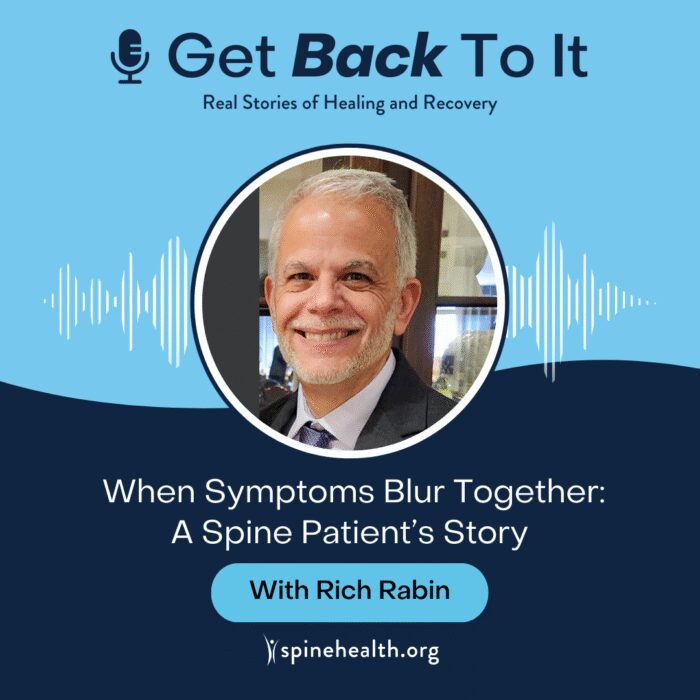
Let’s dive in. At the Get Back Toit podcast, our mission is to share the stories of spinal champions individuals who successfully overcome a spine condition. Today’s guest is Rich Raven, a technology delivery and product leader whose life was unexpectedly disrupted by severe nerve pain from a lumbar disc herniation.

What began as glute pain gradually evolved into a condition that affected his sleep. Mobility and daily decision making. Rich’s story highlights the uncertainty of recovery, the mental challenge of setbacks, and the importance of patience and self-awareness during healing. Rich. Your spine journey did not start overnight.

Take us back to when you first noticed that something just wasn’t right. 

Rich Rabin: Hi, Dr. Roy. Thank you so much for inviting me to share my story today. Um, I did, I began experiencing severe right side glute pain early last year. At first, the pain was really manageable, um, uncomfortable, but not totally alarming. Uh, it didn’t really take long though for it to progress to nerve pain, tingling and muscle spasms that traveled up and down both my legs.

What started is sort of localized pain really became something that was hard to ignore in my day-to-day life. 

Dr. Rita Roy: Like many patients, you initially tried what we call conservative treatment. What were those early steps like for you? 

Rich Rabin: Yeah, so initially the pain was thought to be bursitis, so I received a steroid injection for that.

Uh, I tried rest and modifying my daily activities and definitely physical therapy. I had hoped that those approaches would be enough, but despite doing, you know, all the right things, the pain just continued to worsen and became more intrusive. Uh, the most excruciating part was actually just the simple act of sitting down and standing up.

I couldn’t do either of those things without wincing or actually crying out in pain. I couldn’t drive for more than 10 or 15 minutes before the became, the pain became too much. Um, the only thing that ever brought me relief during this time was lying flat on the floor with a wedge pillow for my legs, and I would do that for maybe five or six hours a day.

Dr. Rita Roy: Wow. Rich gosh. Eventually you pushed for more answers. Tell us what further evaluation revealed for you. 

Rich Rabin: Yeah, so I was finally able to get an MRI, which showed a right side L five S one disc herniation that was severely compressing a nerve and it helped explain a lot, like I’m really happy we found the root cause.

Um, so I continued with physical therapy. I received an epidural steroid injection, but none of that really provided lasting relief. Um, sort of by late summer last year. The pain was just getting worse. It was affecting my sleep, my mobility. My overall quality of life, um, it was just really frustrating having to endure the pain for so long.

Uh, wondering why the process up to that point couldn’t have gone faster. Uh, and that quickly turned into sort of being scared and nervous about what potential surgery and recovery would be like. 

Dr. Rita Roy: Yes. And that’s often the point where patients have to face difficult decisions about their, their healthcare.

Um, so, so Rich, tell us what led you to the decision to have surgery? 

Rich Rabin: Yeah, so my decision was almost easy. Um, sort of early fall. Um, it was crystal clear that surgery was in order. I went through all the conservative treatments that my care team suggested that I do. Uh, the pain was just only getting worse.

I almost didn’t really have a choice. Um, so in October of last year, I underwent a right L five S one microdiscectomy, along with some bone decompression to relieve pressure on the nerve. The surgery addressed the primary source of the nerve pain, which was great, but the recovery has just been gradual and pretty unpredictable 

Dr. Rita Roy: that unpredictability can be one of the hardest parts.

What has recovery been like for you? 

Rich Rabin: So a few symptoms improved really quick, which was encouraging. But some of the other ones like this, constant residual glute pain. I had lingering nerve related sensations and spasms. Um, they’ve taken much longer to heal and they still fluctuate even today. Uh, I would say I’m still in the recovery process and not fully back to my sort of original pre-surgery baseline.

I think maybe what surprised me the most in all this is I just didn’t have a good grasp on the potential length of time it might take for all of these nerve related sensations to quiet down. 

Dr. Rita Roy: Rich, you’ve spoken about learning patience during recovery. Um, can you expand on that? 

Rich Rabin: Yeah, so for me, recovery has required me to learn a little bit differently how to interpret what my body is telling me without over overreacting to every setback, which is super difficult for me.

Uh, I learned to accept that improvement would not happen every day. Progress is not linear. So sometimes it felt like I took a step forward. Other days felt like a huge step back, and honestly that uncertainty has been one of the most challenging aspects of, of the whole experience. 

Dr. Rita Roy: Outside of your diagnosis, you have a full life and career.

Tell us a little about who you are beyond your spine story. 

Rich Rabin: Sure. Thanks for asking. Um, so I’m 54 years old. I work in technology delivery and product leadership. Outside of work, I spend a lot of time with my girlfriend. We enjoy seeing live music and walking and being out with our friends. Uh, I love spending time with my two adult daughters.

Uh, and you know, the whole experience has really reshaped how I think about health recovery, um, and sort of how it can be hard for patients to clearly describe what they’re feeling from day to day. It’s really changed how I intend to approach my daily life going forward. Um, I have missed so much over the last eight or nine months.

I really now recognize the need to take advantage of doing the things you love when you’re physically able to do them. 

Dr. Rita Roy: Yes, rich, that’s great insights. And you’ve mentioned, um, you know how hard it can be to clearly describe what you’re feeling from day to day. That’s something we hear from so many spine patients.

How do you personally deal with that challenge? 

Rich Rabin: Yeah, this truly was one of the most frustrating parts of this whole journey, both before surgery and during recovery. Uh, my symptoms would blur together day to day, glute pain, tingling, spasm, nerve sensations. I, I had them all, uh, when I went to physical therapy or back to my doctors and they’re like, how are you doing?

Uh, I struggled to give a clear answer. I couldn’t always tell if things were improving. They were plateauing or they were just different. How many times did I walk into an office and they say, well, what’s your pain level today? And I’m thinking, what do you mean? Like my glute pain, my nerve pain, my spasms, which one?

Um, so something I did to help myself, I actually ended up building an iPhone app called Recoverly. Uh, it’s a symptom tracking tool. It’s designed to help patients log what they’re feeling once a day. And the important thing was, is to be able to see patterns over time instead of relying on memory or how you’re feeling in the moment.

It helped me a ton ’cause it grounded me and reduced my second guessing of how I might be feeling. Um, and it just made conversations with those folks, like physical therapy, my doctor’s office, whoever. Um, it was just clear to discuss ’cause I could describe trends and separate how I might have been feeling in the moment or relying on my hazy memory.

I should say though, like for the app itself, um, it doesn’t provide medical advice. All the data stays on the user’s device. It was really just meant to support better communication between patients and their providers, and so recovery came directly just outta my own experience and what I needed to make sense of what my body was doing from one day to the next.

Dr. Rita Roy: Rich. That is such a powerful example of turning a personal challenge into something that can help other patients feel more confident and prepared during their recovery and during their spine journey. Um, you know, I think one of the things that you’ve talked about is that spine health is a journey.

It’s not a linear journey and you, you know, you’ve mentioned one step forward, two steps back, one, two steps forward, one step back. It’s a, it’s a journey and it requires, um, you know, constant, uh, attention. And, and I think that that’s something that all of us who’ve had a spine condition, um, can relate to.

Especially over time, and something that we talk about here is that, you know, aging is inevitable, but pain doesn’t have to be. Um, but you have to do things. To, to, to, to take care of that. 

Rich Rabin: Absolutely. 

Dr. Rita Roy: You know, we can’t, we cannot, uh, we can’t change the forces of gravity. So we have to, we have to figure out how to make it work for us.

Um, one of the things I wanted to ask you about, rich, looking back over your journey and in the scheme of things, your journey has not been the longest. We all want want these to be as short as possible, but I think one of the things that was, was frustrating for you, as you’ve described, is, um. Getting to the point of understanding what the, the cause of your pain was.

Um, can you tell us how you got to that information? Period. So what, what providers did you see and how did, why did it take time to get the MRI and what, what was involved in that journey? 

Rich Rabin: Yeah, sometimes I wish I knew what the answer to that was. Um, I went and spoke to neurologists, to orthopedic surgeons.

Um, I just try to gather as much information as possible. Um, I was all for the recommendation of conservative therapy. Um, to see what may help me the most at the beginning. Um, so it was really learning to self-advocate for myself. Yeah. Push to get, you know, insurance coverage, um, approved for MRIs, asking why physical therapy may not be helping me in the short term.

Dr. Rita Roy: Mm-hmm. 

Rich Rabin: Um, and so it was a frustrating but needed process to finally get all of the answers that I needed. 

Dr. Rita Roy: Yeah, when you first discovered that something just wasn’t right, that, you know, sometimes you wake up in the morning, you’re a little stiff, you slept funny, but you had this glute pain and it just, and you know, in your hips there, in your buttock area, and it just got worse and worse.

And at some point. You say, I, I, I can’t take this. I, you know, Tylenol’s not touching it. Advil’s not touching it. I need, I need some help. Um, what was the first doctor you went to or healthcare provider that you went to? 

Rich Rabin: Yeah, so I had gone to an orthopedist that I had seen before for a previous injury. I was going through a really good exercise program and lifting weights.

So I just made the connection that I thought maybe I injured myself doing something in that regard. Um, and he helped try to diagnose and originally thought I was exhibiting symptoms of bursitis. Um, and it was just a step-by-step process. I knew it was required, um, to go through all of the steps to try to find some relief, uh, before anything more drastic was going to happen.

Dr. Rita Roy: Yeah. Well, that’s that’s awesome that you had access to such knowledgeable. Healthcare team. Um, and admirable, you know, sometimes people start in an emergency room where they’ll start at a chiropractor that, you know, you sort of start your journey wherever you can get access. And um, I think one thing that’s interesting, um, many states in the United States no longer require a doctor’s referral or a prescription for physical therapy.

So I think that’s good news. So, you know, for people who are listening to wherever you are in the country, look into what the requirements are in your state. I don’t know if that’s a national, you know, uh, a policy or if that’s a state by state policy. Um, but where I live, you don’t need. Uh, you, you can go to see a physical therapist without needing a doctor’s prescription to do that.

So that’s, um, just another, another option for kind of an entry point for that conservative therapy, um, pathway that, you know, that, that is good to, to head down. Um, you know, look, looking back on your journey, what do you wish you had known earlier as you, as you reflect now, hindsight’s 2020, so 

Rich Rabin: right. Um, I guess what I wish I had known earlier is understanding the potential recovery time.

I sort of looked at my surgery as the end. Right, the, the light at the end of the tunnel. But in fact, it was truly just the beginning of the next phase. And so I had spoken to folks who gave me very, um, positive ideas about how long recovery would take, and I had that in my head that it was only gonna be three months or six weeks or eight weeks.

And I just didn’t allow myself the ability to take a step back and understand that this is not a quick turnaround thing. Recovery takes. Many, many months, maybe a year or more. Um, and just try to set my expectations correctly at the beginning. I wish I had known and done that to start. 

Dr. Rita Roy: Yeah. Did you, when you say you wish you had known that, um, did you, did you find the sort of mental anguish going through that to be something that was, um, interfering in your, in your life?

Rich Rabin: Yeah, absolutely. I mean, besides just dealing with the physical pain and anguish, um, a lot of, um, intrusive thoughts just around how difficult it was because you don’t really get a break from it. It’s constant, whether it’s the, the symptoms or the ideas of when will it stop? How do I get through this? Um, so a very difficult time.

Dr. Rita Roy: Yeah. That’s one of the things that we try to do here in the foundation is these kinds of conversations and making them publicly available and kind of, you know, spreading the word that these are lonely journeys, right? And you, and you think to yourself, what’s wrong with me? Like, is there something wrong with me?

Like, is, is is this unique to me? There’s something wrong with me. And, and you know, and, and the short answer to that is no. Your body’s doing exactly what. It’s designed to do. Um, and, but that can be a very lonely and a very, uh, isolating, um, and, um, mentally challenging, you know, from a mental health aspect.

Um. You know, episode to go through, and a lot of times we don’t recognize that yes, there’s the physical challenges, but there’s also mental health challenges that come along with getting through that recovery, and that’s one of the reasons why I’m just, just so excited to hear about the app that you created that was sort of born out of, you know, your own need.

It’s sort of a fancy note taker. Like you said, it doesn’t give medical advice. But just kind of helps you keep track of what you’re going through. Um, so I, I just would love to hear a little more about the app. 

Rich Rabin: Yeah, I, I appreciate that. Thanks so much. Um, yeah, I, I had plenty of extra time at home, right.

Just having all of those thoughts and being miserable, um, with my pain and symptoms. Uh, and when I was trying to think about how do I talk to people about how I’m feeling other than what I’m feeling in the moment? 

Dr. Rita Roy: Yeah. 

Rich Rabin: Um, and so I started, uh, formulating this idea of I need an easy way to track my pain and my symptoms.

Um, and also a way to understand what has my activity been like. Because the doctors would give me suggestions, see if you can walk 15 minutes, see if you could walk 30 minutes. Um, and so I played around and started building out this iPhone app. Of course, 

Dr. Rita Roy: because you developed technology product, 

Rich Rabin: right?

I’m teching, I’m a techie. Exactly. And so I started iterating through this process of, alright, I’ll, I’ll keep my one to 10 pain levels in the, in my head. Let me just go down the list of how I’m feeling in that particular day. Um, and I made it easy enough that it takes just a few minutes to track, but the important part was, I know how I’m feeling today, but when I go back to yesterday or the day before, I don’t really remember.

Um, and so the biggest thing that came out of it was to give me trends. So like maybe my nerve pain had gotten a little bit better over the past week. 

Dr. Rita Roy: Yeah. 

Rich Rabin: Or I was able to walk a little bit more. Or obviously the opposite. Your, your back pain really increased this past week. Watch out. Yeah. Um, and it even gives you, it even gave you an, gives me an option to, um, highlight that I really overdid it that day.

Maybe I really walked too much. Maybe the pain really was at a 10 and I felt really bad. And so when I, when I talked to my. Healthcare team, I was able to explain my trends and let them get a more holistic picture of how I was doing. 

Dr. Rita Roy: Yeah, that’s that’s amazing. And that’s so good for you because like you said, when you’re in the moment of pain, you, you really just can’t think about anything else like.

I don’t know. I think I felt this bad a couple days ago also. Well, actually it was 10 days ago that you felt this bad. Right, exactly. And so that’s actually a bit of good news because the gap is widening of, you know, more days, feeling good than bad and, you know, and so yeah, to be able to chart that out and look at that and give yourself the feedback and, and then be able to share that with your, your healthcare team, that’s, uh, that’s really awesome.

And 

Rich Rabin: thank you. Yeah, it was, it was very grounding. Um, and really. Try to give me a positive spin on my progress when it was warranted. 

Dr. Rita Roy: Yeah, and I love what you’ve just said there, staying positive. You know, there’s the difference between staying real and staying positive. Right? It’s, it’s, you want to be real because if something is going on and that it hasn’t been fixed or something else is going on, you need to know that.

Um, but staying positive is. Important to. Continuing the journey, right? So it’s like, I, I wanna stay real, but I wanna stay positive. Right? I don’t, I don’t wanna be pretending like I’m ignoring pain or I’m just, just wanting it to be over with. But yeah. And I, I, and so I think the app really addresses that, that, that schism that people can have right as they’re 

Rich Rabin: going.

Yeah. And you know, don’t get me wrong, it’s hard to stay positive when you’re lying on your back, but because it’s rooted in actual data. Then you can’t argue with it. 

Dr. Rita Roy: Right? 

Rich Rabin: And so it, it just gives you just a little bit of a different perspective into the window of your progress and just, just helps you ground, ground you a little bit.

Dr. Rita Roy: Yeah. Oh my gosh, I just love that so much. 

Rich Rabin: Thank 

Dr. Rita Roy: you. Um, rich, tell, tell us about, um, you know, what, what, uh. You, you would say to others in terms of getting support around you, so you have your app, you’re getting sort of your own personal feedback on that. What other, um, kinds of situations were helpful in this difficult recovery that you.

Are still going through, have been through, maybe it’s getting better now. Mm-hmm. 

Rich Rabin: Um, 

Dr. Rita Roy: but what, what kinds of things do you suggest people, uh, think about as being positive influences in that recovery journey? 

Rich Rabin: Yeah, so I know not everybody has this, but I am super lucky to have a family close by a girlfriend who is so super supportive.

So having just people there to. Either help you facilitate the day to day, be there to listen and support and encourage, um, was enormously helpful for me during the good and the difficult days. 

Dr. Rita Roy: Yeah. 

Rich Rabin: Um, and certainly the idea of tracking how I was feeling and following very closely to what my recovery was like and what potential next steps would be.

Dr. Rita Roy: Yeah. 

Rich Rabin: Um, and the other thing I did, which helped sort of pre recovery is just, um, prepare my home. Yeah. Right. Make things counter accessible. Grab her tools and 

Dr. Rita Roy: yeah, 

Rich Rabin: pillows and just getting my home ready for the recovering me. 

Dr. Rita Roy: Yeah. Rich, how much time did you have to take off of work? Around the surgery time or maybe throughout the whole episode, I don’t know if you had a lot of needs.

Rich Rabin: So I’m very lucky to have a job where I’m able to work from home. I’m mostly on a laptop, so the time I needed to take off was very flexible from my leadership at work, whether it was for physical therapy, recovery time, or that I was just really in. Too much pain. Um, so it wasn’t super long that I had to take off work.

Dr. Rita Roy: Oh, that’s great. 

Rich Rabin: Um, but I also have, um, friends who have gone through surgeries where, um, they’re unable to go back into the office for days, weeks, months, because they can’t drive. Um, so I’m very fortunate that I do not have to do that. 

Dr. Rita Roy: Yeah, that’s great. Well, that’s one of those things, speaking of driving, if you’re going to have a procedure, you, you know, you need a support system around you to help you get home.

You won’t be able to drive on the, uh, obviously on the day of surgery. So, uh, yes, you’re very blessed to have wonderful family and friends around you, and that is something that is a consideration, um, you know, for these treatments and, and frankly. Sometimes even for those what we call conservative treatments, whether it’s an epidural injection, which is not surgery, but can be tiring, um, or can be uncomfortable, um, you know, you may not feel like driving after getting some of those treatments.

So it’s, it’s important to think about having your support system around you, I think as you’re, as you’re getting through these things, um, for sure. 

Rich Rabin: Yeah, absolutely. And you know, exhaustion is a huge part of the recovery. Um, your body is just healing and dealing with all the things that are going on, um, and it’s very tiring.

Dr. Rita Roy: Yeah. Before we started this, uh, recording, rich, I said to you, I’m looking at you on a screen here and we’re talking over a Zoom link, but, um, you are the picture of health and fitness. You are, you know, a handsome fit. Happy young man. Can I say that? Young man, 54 years young. 

Rich Rabin: Absolutely. And 

Dr. Rita Roy: you do not look like someone who’s gone through what you’ve been through in the last year.

Part of that I think, is, um, you know, trying to maintain your overall, uh, uh, health and. Pre rehabbing yourself, right? So, um, kind of getting in as good a shape as you can wherever you are, um, so that when you’re facing a, a situation like this, um, the recovery can be optimized. Um, did you find that there were things that you were doing in your life that that helped with that?

Rich Rabin: Yeah, before any of it happened, um, I had put forth a lot of effort in trying to live a healthier lifestyle. Um, whether that was exercise, eating healthy, um, and just surrounding myself with, I have no idea what I was going to say, so let me try. 

Dr. Rita Roy: Okay. It’s okay. I mean, we’re just being, being off the cuff. I mean, because I think that is something for people to think about, right?

Like just. You know, staying, staying in as, as good of health as you can, whatever that means, only helps you down the road, right? Because things happen as you go through life. And so, um, I think for you, it seems to me that you were in pretty good shape. That you were able to sort of have this, um, have the time to explore your options.

Um, that, that having core strength, having, you know, good muscle strength, having, you know, a healthy weight, a normal healthy body weight, those, those are all kinds of, um, stressors or pressures on your joints, on your, you know, back that can complicate. Treatment and recovery. And that’s not a judgment statement.

That’s just how it is. And, and the frustrating thing is that when you are in pain, the last thing you wanna do is go take a walk or you can’t move, you’re in pain, you can’t move. And so it begins this vicious cycle. Right. And that’s one of the things we wanna. We wanna stop, we want people to stay in motion.

A body in motion stays in motion. So it’s all about being able to, to move and do the things in your life that you wanna do. Um, so I was just asking, you know, what, what were some of your pre-surgery things that you do in your life to, to, to keep yourself in pretty good shape. 

Rich Rabin: Yeah. Thank you for asking. So I was an avid exerciser, um, lots of walking, um, gym time, free weights and strength training.

Um, and I was super fortunate looking back on it, that I was prepared physically for what was about to come. Um, and I also think it helps as I’m going through, you know, physical therapy exercises, I, I know how to do them. I’m comfortable with doing those kinds of things, so I know my body is ready for it.

Um, so I, I feel very fortunate that I had began that process before. 

Dr. Rita Roy: Yeah, that’s wonderful. Something about physical therapy that we remind people is that when you go to your physical therapy appointment, your therapist is showing you how to do exercises for you. And then you’re supposed to go home and do those exercises.

So you don’t just do physical therapy at the physical therapy appointment, uh, you’re supposed to do those in between and 

Rich Rabin: something. It’s, it’s a total commitment. 

Dr. Rita Roy: It’s a total commitment. But that can be hard to do if you’re not a person who. Has ever done those kinds of exercises or knows about them. So that’s just really, that’s just hard.

And um, but for you, fortunately that part, that was an easy part. You had other challenges, but at least that part was an easy part for you to, to understand. 

Yeah, 

Rich Rabin: it definitely was. And I was ready and prepared for it and just made it part of my routine. Yeah. Um, was. Giving myself time to get through all my physical therapy exercises, um, every day, no matter what.

Dr. Rita Roy: Yeah. And are you still doing some of those exercises now? Is that still part of your life? 

Rich Rabin: It is. Um, I’ve been going to physical, physical therapy once a week, um, keep progressing with better stretches and now doing some more specific strength training. Um, and yep. Every evening, um, I’m doing the exercises.

Dr. Rita Roy: Do your thing. Yeah. That’s awesome. Well, I had a, um, spine fusion, um, about eight years ago, nine years ago, and, um, I still, I do my exercise. It kind of changed my life and I actually enjoy doing my exercises now. I feel really good when I do my exercises and I feel not so good when I don’t do my exercises.

Mm-hmm. I, uh, I hear you. People say, well, how often do you do that stretching and that myofascial release and the rolling, and I’m like, every day. Every day. And, uh, I didn’t do that before though, so it, it definitely was life changing for me. 

Rich Rabin: Yeah. I think when you make it a habit, it’s just something that your body expects and thrives on.

Dr. Rita Roy: Yeah. Brush my teeth, roll out my, you know, my areas and, and do that. Just wanna pivot for a little bit on, um, sort of how you chose your care team. That’s, that’s something that people ask a lot of questions about is how do I find the right doctor for me? And would just like to, to ask you about how you found the right person to.

Do your surgery, take care of 

Rich Rabin: your, yeah, so I’m a, I’m a data and analysis kind of guy, so I reached out to, you know, trusted people that I knew, um, looking for recommendations. And I talked to maybe four or five doctors and surgeons to just get their opinions, uh, what’s their bedside manner are like, uh, what are their credentials?

And after going through maybe four or five of those, I, I found the one that. Just felt like he understood me. Um, he well regarded in the Atlanta community and immediately chose him and his team. They just felt like they were gonna gimme the right amount of care. 

Dr. Rita Roy: That’s brilliant. Bravo for doing that, rich.

That’s something that we encourage people to do often is, you know, get more than one opinion. It’s your back, it’s your spine. Mm-hmm. You got one and there’s plenty of doctors. So you know, you wanna find the right match for you. You wanna look for a doctor who’s, who’s well regarded in the community. It’s great to.

Check that out. Talk to people and ask them questions. You know, how often do you do this? And are you a fellowship trained spine expert? Um, you know, what’s, what’s your training and, and, um, how often do you do these procedures? And then ultimately making that personal connection with someone who you’re going to trust your, you know, your life too.

Um, that’s so important that you have that rapport. And, and so. I’m really impressed with that. That is really great. 

Rich Rabin: Thank you. Yeah, it was definitely an education for myself to understand what kind of questions to ask and how to take their feedback and responses. Um, and yeah, it took a while to find all those people and talk to them, which I knew made the whole process a little bit longer, but it felt like that maybe was the most important part.

Dr. Rita Roy: Yeah, no, that’s that again. That is awesome. And Bravo. We encourage people to take their time. In that decision making, even though you’re in pain, you wanna get a quick answer or you just wanna get this over with. Um, but take your time with that and choose the right provider for you. Um, it will pay off in the long run.

Right. So 

Rich Rabin: for sure. 

Dr. Rita Roy: Yeah. That’s great. That’s awesome. Um, I guess Rich, you know, we’ve covered a lot of things here. Is there anything we haven’t talked about that you wanna share with our audience? 

Rich Rabin: I, I think the work you do is wonderful. I really appreciate the chance to share my story. Um, it really has been eye-opening, uh, and educational for me, and I’m glad that I get to share it with folks.

I try to do that with as many people who will listen to similar things that they’re going through. Um, so I just very much appreciate it. Thank you. 

Dr. Rita Roy: Thanks, rich. Rich, how did you find the National Spine Health Foundation? 

Rich Rabin: I was just looking for my own resources, um, tools or documents or articles or podcasts to read and educate myself on how my recovery was going, and it just was prevalent in what I was searching for.

So I was just able to get some really great information. 

Dr. Rita Roy: That’s awesome. I’m so, so glad. That is what we’re here for. I mean, that just puts wind in our sails. We just wanna know that the work that we are doing is really helping people and um, I’m so glad you found us. I’m so glad that the information was helpful and I’m so glad that you’ve come back.

To be part of our Spinal Champion community, to be part of our organization and sort of pay it forward. Right. Let let other people learn. From what you’ve learned, um, is, is your app available? Can other people use it? Is, what’s the status? 

Rich Rabin: Yep. It’s, it’s an iPhone app, so it’s out on the, uh, iPhone app store.

Uh, the name of it is Recoverly. Uh, would love to get any feedback from folks that like to, to do it. It’s free to download, free you to track your recovery every day. Um, and yeah, go take a look. 

Dr. Rita Roy: Awesome. Awesome. Well, rich, this has been such an awesome conversation. We’re so proud of the progress you are making, and, uh, you know, the journey is a journey.

Um, it’s not one and done. And, um, it takes, it takes, uh, you know, constant dedication to your health and we really appreciate you sharing your story with us. And I’m, I’m just so delighted that you’ve. Found us. You’ve shared with us and mostly congratulations on, on your success and the cool app that you made to share with other people.

Thank you for sharing that with us, 

Rich Rabin: and thank you, Dr. Roy. I really appreciate the ability to talk to you today. I’ve enjoyed it very much and thanks for the opportunity. 

Dr. Rita Roy: Uh, rich, thank you again for sharing your story with such honesty. Your experience highlights the complexity of spine recovery and the importance of patience, self-awareness, and perseverance.

Again, we’re just very grateful that you’ve shared your journey with us.

At the National Spine Health Foundation, we believe deeply in providing hope through shared stories and trusted education. Millions of people live with spine related pain and it can feel isolating, but you’re not alone. To hear more spinal champion stories and access Spine health resources, visit us@spinehealth.org.

Thank you for listening.

Summary:

In this episode of Get Back To It, Dr. Rita Roy speaks with Rich Rabin, a technology and product leader whose life was upended by severe nerve pain caused by an L5–S1 disc herniation. What began as manageable glute pain progressed into debilitating nerve symptoms that affected his sleep, mobility, and overall quality of life. After months of conservative treatments—including physical therapy and injections—Rich ultimately underwent a microdiscectomy to relieve nerve compression.

While surgery addressed the primary issue, recovery proved gradual and unpredictable. Rich shares candidly about the mental and emotional challenges of healing, the importance of self-advocacy, and learning that spine recovery is rarely linear.

Inspired by his own frustration tracking fluctuating symptoms, Rich created Recoverly, a free iPhone app designed to help patients log daily symptoms and identify trends—supporting clearer communication with healthcare providers.

Rich’s story is a powerful reminder that healing takes patience; progress isn’t always steady, and resilience can grow from even the most difficult setbacks.