Silver Lining: Growing A Backbone

Dr. Rita Roy: Hi everyone. I’m Dr. Rita Roy, CEO of the National Spine Health Foundation, and I’m the host of the Get Back Toit podcast. Here we share real stories of healing and recovery from people who overcame spine problems and returned to the lives they love. These success stories are powerful, inspiring, and sometimes unbelievable.

Let’s dive in.

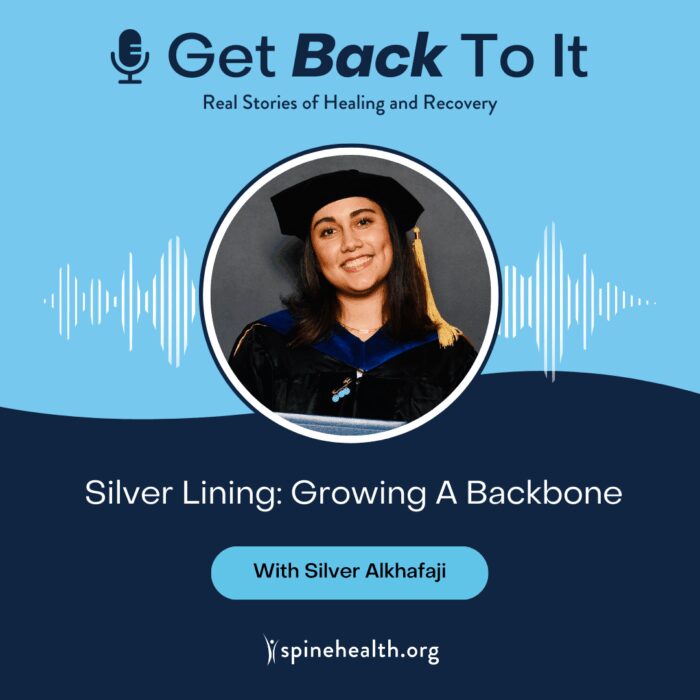
At the Get Back to It podcast, our goal is to tell stories of spinal champions who’ve been able to achieve a better quality of life through spinal healthcare. Today’s guest is silver. A scientist, writer, and chronic pain warrior Silver’s journey began with back pain as a teenager, but it intensified during her years as a PhD student at UCSF.

From misdiagnosis to spinal fusion surgery, Silver’s path has been anything but simple yet through science, perseverance, and even poetry, she has found healing and purpose.

Silver’s journey with back pain began years before her diagnosis 

Silver Alkhafaji: as a teenager. Um, I remember carrying heavy backpacks, um, that started my back pain journey and over time it became something that I just have to live with. Doing my PhD at UCSF and I was spending long hours in the lab on a computer and even doing an MD.

B, A fellowship in 2023. It really escalated to a level I could no longer ignore 

Dr. Rita Roy: at first the cause of silver’s pain wasn’t clear. What were some of the first symptoms you noticed that made you think something more serious was happening? 

Silver Alkhafaji: Initially, I was told to go and change my bed mattress and my concerns were dismissed despite the chronic low back pain that an urgent care doctor diagnosed me with.

Side joint. Inflammation, but the pain kept getting worse, even radiating down both of my legs with sciatica, especially after getting physical therapy based on the wrong diagnosis, everything just flared up. This pain consistently lasted all of the summer of 2023. Finally, my primary care provider was.

Eventually convinced to order my MRI, and it wasn’t until the MRI that I finally received the the right diagnosis, which was L five S one spondylothesis due to bilateral pars defect. 

Dr. Rita Roy: That must have been scary and validating. Scary to hear the big words, spondylolisthesis, but also validating to finally have an answer.

Silver, how did you feel when you finally received the diagnosis? 

Silver Alkhafaji: Yes, I definitely. Had a lot of anxiety about the news, and I had to do a lot of research on my own to understand what that diagnosis means. I was in shock and extremely nervous about my future, especially being in grad school and beyond, and I did not expect to get such a complicated diagnosis.

Dr. Rita Roy: After trying conservative care. Silver faced a major decision. 

Silver Alkhafaji: I had a steroid injection. In the fall of 2023, but that did not bring lasting relief, and ultimately I had to make the difficult decision and choice to undergo surgery, especially because of the overall spine instability that could cause future major problems.

The surgery was a spinal fusion with a laminectomy in December of 2023, which was meant to stabilize my spine and reduce the disc bulge 

Dr. Rita Roy: surgery. Is a very big step Before making that decision, what other treatment methods did you try, which might have included medications, alternative therapies, or even lifestyle adjustments?

Silver Alkhafaji: I was mainly on muscle relaxants in NSAIDs as well as a short course, one week of oral steroids to relieve pain, discomfort, and neuropathy. But I knew I did not want to be on medications for long due to side effects, and I honest. Did not want to return to PT after the MRI results because I was worried and scared that things could even get worse 

Dr. Rita Roy: Going into surgery, it is not uncommon to have fears or expectations of outcomes that might be scary.

And can you remember and share with us what some of those vivid memories were? 

Silver Alkhafaji: Yeah, I, I wrote a poetry, um, piece, a poem about. Experience going into surgery, um, which I would love to share, but to really summarize, it was definitely scary. Um, kind of going to this world of unconsciousness. It was my very first surgery.

Granted a very major one with a lot of risks and unknowns, like paralysis, for instance. 

Dr. Rita Roy: Recovery is not always straightforward. Tell us about your recoveries. 

Silver Alkhafaji: I’ve tried everything. Um, gaba. Pentin Duloxetine, low dos, naltrexone, cyclobenzaprine Physical Therapy and other steroid injection and even Ketamine infusion and some things helped others flared my symptoms, including pt, which in particular has been both a blessing and a challenge, but slowly I’ve regained some normalcy.

Despite the rollercoaster ride of recovery. Uh, by 2025, I was able to take my. First post-surgery trip. Took a flight to San Diego, which was less than an hour, and I was able to enjoy the sun, be in a pool again, which felt like a huge victory. And using the airport, airport wheelchair is such a lifesaving tool.

Dr. Rita Roy: Physical therapy can be a turning point or sometimes another hurdle for many spinal champions. What kinds of physical therapy or exercises have been most helpful for you? And what insight can you share with other people who are starting their rehab journey after surgery? 

Silver Alkhafaji: Any core related workout really helped me build a stronger back and core.

Uh, but I also had to learn my limits on how much to do without flaring up my pain, which requires a lot of patience and trial and error. My biggest advice would be to manage expectation and finding. Joy in small wins and victories. 

Dr. Rita Roy: Silver experienced many setbacks, and even with pt, but there were moments where she felt discouraged and other times where she had to find the motivation to push forward.

Silver Alkhafaji: Yes. One of my first PT sessions after my surgery, I was doing a quadruplet plank and I accidentally did not do it the proper way. I put myself into extension, so I wasn’t additional pain. For two weeks, I was really scared to go back to my pt, but I had to keep an open mind and go back to work on strengthening my muscles while being extra careful.

I had to communicate that to my PT and advocate for myself so that they know my concerns and support me Throughout that flare up and the journey 

Dr. Rita Roy: beyond the medical side, silver found new ways to heal 

Silver Alkhafaji: my PhD work focused on breast cancer clinical trials. Old, some patient advocacy and biomarker research, but I also turned to writing and I started a poetry blog and a page which connected me with others living with chronic pain and back conditions.

It became a creative outlet in a way to process what I was going through and to remind others and myself that we’re not alone. My debut poetry collection going A backbone was actually released last week and it’s. A reflection on healing, acceptance, patience, and perseverance.

Dr. Rita Roy: Wow. Silver, your story’s amazing. I, and as I’m looking at you as we’re recording this podcast, I just see a young, healthy, vibrant, beautiful young woman who you would never know has been through this paint journey. Yeah. And I mean, just congratulations. Um, you know, you’ve gotten through this, but you’re, it’s still a journey, right?

It doesn’t, it doesn’t go away. I know through my own experience having a spondylothesis, um, it’s, it’s something that we just have to take care of all the time. It’s just an ongoing commitment to Right. Caring for ourselves. How, how are you, how are you managing now? How do you find that? 

Silver Alkhafaji: Like you said, it’s invisible.

Like it’s very hard to miss, right? Like we’re not constantly on a wheelchair. We’re not, you know, on a cane. Or some people may use that or a walker. I use that in the beginning. But that’s the thing, like it’s invisible and people would not know what’s going on. What are you going through and how are you feeling?

And I sometimes struggle with that, but it’s always good to communicate, especially with loved ones when. Anything comes up like a flare up to be there for you and I, yeah, I think it’s a work in progress and just never healing. Like I put in my book is never a linear process. It’s a rollercoaster, right?

It’s up and down. But I think like I gave the advice with PT. Recognizing the small wins and expressing gratitude really helps a lot, like even emotionally with the pain, because pain is emotional and physical, very come hand in hand. 

Dr. Rita Roy: Oh, yes. I mean, that study of pain and how people perceive pain and mm-hmm.

Manage pain is a, that’s a whole, as you know, huge field of study. Just, just in that chronic low back pain is the number one cause of years lived with disability. In the US and on the planet around the globe. Right. So it is not an insignificant problem and you’re not alone. Mm-hmm. And yet mm-hmm. When you get a diagnosis like this, it feels so lonely and isolating.

Mm-hmm. Um, te tell me about how that felt when you finally got your diagnosis. 

Silver Alkhafaji: Um, definitely surprised. I knew something was wrong, but I had, I did not have an idea like this would be that serious. But it gave me a perspective to practice more self-care and put myself first. I’ve always put my education first, which I love.

I love going to school. Obviously I was doing my PhD for five years, but I think learned to prioritize my health and um, resting when I need to and listen to my body. That’s also a work in progress. I mean, I say this to people and I say this to myself and really being patient, which is something very difficult, that I say this to myself and others too.

It requires a lot of patience. 

Dr. Rita Roy: Yeah. Why do you think it took so long for you to get your diagnosis? You, this, this pain sort of started creeping up on you Mm. You know, in high school really and mm-hmm. Um, you know, kind of lingered there through college, and it just seems like it just got worse and worse for you.

Why, why do you think it took so long? Do you feel that people didn’t recognize your pain? Mm-hmm. Or you didn’t recognize your pain yourself? 

Silver Alkhafaji: Right. At first I was the one dismissing my own pain. Yeah. Was just say, I was just saying, oh, I’m just tired. I had so many exams. I’ll just put some heat pad, take it olol and I’ll be fine.

After the finals and things calm down, but then the next time I have a lot of schoolwork, it will fla up again. I’ve always said, oh, my back hurts. But I saw, oh, a lot of people struggle with back pain, so it’s just whatever. But then that year when I was doing a fellowship with the FDA online and working long hours in the lab working on my thesis, it was a lot happening and I think my body just had enough of ignoring.

But then I was still ignored in the clinic because, you know, a lot of people also struggle with back pain and the first thing people tell, oh, just go home. Take some ibuprofen, rest, change your mattress like they told me first. Wow. Which was very dismissive. Uh, but be I learned advocacy, definitely. This experience for the past two years taught me how to advocate for myself.

In the healthcare system in America, because self-advocacy is very, very key. Like you have to stand up for yourself, say, no, this is not going to work for me. I want imaging, like I really have to push back a lot and get those orders in because I want to know what’s going on. 

Dr. Rita Roy: Yeah. I think that’s, that’s really the heart of our mission here at the Spinal Hill Foundation, is to encourage people to be their own best self advocate.

You have to. Mm-hmm. Mm-hmm. And, and yet so many people don’t, are not given permission to do that, and so we’re here to say. We are giving you permission. We are here to give you tools. We’re here to connect you with people who’ve gone through a similar experience. Learn, get educated, ask the right questions, and don’t give up.

Can’t give up on yourself. Exactly. That’s what I love about your story is you just didn’t give up on yourself, and that’s just hard to do. 

Silver Alkhafaji: Yeah, I happen to have family members who say I’m very, I’m very persistent. If I want something, I’m going to get it and I’ll get it done. And with healthcare, that’s definitely key.

You cannot just ignore your body. You have to listen to it. 

Dr. Rita Roy: Yeah. Well, and it sounds like it took you a while to get there because you did sort of Yes. You know, and, and I think having been a person that lived with back pain for a long time, and I no longer live with back pain, but I do take care of myself all the time.

Um, I will say that I used to think, well, doesn’t everybody have back pain? Isn’t that just part Exactly, exactly. That’s part of like, you get older, it’s normal to have. And, and so, you know, we’re, we’re very, um, passionate about, you know, messaging. Look, aging is inevitable. Pain doesn’t have to be. You know, and, and so if, if there is a pain message, it is telling you something, right?

Something about your body, your body’s sending you a signal and don’t ignore the signal. And I think one of the other challenges in spine care is that sometimes if you wait too long there, there are fewer options that you have for treatment. And that’s true in any other. Disease state in your body and if you wait too long, you ignore the symptoms, your treatment choices narrow and that’s right.

Something that you don’t know until you experience it. And so we wanna tell people loud and clear and you know, shout it from the mountaintops that don’t ignore your symptoms, get help. It might take a while to find the right help, but don’t give up help is out there. Mm-hmm. Agreed. Well, something that has happened, the physical therapy part of your story, silver is really interesting.

Mm-hmm. And there’ve been some big changes in access to physical therapy in the us mm-hmm. Many states, and I don’t know if it’s every state now, but do, do no longer require you to have a doctor’s prescription to go to physical therapy. Tell me what you learned about physical therapy. Was that the case for you?

And, and what was that journey like for you? 

Silver Alkhafaji: I think with physical therapy, um, it was a little bit challenging in the beginning because I had no idea how to go about it. I’ve never had physical therapy done. I was told by many people, you should do physical therapy. It helps with back problems. The mistake I made.

Um, was that I went in to my first PT without the proper imaging to guide them through what to do for me. 

Dr. Rita Roy: Yeah. 

Silver Alkhafaji: So, and that’s a big lesson. Um, also to make sure that I or you or anybody who’s listening to have the right diagnosis and imaging in your hand before you go without even a doctor note, really what matters is.

What is the diagnosis? What’s happening? Is it an inflammation? You know, is it a stress fracture? Is it a disc bulge? That helps a lot and I learned a lot from that mistake for sure. And beyond that, um, really listening to those who are around me. I had mentors who also had back surgeries and back problems, and with their recommendation, I went to several people based on their experiences.

That have worked for, with, for them very well. So I consulted with multiple PTs and I recently started at a new PT place with kind of massage therapy and it in really involves a lot of body works and kind of Chinese medicine, which takes a different approach, um, to even neurological problems in nerve pain.

Yeah. So it’s work in progress and kind of being open and. Noticing there are any red flags from the get go. If you don’t feel comfortable, like speak up and say, I don’t wanna do this. This will cause me a lot of pain, because nobody knows your body more than you do. Right? So definitely having an open mind is something I learned.

Um, and going in with their eye diagnosis, um, with the right imaging tool. 

Dr. Rita Roy: Yeah. That is such, such powerful insight to share silver and so much of what we say in, in, in the Spine Foundation is that you’ve gotta get the right diagnosis in order to get on the right treatment journey. Exactly. And that sounds so basic and simple, but the challenge in spine is that your spine is very complex.

You have bones. You have discs, you have soft tissue, you have muscles, ligaments that all attach on and support it, and it’s literally the backbone of your body. And so it’s not always easy to figure out what the pain generator is, and so mm-hmm. That, that part alone, just the diagnosis journey can take time.

Mm-hmm. Um, oftentimes you can find the answer right away, but mm-hmm. Much of the time. It is confusing and so, right. A lot of the doctors will say, you cannot make a diagnosis just off an X-ray or an M mri. Right, right, right. You’ve got to take the history, you’ve gotta do a physical exam, and you’ve gotta put all those puzzle pieces together to make sure you’ve got the right diagnosis.

Mm-hmm. Because a lot of times it’s just not clear. There’s a study that a lot of people quote that says, um, you know, if, if you just pull random people off the street. And took an x-ray of their back. Mm-hmm. 80% of the time they’d have some degenerative changes in their mm-hmm. But they don’t know that they’re not symptomatic, no symptoms and it’s not Right.

And it’s not causing a problem. Mm-hmm. So it’s not a problem until it becomes a problem. Exactly. So the x-rays can sometimes, or the MRIs can sometimes be misleading. Sometimes there are things there that are not a problem. Other times, you know, it’s clear and a lot of times there’s nothing that we can see, but yet we have these symptoms.

So it’s such an important point you’ve made getting the right diagnosis. Mm-hmm. Get on that treatment journey. Exactly. I love how you said that, um, you have to be open to different. Even within physical therapy, different approaches to physical therapy. Mm-hmm. Um, there’s lots of innovation happening in physical therapy.

Everything from laser treatments to blood flow restriction, dry needling, like there’s a whole universe of, of things in there. Um, what was that hard for you to navigate? How did, how was, you know, I, I know you’ve, you said you’ve talked with other people. Yes. You feel like that was your best resource to find, uh, what to do there.

Silver Alkhafaji: Talking to definitely trusted resources, but also doing my own research and reading and uh, using kind of different articles to understand what has worked for people. And because back pain is also very complicated, like you said, with individuals having different diagnoses and just like pt, uh, some, you know, motion exercise might work for one person, but the other would not work for another person.

So. A lot of research and asking a lot of questions. If I do this, what, how would you think this would flare me up? How much should I do of this? And you just have to try, like, try for me, like I said earlier, trial and error was a big thing to accept that I might have to try this and it may not work, it might flare me up, but I, I might get very discouraged for a week or two, maybe longer, but then I have to get up again and try.

For the sake of building that strength and better mobility because you know, I’m 29 and people my age, they’re doing a lot of different things that I might not be able to do right now, but I want to continue to get there. Like that’s, life to San Diego was a major milestone beyond wow spine surgery. So I would like to keep taking those big steps and make those milestones happen.

And that wouldn’t happen if I’m just 

Dr. Rita Roy: laying down on a couch. Right? For sure, for sure. Um, Silva, we’ve talked a lot about physical therapy and, and navigating that. I wanna talk a little bit about, um, your surgical experience. Mm-hmm. Did you identify a surgeon? What were some of those moments like? How did you get information?

Um, share a little bit of that story. 

Silver Alkhafaji: Yeah, definitely. I had a first opinion, second opinion, and a third opinion. Bravo. All in the span of four months. I don’t know how I did that, but I scheduled them like that. Boom, boom, boom. Like, I have to get it done. And I had a lot of encouragement around me from family members telling me, you need to talk to other physicians and surgeons to see what they think.

And because I’m a student at UCSF, I was a student at UCSF, it was readily available for me to look into that institute and. My second and third opinions were people also in the Bay Area. Um, neurosurgeons and everyone kind of agreed on the same treatment. That’s great. Great. And the same surgery, which was honestly, I was very grateful for that, that nobody had conflicting opinions.

Yeah. That’s great. And the one concerning item that came up between kind of a common thread between all three surgeons. Was the instability, the pars defect, that something was of a concern for them because of my age, and they wanted to make sure to fuse that part to make sure I don’t have additional problems in the future.

Um, even though sometimes my symptoms came very, uh, really slow, not that intense. And sometimes came back more intense and that was just fluctuating. But the goal was to stabilize that spine, and I think that’s something I just had to get done. It was a matter of when, pretty much, should I get it done while I’m in grad school or should I get it done, you know, after I get a full-time job.

Yeah. And honestly, with healthcare and insurance, which is a big topic in America. I thought this is the best plan I can ever have right now being a student, so let me take advantage of it. 

Dr. Rita Roy: Yeah, that’s great. And UCSF, I don’t know, did you end up having your surgery at UCSF? Yes, I did. Mm-hmm. Yeah, I mean, it is just a, um, storied, you know, very, you know, reputable, amazing institution.

And in fact, we work with a number of the surgeons there. Mm-hmm. Both ortho and. Your amazing hands there, so that, that’s, uh, lucky you to get to choose a surgeon at that amazing institution. Definitely. Yeah. Um, and so then, you know, you saw these three different surgeons. Everybody said the same thing, so that was very validating.

You’re so lucky that that was clear. Then how did you decide which one to choose? Was it, did it come down to like a personality, um, match or was it just a feeling that you had that, you know, how did you, or was it just an insurance thing like this? This one was on the insurance, and that’s the one I went with.

Silver Alkhafaji: It was a combination. Insurance was definitely one item that I hate. Had to. Taken mind. I was a student, wasn’t making much money. I needed to be, make sure that I can afford this surgery. Uh, so that was one big item. The second item was talking to them and understanding what their goals were and the procedure itself.

How advanced is it, how confident they are. And some of these surgeons have done this for years and they’re using robotics minimally invasive. Uh, ways to go about the surgery and I went with the, with the kind of team that was offering something that’s more minimally invasive and hopefully minimizing the pain beyond the surgery.

Yeah, that’s great. 

Dr. Rita Roy: Amazing. Congratulations. Thank you. That’s, but, but you clearly, um, did your research and you did your homework and, and maybe it helps that you’re in healthcare to really understand how to. Even read that information, what did you find was the most helpful sources? I mean, we, we, I don’t know if we were a source for you on that journey.

Um, tell me what that was like, uh, to find sources for information. 

Silver Alkhafaji: I think one thing I want to say is I should have done more. I, I am always that person that I should have read more. I should have kind of. Read more about patient experience rather than from a physician standpoint. I read a lot about kind of a physician stand physician standpoint towards spinal surgery infusion.

If I had read more on social media kind of posts on patient experience, I would’ve probably hesitated more, which in a, I think in a way that. I’m kind of glad that I did not do that before the surgery because like I said, it’s something that I had to do regardless because of the major overall instability that needed to be fixed.

So beyond the surgery, I started reading more about people’s experience and it’s a variety of experiences and depends on, you know, where did you get the surgery, who’s your neurosurgeon, what way, what the surgery done, how did you, you know, match symptoms after and beyond. So I think I would’ve loved to read a little bit more, um, on.

Resources, like support systems. Uh, I didn’t find that out until later actually. Like after I continued to struggle with pain beyond the surgery, that’s when I started looking into resources like, uh, national Spine Foundation and National Spine Health Foundation and Chronic Pain Foundation, and also some of the chronic illness communities online too.

Um. Maybe if I had done that before, it would’ve equipped me with more information and kind of manage my expectations better. But I think I did my best at that time. 

Dr. Rita Roy: Yeah, no, you did. You did. You did more than what most people do. Um, and you know, here’s the other thing. When you are doing your research, you are also in pain and it is so exactly hard to get through your day to day.

Deal with the pain and now you’ve gotta make these big medical decisions for yourself. It’s a lot. That’s true. It’s hard. I agree. And it’s exhausting and it takes time. And um, you know, that’s, we just wanna be a resource here for people, right. ’cause we know what that journey is like. And I’m really glad you found us on your journey and I hope that our resources were helpful to you.

Silver Alkhafaji: They are definitely. And like you said. Researching treatments and making a major decision and advocating for yourself as a patient. It’s a full-time job on top of, you know, what you’re doing day to day, plus the pain, plus the can get overwhelming. Yeah. Plus 

Dr. Rita Roy: you don’t, you don’t feel good. You know, that’s exactly’s the, the bottom line.

You know, we, we say that the problem that we are trying to solve here in the foundation is that information is scattered and confusing. False claims are commonplace. Bad news sells headlines, and so we want to be that trusted, truthful, unbiased resource to come alongside and to advocate and to share information and guidance as people are going through their journey.

Silver Alkhafaji: Absolutely. I love the stories of everyone you interviewed before on the podcast, and those were definitely inspiring to see and encouraged me to reach out and do the same and learned a lot from them too. So it’s a great resource. I, I’m really grateful that you guys have this program. 

Dr. Rita Roy: Thank you for saying that.

I’m gonna use that in an ad. Please feel free. Um, I guess just one last thing I wanted to just talk about before we wrap up here. Um, I wanna hear about your writing and your poetry. Mm-hmm. I wanna know more more about your book. We’d love to Yes. Talk about your book. Um, tell us a little bit about that.

Silver Alkhafaji: Thank 

Dr. Rita Roy: you. Part of the healing journey. Yeah. 

Silver Alkhafaji: Yes. So by almost March, um. Of 20. 20, what? Four. So three, three months after my surgery. My fiance at that time, now husband, he encouraged me to. Open a blog, start an account because he knows I, I’m really into writing and why not share what I’ve been writing about and kind of connect with people.

So I did that and the page started attracting so many people. I got a lot of followers and I short amount of time, 

Dr. Rita Roy: how, 

Silver Alkhafaji: and I got to connect with so many people from chronic. Illness, back problem issues, back, um, surgeries and kind of, we shared information and they would tell me, oh, I did this. Why don’t you try that?

And there were people from all over the place like India, Europe, Asia, like all over the place, which was very interesting to discuss these things with because our healthcare in the US is also different. Sometimes it’s even more advanced. So when I tell ’em about a treatment, they say, oh, we don’t. Really have that available to us.

And that makes me feel sad, but at the same time, grateful for what we have here too. Right? Yeah. And then I kept sharing and, uh, built a really comfortable community, very supportive individuals. And I just felt hurt. You know, like you said, pain and back issues. They can be very isolating. Talking to these individuals online felt comforting.

Like, I’m not alone. And they’re not alone. And they get it. They understand and they get it. Exactly. They, they get what it means. Yeah. And then I decided to kind of put it in a book, uh, because why not? At that point, I can, I kind of collected a good amount of, um, prose and poems, and I started the publishing process in August, released it just last week.

And it’s been really nice to hear feedback from people. It’s called Growing a Backbone, and I give credit to my therapist because she inspired me with the name I was going with Silver Lining because that’s my page, the silver lining. But then I thought, you know what? Growing a backbone is also very, it can resonate with a lot of people and also sounds.

Well, talks a lot about strength and resilience at the same time. I think I just got the title of this podcast, 

Dr. Rita Roy: silver Aligning, growing in that song. Yes, 

Silver Alkhafaji: yes. I love that. Yeah. And um, a lot of it also was inspired by patient advocates I used to work with at UCSF in the breast cancer space. They put together a poetry book about their experience and their healing journey going through breast cancer.

So I learned a lot from them. And I appreciate them for also being there for me. They gave me a lot of advice because as you know, a lot of cancer patients deal with back pain and neuropathy as side effects also. 

Dr. Rita Roy: Yep. 

Silver Alkhafaji: And so, yeah, that’s a little bit about my book and it’s on Amazon if anyone is interested to out it.

Thank 

Dr. Rita Roy: you. Yeah, I’m definitely gonna check that out. Great. Do you think you’ll continue writing? Will you 

Silver Alkhafaji: Yes. Yeah. Yes, absolutely. This, um, this page will keep growing, hopefully, and it will, I keep hoping that it will be a place of comfort for others and for me, and it’s a place that I can go to when I feel less encouraged, discouraged, and on my own.

It’s a place to go to, to feel comfortable and heard and seen. 

Dr. Rita Roy: And that’s what we wanna be at the foundation. Um, you know, we want to be in this community inclusive. We want people to feel heard. To be seen and to make connection. Um, and to the extent that we can be a conduit for that, that’s our mission.

So thank you for being part of our mission. Thank you. That and sharing your story. Oh my God. It’s, it’s amazing. I’m so, so honored to meet you today and to have your time and, um, to help share the good news of what we’re doing here and be part of 

Silver Alkhafaji: that. Thank you. Thank you so much. It’s my pleasure. And it’s such a.

Good experience meeting you and also learning about you and hearing your perspective. And I hope this episode will reach so many people and their hearts, not just them. 

Dr. Rita Roy: Yes. Yes. Thank you. All right. That was wonderful. Um. I feel like we’ve covered everything. Is there anything you wanna say in closing that we haven’t talked about?

I, there was this prompt here about managing pain, balancing career and self-care. Yeah. I feel like we’ve covered that. If there’s anything you wanna say, 

Silver Alkhafaji: I could share a piece really quickly from my book. 

Dr. Rita Roy: Yeah, I, yeah, let’s do that. That would be wonderful. 

Silver Alkhafaji: So I wrote this September 25th, 2024, so almost a year ago, and I was still kind of experimenting with different treatments.

Um, so it says, every day I wake up to the sound and sight of an inevitable thunderstorm and grief. I look into my toolbox of therapy, radical acceptance, gratitude, and patience. I close the toolbox and look out the window. I weather this storm. Because it left me no other option. I convinced myself that this thunderstorm will pass and the sun will shine again someday, somehow.

Dr. Rita Roy: That’s beautiful. Thank you. Really, really beautiful. What a powerful metaphor for getting through that storm is rough to get through it. 

Silver Alkhafaji: You have to. There’s no other option. 

Dr. Rita Roy: There’s no other option. There’s no other option. 

Silver Alkhafaji: Exactly. 

Dr. Rita Roy: That’s awesome. Thank you for sharing that. 

Silver Alkhafaji: Thank you. Thank you for giving me the space to share.

Sliver. How did you find out about our podcast? I kept looking for resources, which I, um, love the website. It has so much valuable information for me to continue exploring with this, you know, treatment journey, dealing with back, um, issues. And the stories were very inspiring to me with this point.

Champions and the podcast I listened to almost all of the episodes, gave me a lot of perspective learned. A huge amount of lessons from each. And I was just, um, looking into, I, I, I thought I was, I’m pretty sure the US has some national foundation for spine, just like how we have, you know, American Association of Cancer Research.

I’m pretty sure we have something for Spine Health and I find you guys 

Dr. Rita Roy: Oh, 

Silver Alkhafaji: that’s awesome. I’m so glad you found 

Dr. Rita Roy: us. Me too. Sharing that silver. Thank you for sharing your story of persistence, vulnerability, and creativity. From your work in science to your poetry collection, growing a backbone, your story shows us that healing is not only physical, it’s emotional, and creative as well.

At the National Spine Health Foundation, something we believe in most is providing hope for recovery. Through sharing stories of success and expertise, it isn’t always easy to find someone to relate to, even though a hundred million adults suffer from neck or back pain each year. To hear more stories of spinal champion recovery and access educational materials about spine health, visit us@spinehealth.org.

If you’re interested in supporting our show financially, you can contribute at the link provided. Thank you for listening.

Summary:

Silver Alkhafaji’s journey through chronic back pain began when she was a teenager and intensified during her PhD studies at UCSF. Misdiagnoses, escalating symptoms, and delayed imaging prolonged her suffering until an MRI finally revealed L5–S1 spondylolisthesis caused by a bilateral pars defect. After conservative care failed, Silver underwent a spinal fusion with laminectomy in December 2023. Recovery was far from linear—marked by setbacks, medication trials, physical therapy challenges, and emotional hurdles—but through perseverance, self-advocacy, and creative expression, she reclaimed her life. Today, Silver embraces healing through writing, community, and continued strength-building. Her story exemplifies the power of persistence, proper diagnosis, and listening to one’s body.