Engineer to Patient: A Full Circle Spine Story

[00:00:00] Dr. Rita Roy: Hi everyone. My name is Dr. Rita Roy, CEO of the National Spine Health Foundation, and I’m your host for the Get Back to It Podcast where we tell real stories of healing and recovery. What does it mean to get back to it? It means overcoming a spine problem through treatments that work in order to return to the people and activities you love.

[00:00:23] Whatever that looks like for you. It means getting back to your life. We’re here to share the success stories of those who did just that, and some of these stories. You’re not going to believe

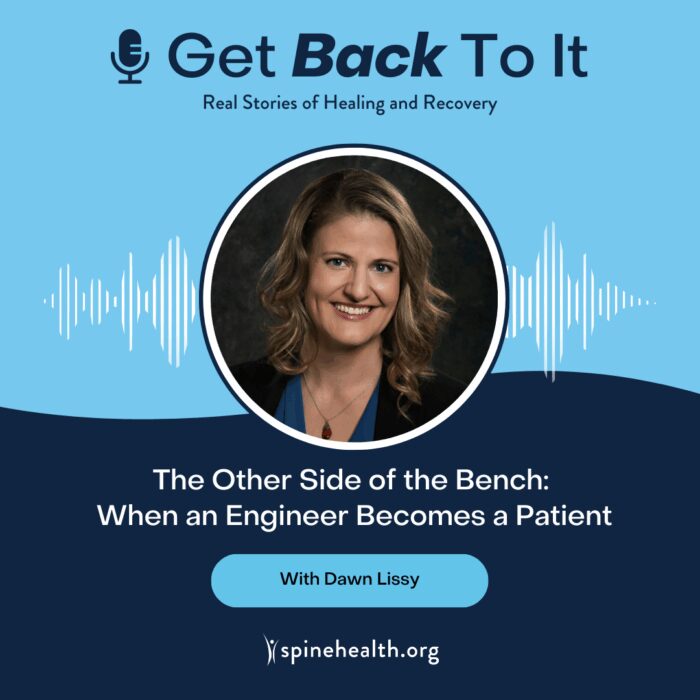
[00:00:37] at the Give By Toit podcast. Our goal is to tell stories of spinal champions who’ve been able to achieve a better quality of life through spinal healthcare. Today’s guest is Dawn EY from Colorado Springs, Colorado. She’s made an extraordinary impact both professionally and personally in the world on spinal health, spending nearly three decades helping improve the lives of others through spinal implant design, mechanical testing, and FDA regulatory support.

[00:01:08] In 2021, she found herself on the other side of the table As a patient, let’s get back to it and hear her powerful story.

[00:01:23] In early 2021, Dawn was already a recognized expert in spinal technologies. She had over 30 years of experience in the orthopedic. Device industry, beginning with spinal implant design and later leading device testing at empirical testing corporation. But nothing could have prepared her for the moment.

[00:01:41] Her own spine began causing her pain. 

[00:01:45] Dawn Lissy: In February of 2021, I started experiencing shooting pain that radiated from my left hip all the way down to my foot. At first, I assumed it was something I could manage with movement or stretching, but it became clear that something more serious was going on after getting an.

[00:02:01] X-Ray and an MRI. I learned that I have a grade one spondylolisthesis central in foraminal stenosis, a herniated disc, and degenerative disc disease. I remember thinking, doesn’t everyone over 35 have DD, D? But this was more than just normal aging. This was affecting my life. 

[00:02:21] Dr. Rita Roy: Despite the diagnosis, Dawn remained hopeful.

[00:02:24] She turned to physical therapy, a treatment she was already familiar with through her professional work. 

[00:02:32] Dawn Lissy: I had done a full round of physical therapy and initially experienced some relief. I think as we all do. But by the fall of that same year, I had lost all feeling in my left leg from my hip all the way to my toes, and that was incredibly terrifying.

[00:02:46] I had a background in spine biomechanics, but being on the patient side was an entirely different experience. 

[00:02:54] Dr. Rita Roy: By fall 2021, Dawn lost all sensation in her left leg from hip to toe. The numbness disrupted her daily life. Making it hard to walk, exercise, or even feel where her leg was in space. At times, she experienced intense pins and needles, but the normal sensation never returned.

[00:03:15] It was both physically limiting and mentally draining. 

[00:03:19] Dawn Lissy: The spine surgeon I saw initially recommended a fusion, but I was opposed to that path. I knew of a device in development at the time called limo Flex that could stabilize the spine and correct my spondylolisthesis and stenosis without fusing. The vertebra, but it was still under FDA review and I still felt strongly that this non fusion technology represented the future of spine care.

[00:03:42] I decided to hold out for that option if I could. 

[00:03:45] Dr. Rita Roy: In the meantime, Dawn underwent a discectomy in December to relieve pressure on her nerves. 

[00:03:52] Dawn Lissy: The discectomy gave me almost immediate relief. It was incredible to feel sensation returning to my leg. Recovery took about six weeks and I spent the first few days resting and relied on pain meds.

[00:04:03] For a week or two. As a busy mom, not being able to lift anything was tough, and wearing a back brace constantly, certainly didn’t make things easier. The hardest part was how the medications affected my sleep and digestion. Finding a new balance during recovery was a real challenge, but I was hopeful that the worst was behind me.

[00:04:23] Dr. Rita Roy: Me, unfortunately, Dawn’s relief was short-lived. Six months later, new symptoms began to emerge this time on the opposite side. Of her body. 

[00:04:35] Dawn Lissy: I started feeling intermittent numbness on my left lateral thigh, and then I began having sciatic like pain on my right side in my low back and leg regions. It wasn’t constant, but it was enough to interrupt my daily routine.

[00:04:52] Dr. Rita Roy: By this point, Dawn was not only navigating the physical toll of her condition, but also the emotional challenge of living with unpredictable symptoms. 

[00:05:03] Dawn Lissy: One of the hardest parts was the unpredictability, not knowing when the pain or numbness would return. On top of that, I was gaining weight despite my efforts putting on nearly 10 pounds a year between 2019 and 2023.

[00:05:19] It was both physically and emotionally draining. Per menopause and menopause didn’t help. I was told I was too young for years. When I finally got a full workup, even my doctor admitted the math isn’t math. It was frustrating and disheartening, but I kept searching for the right solution. I’ve learned that no single approach works for everyone, and what matters is finding what works for you.

[00:05:44] For me, exercise is essential for managing stress and boosting dopamine. I also focused on reducing other stressors. Leaning on close friends and continued the self-growth work I’ve done for decades. Through therapy, reading and reflection 

[00:06:00] Dr. Rita Roy: determined to take control of her health, Dawn began implementing changes to her lifestyle in late 2023.

[00:06:08] Dawn Lissy: In November, 2023, I began tirzepatide injections under my doctor’s guidance and started seeing real progress with weight loss. The medication helped retrain my body to use food more effectively. And over the course of. About a year and a half, I lost nearly 60 pounds. I believe that the weight loss played a major role in relieving the sciatic pain I had on my right side.

[00:06:31] I paired the injections with clean eating, lots of lean protein, low carbs, along with daily walks and core strength exercises like dead bugs and pal off presses. Fortunately, I didn’t experience nausea or other side effects, and the slow steady progress made the routine sustainable. I was doing everything I could to delay another surgery.

[00:06:52] And prepare my body for whatever came next. 

[00:06:55] Dr. Rita Roy: Even now, Dawn continues to manage episodes of total leg numbness. She recently received an epidural steroid injection and is awaiting an FDA decision on the Liif Lex device, which she hopes to receive. 

[00:07:10] Dawn Lissy: The last week of July, I had an epidural spine injection at L four five and then L five S one, which I I know has helped provide some relief.

[00:07:20] I’ve also been taking gabapentin. To manage nerve pain earlier in June, a round of prednisone help e ease the numbness I was experiencing. At one point, I had six full days of leg numbness across April, may, and June. I’m still hopeful that once limo Flex gets approved, I’ll be a candidate if I can just buy some more time.

[00:07:40] I believe I can still avoid a fusion 

[00:07:43] Dr. Rita Roy: as both a spine industry expert and a patient. Dawn’s experience gives her a rare perspective. 

[00:07:51] Dawn Lissy: I’ve. In on both sides of the table, and I’ll tell you, being informed helps, but even more important is learning to listen to your body and advocate for yourself. No one else can do that for you.

[00:08:03] Dr. Rita Roy: Dawn’s story is a reminder that healing is never linear, but with persistence and a proactive mindset, progress is always possible. 

[00:08:14] Dawn Lissy: I’m still on this journey, but I’m stronger for it and I want others to know there are options.

[00:08:26] Dr. Rita Roy: Wow. Dawn, your story is incredible. Um, you have a unique level of knowledge going into your condition, and I just wanna talk about how that has, you know, affected your decision making and, um, you know, what advice you have for people who are not in the spine field, who really just don’t know where to start and how to think about.

[00:08:51] Approaching solutions to their condition. 

[00:08:54] Dawn Lissy: You know, Rita, being someone who has done the mechanical testing for orthopedic devices for head to toe for almost 30 years, anyone who comes to the mechanical test lab, I always tell them, live your life that you never need any of these things that we’re testing.

[00:09:11] And then I turn around and I’m like, I, I’m the. Gold standard for all of the things, minus scoliosis that could go wrong with your lumbar spine, right? 

[00:09:21] Dr. Rita Roy: Yeah. 

[00:09:21] Dawn Lissy: And so along those lines, what I’ll tell people is that the spine industry is unique compared to other orthopedic segments because there still is no gold standard for spine care.

[00:09:33] Meaning you could go to three different surgeons and get three different paths of care for your condition, unlike. A knee replacement or a hip replacement. There’s still a lot of unknowns in spine care. Um, what causes pain is one of those things. And so, and how people deal differently with pain. So in my case, I was experiencing both physical symptoms from an anatomical issue.

[00:10:02] IE the numbness is your nerves being. Pinched from the stenosis and the spondylolisthesis pain is a, a response in your muscles, right? And so you have to deal with pain management different than the physical symptoms. And so even going to the pain specialist when they said, where’s your pain level when don’t have pain because I’ve got rid of all the weight on my body that was pushing on my stic part of it.

[00:10:31] I have numbness. And numbness is because the nerve is being pinched. So when I, when you ask me how can I help others? Become more informed, understanding. Do you have pain or do you have physical responses because your nerves are being pinched is a really important distinction because there’s different pathways to manage both of those things.

[00:10:53] There’s lots of information out there. Um, the National Spine Health Foundation is a great resource, so I’m gonna, I’m going to plug your organization. I love it. You. Thank you. Ask. Ask providers. Ask PT when you’re going through pt. Ask the PTs what they’ve seen and found, and especially around the surgeons that get the best results from the patient’s care and listen to your own body.

[00:11:18] And if something doesn’t jive, get a second opinion. 

[00:11:23] Dr. Rita Roy: Yeah, that’s, that’s a lot. Dawn, and you, you’ve covered a lot of things there and I just wanna feel that back a little bit and explore some of the, the comments you’ve made there. One thing being that there, there are still a lot of unknowns about the spine and I think that, you know, you and I both know, the spine is just so complicated.

[00:11:44] There are bones, there are discs. There are ligaments and tendons and muscles and blood vessels, and the nerves. Come through. So it’s just about everything that, that you’ve got, you know, we talk about musculoskeletal health, where we talk about our spine, um, but it’s, that encompasses a lot of things. And you had a structural problem with a bone, with a vertebrae in your back.

[00:12:13] That’s, that’s the, um, the spon, the, the slippage there. You had degenerative disc disease, so you also had a problem with disc in your back. Um, that disc herniating was narrowing your canal, your, so your nerves are getting that stenosis, so the nerves are getting crushed on the inside even, and even as they come out besides there, um, as the, as the instability is slipping back and forth and creating that.

[00:12:43] So you had a lot of things going on there and, um, those are structural problems, as you say. Um. I’m curious, Dawn, about why you felt so strongly about avoiding a fusion. Let’s just talk about that a little bit. There’s this, you know, there are these ideas out there. Fear the fusion. Why do people fear fusions?

[00:13:10] Dawn Lissy: Okay. First of all, I wanna point out that everybody has a different threshold for surgery, right? And your pain management and where you are in your life and the risk reward of a fusion is an individual decision, right? Right. And so I can’t say enough that you have to listen to your, where you’re at, right where you are managing your life.

[00:13:32] And fusion is absolutely the right solution for lots and lots of people. You’ve had a fusion and Fi finally did a fusion for yourself, and you have had great success from a mechanics and a biomechanic standpoint. And this is where I might know too much, um, you know, understanding bi uh, spine biomechanics, adjacent disc disease.

[00:13:56] Is real, right? Yeah. And that’s what happens and can happen after a fusion where then you’re now stressing the disc above and below the fusion, which are now going to put more. Um, stress on the vertebra above and below. And so then there are a number of people, and I don’t remember the statistic anymore, that have to go back in later in life and get more fusions.

[00:14:22] I happen to know that there was a non fusion solution in the works. Yeah, and I might have a, a good understanding on how that non fusion solution. Can work. And so for me it was one of those things at the time when all this started, I was 50 years old and, and I’m pretty active. And so the intention of, um, giving a non fusion solution, the first rer refusal made sense for me.

[00:14:54] And if that doesn’t work, then a fusion, I will, I will, because of my spon, because of the instability. I will eventually have to have a fusion, but if I can delay that fusion for five to 10 or possibly forever by having an outpatient surgery, that mechanically makes sense to me as a biomedical engineer.

[00:15:17] That’s, that’s why I am opting for, um, the Li Aflex and waiting for that option. 

[00:15:23] Dr. Rita Roy: Yeah. That’s such a great answer. And I think in that is that very strong message there that each person’s journey is unique to them. And we talk a lot in spine about patient expectations. You know, what is it that a patient wants?

[00:15:42] And, and, and that’s, you know, that’s again, another whole reason why we do this. We do the work that we do in, in the, in the National Spine Health Foundation, is that. We have choices and we’ve gotta know what those choices are and understand the risks and benefits, and then figure out what we want and then make that decision.

[00:16:03] And so it’s this shared decision making world that we live in with our healthcare providers, but it’s, it relies on individuals finding information so that they can inform themselves and then make the right choice. For them, and that’s why we call it a journey, right? It. This is a journey. This is not a one and done thing.

[00:16:25] And even for someone like me who’s had the surgery, I had a fusion after waiting for 10 years and deciding whether or not I wanted to do that, and then finally being exhilarated that I had the surgery and went on with my life. I still have to think about it. I still have to do the things to take care of myself, um, because I don’t wanna have an adjacent, uh, disc disease, an adjacent segment disease.

[00:16:49] Um, you know, that’s sort, sort of one of those things out there that people think, well, if I have one surgery I’m gonna have to another and another and another, and it just goes on and on. And sadly, for some people that does happen. Um, but for the majority of people, um, modern spinal techniques are giving options.

[00:17:08] That are reducing the need for multiple surgeries, and whether that’s combinations of treatments where we are looking at, um, you know, doing a disc replacement and a effusion and a stem cell injection and a, you know, tho those are, there’s lots of different things that are going on out there. So it’s, it’s just so important to inform yourself of what you might qualify for and what that picture looks like and how do you learn that?

[00:17:34] Right. It’s a lot. I, I, I, I’d like to talk Dawn a little bit about, um, your discussions with your healthcare providers. Um, you know, you’ve, you know, what questions to ask to a, to a spine surgeon or a spine expert. Did you feel the need to talk to more than one or talk to us about that journey, finding the spine care for you, because you’re in the field, you’ve helped invent some of these things.

[00:18:00] So what does, what did that picture look like for you? 

[00:18:04] Dawn Lissy: So, so what I’ll tell you is that. I am the person that gets taken to all of the orthopedic patients for all of my friends and family. And probably by the third question, the surgeon looks at me and says, who are you again? And why are you here? Because I’m the one that asks, okay, what is your, what is your typical treatment of care?

[00:18:29] How many patients have you done this care on? It’s not so much, and I’m very, very familiar with. All of the technologies that are out there, and people always say, well, is this company better than this company? It’s not so much the device itself, it’s how many times that surgeon has used that device in surgery so that he’s comfortable with the instruments and the order of operations and things like that.

[00:18:57] So asking how many times have you done this surgery? What is your success rate with that surgery? What side effects or, or, or, um, adverse events have happened that I should be aware of that could happen to me? If this was your mom, is this the solution that you would offer your mom? That’s my favorite question.

[00:19:20] Uhhuh, or you might say, who’s your family? You know, my, I, the first time I did, I said to the, the surgeon, who’s your FA favorite family member? And they gave me the answer. I said, great, if that person needed. Had this situation going on, what care would you recommend? And that changes perspective, right? So, um, again, it’s, it’s not so much the technology.

[00:19:44] It’s what’s the care, the treatment care. And again, with going back to the fact that there’s really no standard of care in spine, because it is so complex. You know, if we’re looking at one thing. One indication if it was just DDD, there’s a general agreement on how to manage that, right? But when you start, like in my case where I’m, I got four things going on, then your options get narrower on where your care is.

[00:20:16] And it all depends again on that individual journey that each of us are on. So for me, I knew gaining weight was. Adding to my pain. Right. And I, so I was working on how do I get the weight loss in? And when we talk about things that you’re, you know, for or against, I, you know, and you had to, Rita, you said that you asked yourself, um, you know, where are you at with things?

[00:20:42] I had to ask myself about the Tirzepatide shots. Yeah. You know, and I remember the doc saying to me, do you wanna do this? And I was like, no. He is like, why not? Well, because I wanted to be able to solve this on my own. Yeah. Yeah. And it turned out that for whatever reason, there’s something going on in my body.

[00:21:00] He actually said, if you heard a fight or flight, and I was like, dude, I have the T-shirt and could teach the class. And he’s like, I think your body has been under so much stress that it doesn’t know how to use fuel. Yeah. And, and this shot is a hormone that will, that should be being produced in your body that will teach your body how to, to use fuel properly again.

[00:21:21] And so I’ve had a very successful journey with that. Um, you asked about, again, how did I go about finding a spine surgeon? Well, I’ve already, I’m working with Dr. Uh, Todd Alman at, at Stanford to be a Li Aflex candidate. So I’ve seen him and I already knew of Dr. Alman because of. Limo Flex and he’s one of the surgeon champions for it.

[00:21:47] Um, I missed the window of being part of the clinical trial, um, just because of the course of events. By the time I started having symptoms, they had closed the clinical trial. Um, so then locally, I know people in the medical industry, everybody knows somebody, whether it’s a nurse mm-hmm. A pt. Those are the people that ask.

[00:22:06] Yeah. Who has a good reputation in town? Who has a good bite side manner? Who has an open mind? I, I have a friend that just went to, uh, a spine surgeon who came in and said, I can’t help you and I, there’s nothing more I can do. 

[00:22:20] Dr. Rita Roy: Wow. 

[00:22:21] Dawn Lissy: Yeah. And so if that’s the answer, go find someone else and keep talking to people.

[00:22:27] And that’s frustrating. But keep talking to people until you find someone who resonates with you in your journey. 

[00:22:34] Dr. Rita Roy: I think that’s such good information to share because you have one spine if one’s fine, and so don’t give up on yourself. And the the problem is that when you’re in this situation, you are generally in pain.

[00:22:53] Or having numbness or some level of discomfort, you’re mentally not in your best place because you’re dealing with disruption and it’s hard. And the last thing you wanna do is schlep all over town. Talking to one doctor and then another doctor, and then a third doctor, and like, I don’t know what they’re talking, just someone, just fix this, you know?

[00:23:14] And it’s like, but we owe it to ourselves to take that time to, to get questions answered and to find the right provider for you because they’re different and there’s different philosophies. There are different ways of looking at things. And you know, a lot of times people will say. I went to one doctor, it just, it just wasn’t the right vibe.

[00:23:36] But when I went to the second doctor, we just connected and I just felt comfortable. And I think sometimes that that’s, there’s, you know, you can’t quantify that. Right. That’s, that’s something you just feel, and it just feels right. Um, did you experience that Dawn, in your journey? 

[00:23:55] Dawn Lissy: Oh, absolutely. Um, you know, and, and given, you know, when I used to design spinal implants, I worked with spine surgeons all across the world.

[00:24:06] And there’s definitely, these are, these are human beings. Mm-hmm. Right. And recognizing that these are human beings that are trying to do their best to help patients, and that their philosophy is going to impact their patient care. Right. And so it’s a matter of, I mean, it’s, it’s a crazy way of seeing it, but it’s kind of like speed dating.

[00:24:28] Right. Yeah. You get, you get a 15 to 30 minute consult with someone who is going to be responsible for putting you under anesthesia and opening your body and fixing a mechanical issue. With the outcome of reduced pain and not having mechanical numbness, you know, and, and that’s, I’m real big on making sure that people understand pain management is different than the physical physicality of the situation, right?

[00:24:58] Mm-hmm. Right. And, and it’s very interesting as a, as a sidebar there, Rita, um, I know that there’s products under development for folks who just have. And I say that lightly, just have a herniated disc or, or DDD where they can do an outpatient pain management and there and there might be, you know, so there’s, there’s different layers, right?

[00:25:18] Right. And so keeping up with new technology that’s under development versus what someone does in their everyday practice. I’m actually gonna take a step back and, and talk about just pain, like some of the things that I’ve done for pain management. Yeah. So like red, red light therapy. Is is a, is an amazing new thing that’s sort of taking off.

[00:25:41] But I will tell you that when you talk to medical professionals, like my eye doctor for instance, he is like this red light therapy works for. Soft tissue, right? So I have a medical grade red light therapy machine and you can, you can buy a medical grade red light therapy machine all the way down to on Amazon for, you know, $30 a red light therapy belt.

[00:26:03] But sitting with that helps take away muscle pain. Which is what triggers pain response, right? And so if you do something like red light therapy or I have a stretching routine, and I know we mentioned earlier, uh, you know, uh, dead bugs. So having good core strength is really important. So you asked the, your original question was, you know, how did I find that person?

[00:26:27] I, I did references locally. Again, everybody knows someone who’s in the medical industry. So just asking around, who would you recommend? Who would you talk to? I got a couple names and I went and sat with each of them and I gauged how they responded to me saying, Hey, I’m not your normal patient. ’cause I, you see these things on your desk here.

[00:26:47] I, I’ve tested them all. So, yeah. How do you go about helping someone when I come in and tell you I don’t want a fusion as, as my answer. You know, as my first answer. Yeah. And so that’s, you know, as again, being an advocate for myself, being an advocate for myself was the most important part. 

[00:27:08] Dr. Rita Roy: Yeah. And, and having a provider who was willing to, um, just work with you through that and not, not impose their, their feelings or their desire on how they wanted to treat you.

[00:27:20] And, and, um, you know, I think that’s, that’s really hard because I think. You know, providers get trained to do certain things like this condition, you do this operation or this condition, you do that procedure or what have you. And if the patient is saying, I want an alternative path, um, you know, they may not feel comfortable with that.

[00:27:40] They might feel that it compromises them. And so, you know, finding that right fit for you is, is really important. And, and I love what you’re saying there, John, that we all know someone who works in healthcare or someone who knows someone. So, you know, asking around and, and getting that kind of feedback.

[00:27:59] Our surgeons on our board tell us the same thing. You know, talk to someone who works in healthcare, a neighbor, a friend, and just ask. And that’s that, that gives you great insight into, um, you know, how somebody, uh. Is perceived by their own peers. And that’s, that’s really good information. That’s really good insight.

[00:28:19] Um, I think another thing you said, Dawn, that’s so important we encourage people to think about a lot, is to not be afraid to ask the surgeon that they are interviewing, um, or speed dating, um, how many times they’ve done this particular procedure. Because that experience is so, so important. And oftentimes people feel ashamed to ask that question or that, that they’re gonna offend the, the, the doctor by saying, now how many times have you done this?

[00:28:48] Um, so Dawn, can you talk a little bit more about that? 

[00:28:54] Dawn Lissy: Absolutely. And again, you said it correctly, I think, Rita, that each spine surgeon, they go. They go to medical school and then they go, you know, they do their residency and then their postdoc and they, and they do all their training and they have picked, uh, a, a thought leader to be a resident for and done their residency.

[00:29:18] So they have their path. And some spine surgeons really like to open their exposure and say, well, wait, is there a better way to do this? And those are, those become the thought leaders in the industry and that’s fantastic. But some spine surgeons look at it as, okay, I’m really good at this pathway and this is what I’m gonna recommend because I have success with this.

[00:29:42] My patients have success with this. And that’s, I know it works. Just like when I tell engineers that are coming up, you know, the students that are graduating as engineers, what you’re doing is important. Where you’re doing it and the size of company that you’re working with is also important. If you want a small startup, that’s a radically different experience than going and working for a very, you know, fortune 500 company.

[00:30:11] The same is applied to. Again, someone who you’re going to trust literally with your body mm-hmm. To fix it. So you should advocate for yourself and you should ask those hard questions. And if you’re bringing, like for me, walking in, knowing I wasn’t gonna do a fusion as my first answer unless my spine became so unstable that I didn’t have a choice.

[00:30:39] You know how this, the surgeon answered me was going to dictate if that’s, if we’re gonna continue to date number two. Yeah. You know, and so, um, I like using analogies ’cause I think they, they hit well with folks. Right? And the other analogy I like to use is that your body has one bucket of energy. So it can either tell you you’re in pain or it can work towards healing.

[00:31:03] And so it’s so important to gauge where you’re at, and I always tell people on a scale of one to 10, where’s your pain at today? Because having sleep, I mean, and, and as we learn more mm-hmm. About the importance of sleep. The importance of managing your pain, those are all gonna have an impact on your decision, your personal decision of when it’s time to have that surgery.

[00:31:29] I mean, you said it took you 10 years and you wish you would’ve done it sooner. The fact is, is that hindsight’s 2020. 

[00:31:36] Dr. Rita Roy: Right. 

[00:31:37] Dawn Lissy: But it was a very, very personal decision that you said, okay, I’m ready to do this now. Right? 

[00:31:43] Dr. Rita Roy: Yeah, yeah, for sure. Um, you, one thing that’s so interesting that you talk about in terms of managing pain is that we know there’s a lot of evidence that shows that.

[00:31:55] Movement is an important way to manage pain and and reduce pain for a lot of people. But the irony of it is that when you’re in pain, the last thing you wanna do is move. Because you don’t feel, because it hurts and you’re afraid of it hurting even more. And I’m not talking about an acute situation where, you know, you’ve pulled a muscle and you’ve got rest it and you’ve gotta, you know, not, not do your regular exercise.

[00:32:20] I’m talking about like chronic pain situation that, you know, flares up and what do you do in that? And I think that, again, your example of. Being committed to a, an exercise program, building core strength and doing that consistently. And it’s the consistency that has and continues to this day. I mean, you’re still managing a situation that you know is happening in your body, but you’re managing it.

[00:32:49] So that you can live with it. Can you tell, tell us a little bit more about that and what happens when you have a flareup? 

[00:32:57] Dawn Lissy: Um, so what happens when I have a flareup is I have muscle relaxers and um, high dose pain meds, and I’m flat on my back with a heat pad for one to three days. That’s, that’s my reality.

[00:33:13] Um, I also have a pillow that I sit on in my car when I drive and that I take on airplanes when I get on an airplane. And so I do 20 little things in my personal life to help manage something that can take me out for days when I have a FLA up. 

[00:33:32] Dr. Rita Roy: Yeah. 

[00:33:33] Dawn Lissy: I sit in a hot tub almost daily. Wow. Because that, that deep heat Yeah.

[00:33:40] Helps. Yeah. Um, anytime I’m sitting in front of my tv, I’ve got red light therapy going on both my left side for the, you know, for what I know I have nerve issues going on, and then on my right side to manage the muscles and the pain. Um, from an exercise routine, I listen to my body and mm-hmm. You know, dead bugs are a small, powerful movement, and anyone can, well, if you can lay on the ground, and that’s, you know, again, that goes back to where you at.

[00:34:11] If you can lay on the ground, you can do small movements that do have big outcomes for your core strength and your core strength. Again, we’ll help manage the pain of the big muscles in your back. Mm-hmm. Because what’s happening is that if you have weak core strength, you’re gonna strain those big muscles and that’s what’s gonna cause big pain that radiates up and down your, your, you know, your, your legs and your back.

[00:34:37] Dr. Rita Roy: Yeah. 

[00:34:37] Dawn Lissy: Um, if I’m, if I’m feeling rough that day. I don’t, I don’t do anything but maybe walk around the block with my dogs and I definitely sit in my hot tub. And if you don’t have a hot tub, you have a hot bath. Right. So you can, you know, and Epsom salts are a fantastic thing to help relax your muscles and, and again, working on things like, I sleep in a zero gravity chair every night.

[00:35:03] Wow. To, yeah, I start sleeping in a zero gravity chair. Again, the, the spine, the this, the biomedical engineer in me finds solutions to have longevity, but they’re small steps, right? So do what you can in your life. So I, I start sleeping in a zero gravity chair with a heat pad underneath me. Um, under my back.

[00:35:24] And then when I get up in the middle of the night, about two o’clock in the morning, I go to my bed and then I’m a side sleeper. Mm-hmm. Mm-hmm. Um, but the side sleeping, aggravates the nerve side. Right. So I was, that’s, that was what was helping aggravate the numbness more so, you know, managing those things.

[00:35:41] But small movements are very powerful and you don’t have to have fancy exercise equipment. Equipment. Right. The pal off presses is literally take a, uh, a can of beans and push it out and rotate. And rotate back. Yeah. That’s a pal off press. Yeah. You don’t have to have, you don’t have to belong to a gym.

[00:36:02] But doing something like that, or Chair Pilates, do any YouTube videos of Chair Pilates. Everybody has a level where they can start. And then once you start doing a little bit, you’re gonna feel relief. Yeah, which will hopefully give you the motivation to do a little bit more tomorrow. To feel more relief.

[00:36:21] Dr. Rita Roy: Yeah. That’s fantastic. Um, we talked about, you know, a consistent exercise program. We’ve talked about getting enough sleep, um, and finding a sleep position that’s comfortable for you. You know, we talk about a lot of times for people putting a pillow in between their knees and side sleeping is, is really good for relieving pressure on your and.

[00:36:47] There’s, there’s two things about diet. So last month we did a series, it was Chronic Disease Awareness Month, and we did some education, um, about last month happen if you’re, I don’t know when people are listening to this program, but, uh, the month of July is Chronic Disease Awareness Month, and we did, um, some education around obesity and overweight and its impact on your spine.

[00:37:08] And so this is a perfect time for us to, to talk about that dom because. You experienced directly the impact of having excess body weight and how that is, has affected your spine and allowed you to delay surgery just simply by reducing your body weight. And simply, it’s not the right word there. It’s not simple.

[00:37:31] Uh, these are complicated things. There’s a lot, there’s a lot involved in, in, uh, in body weight and, um. I, I think that that, so there’s the weight itself and there’s also the quality of food. Foods can be inflammatory. And when you’ve got a situation like this, inflammatory foods can make it worse and can exacerbate it.

[00:37:52] So, um, you’ve done, you did some amazing things with your diet. You, you know, in, in the story you talk about eating clean foods and then reducing your body weight. Those are hard things to do. You’ve done them, and I just wanna talk a little bit more about that and hear from you on that. 

[00:38:10] Dawn Lissy: Um, well, it’s definitely a journey, right?

[00:38:12] So I, I’ve lost the 60 pounds it took about a year and a half. So it’s, it’s one of those things where it’s slow steady progress, which we talked about. Um, in full disclosure, when part of taking TIR Zepa side or um, any of the other LPs, you don’t want to eat. Food that’s not good for you because your body’s gonna tell you right away, man, that was, that was a bad decision.

[00:38:39] Right? And so again, listening to your body is really, really important. Um, having, you know, people talk about breakfast is actually when you break fast, right? Right. And so some people have to get up and eat right away. I have a thyroid condition where I have to take a thyroid medication, so I’m not eating right away anyway.

[00:39:01] Um, and so I don’t eat my breakfast until my body tells me that I’m ready to eat. And then when, so when you start listening to your body, and the other thing about GLP that I’ll tell you is that the, the noise around food in your head, that, that internal conversation that we all have, and you don’t even realize that you’re having it until it’s not happening.

[00:39:24] Is really important. So listen again, again, this is coming back to listening to your body and being smart about what’s going into your body is, is really, really important. And that helps with the longevity of as I’m, I’m actually at the stage now where I’m, um, titrating off of my GLP, so we’re watching to see if my habits that I have.

[00:39:52] Created and developed and practiced over this past year and a half are maintaining as I’m titrating off. And actually they are so far, so, and I’m about halfway through the, the titration. So, um, yeah. So it’s, it’s really important to be smart and it’s not about like when people say you can’t eat eggs or you can’t eat cheese, or, I remember growing up in apples were a thing you couldn’t eat, so it’s.

[00:40:18] You know, we, we, we go through these, um, phases of, of what’s healthy and what’s not healthy. But we know enough now that there are healthy fats. So you have to have fat in your bo you know, in your body. You have to have carbo carbohydrates in your body. But it’s, is it a complex carbohydrate or is it a Dorito?

[00:40:36] Yeah. You know, and so, and those are choices. And, and the other thing is that sometimes you get a craving. For ice cream. That is not something I get a craving for, but I have family members that they get cravings for ice cream. Listen to your cravings, because if you don’t, then you’re just going to, you’re gonna basically whiplash and go three times farther than you would if you had just indulge your craving and recognizing that we’re human.

[00:41:03] And you know that life is a dance, so you’re gonna take two steps forward and what’s one step back? Right. But you have to continue. Continue that journey. And I always tell folks that I mentor, how do you eat an elephant? One small bite at a time. And so those are all important things. So what do you enjoy eating?

[00:41:27] Find the healthy 

[00:41:27] Dr. Rita Roy: versions for that. Yeah, that’s great advice. Dawn, one last question for you. If you could go through this journey again from the very beginning, would you change anything that you’ve done?

[00:41:45] Dawn Lissy: I don’t think so. I, you know, I, I, I think that my journey has really been, you know, 40 years when I started my education and going into biomedical engineering. Um, I don’t, when you ask that question, and I think about that, Rita, I don’t know that I would change anything because I’m still. On my journey, and I’m still on the journey that I think is right for me.

[00:42:09] Mm-hmm. But I also know that I have a choice. And then if that choice doesn’t work, then I’ve got, I’ve got another choice. And so I have always been very pragmatic in making sure that I’m looking at all my options. Um, you know, there’s a lot of conversation around, well, Google isn’t always right, but you know, there’s a lot of information on the website and so you can.

[00:42:35] Look at multiple sources, and if multiple sources, reliable sources are giving you the same information, you can feel confident about that and being willing to advocate for yourself and knowing where you’re at in your journey are all really important pieces for your own answer. 

[00:42:55] Dr. Rita Roy: I love that we say there are no cookie cutter approaches to spinal care.

[00:43:00] And that is what you are saying, Dawn, in. It’s such an eloquent way. Um, there’s no one right answer for everybody. It’s, it’s complicated. It’s different, and each person has their own journey to walk and I’m so, so grateful that you’ve shared yours and we wanna keep in touch with you. I wanna find out how this is going so we’ll, we’re gonna stay in touch.

[00:43:24] Dawn Lissy: Absolutely. I would love to give you a follow up after I have my surgery and after limo flex is cleared. Yeah. 

[00:43:31] Dr. Rita Roy: Yeah, let’s see how that goes. Hopefully the FDA will get their work done in a timely way and you’ll have that option, so We’ll, we wanna know how that goes, Dawn. 

[00:43:42] Dawn Lissy: Well, what’s interesting is my pain management guy, when I did my follow up for my, uh, epidural spinal injection, I said, you know, I’m having really good results with this.

[00:43:54] Um, not having the nerve pain, uh, the nerve issues. And I said, I’m waiting for limo flex. And they said, we are too. We, we think that’s a really good option for our patients to be aware of. So I was really, wow. I was in practice with yes. 

[00:44:08] Dr. Rita Roy: There you go. 

[00:44:10] Dawn Lissy: So, but I would to keep it. And thank you for this opportunity.

[00:44:14] Dr. Rita Roy: Thank you, Dawn. Dawn. Your story is such a powerful example of what it means to be both an expert and a patient. You’ve seen spine care from every angle now. Um. This has really revealed a lot to you and you know, sort of in closing here, last sort of words of wisdom, things that you’ve learned about yourself and more broadly, spine care, um, that you can share with our listeners.

[00:44:43] Dawn Lissy: I will say that pain is real, so don’t discount that I, people who don’t experience pain or prolonged pain. Don’t understand the mental and physical fatigue that enduring chronic pain can do. So don’t discount that for yourself. Listen to your body when you’re talking to a medical professional, remember that they’re human too, and they are relying on their training and their experience and their practice, and that may not be in.

[00:45:17] In, in alignment with what you want for yourself. So you are allowed to have a second or a third opinion and trust your gut on what works for you and recognize that your body is your body and no one else is walking in your shoes. And that sometimes simple is best and sometimes complicated requires multiple steps.

[00:45:44] Dr. Rita Roy: Well said. Amazing. Dawn, thank you so much for joining us and for sharing your story with such depth and clarity. Your journey shows how resilience, knowledge, and personal advocacy can make all the difference. Even when the path forward is uncertain and continues to be uncertain, you have helped countless people in your career and now your personal story will inspire even more.

[00:46:13] Thank you for joining us, Dawn. Thank you. 

[00:46:16] Dawn Lissy: Thank you, Rita. I appreciate it.

[00:46:21] Dr. Rita Roy: At the National Spine Health Foundation, something we believe in most is providing hope for recovery. Through sharing stories of success and expertise. It isn’t always easy to find someone to relate to, even though a hundred million adults suffer from neck or low back pain every year. To hear more stories of spinal champion recovery and access educational materials about spine health, visit us@spinehealth.org.

[00:46:47] If you’re in. Our show financially. You can contribute at the link provided. Thank you for listening.

Summary:

In this episode of the Get Back To It Podcast, we hear the remarkable story of Dawn Lissy, a biomedical engineer in the spine industry who found herself on the other side of care as a patient. After decades of helping others through spinal implant design and testing, Dawn was faced with her own diagnosis of degenerative spine conditions. She shares her deeply personal journey of navigating pain, undergoing treatments like physical therapy, a discectomy, and injections, and making lifestyle changes to manage symptoms and restore quality of life. Dawn’s experience highlights the emotional and physical challenges of living with ongoing pain, the importance of perseverance, and the power of advocating for yourself on the road to recovery.