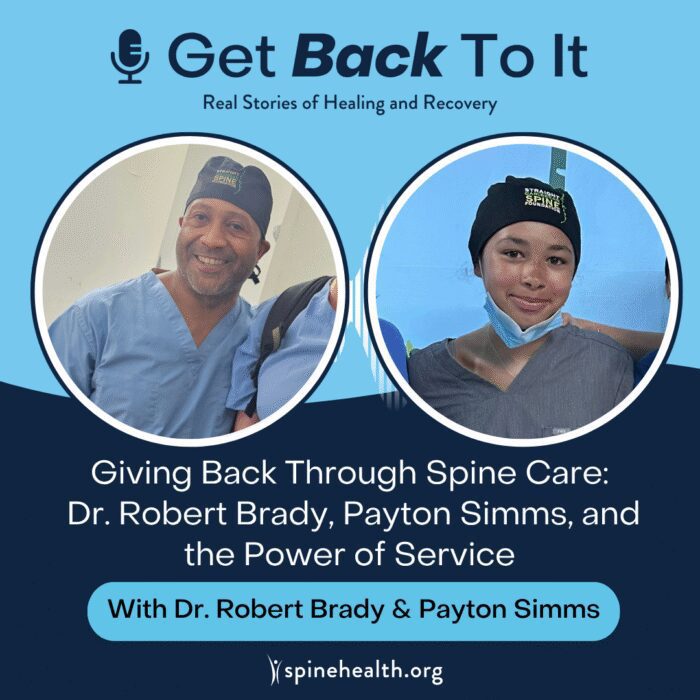
Giving Back Through Spine Care: Dr. Robert Brady, Payton Simms, and the Power of Service

00:00:01 Speaker 1
Hi everyone, I’m Dr.
00:00:03 Speaker 1
Rita Roy, CEO of the National Spine Health Foundation and host of the Get Back to It podcast.
00:00:09 Speaker 1
Here we share real stories of healing and recovery from people who’ve overcome spine problems and returned to the lives they love.
00:00:17 Speaker 1
These success stories are powerful, inspiring, and sometimes unbelievable.
00:00:23 Speaker 1
Let’s get back to it.
00:00:25 Speaker 1
Today, I am so honored to be joined by Dr.
00:00:28 Speaker 1
Brady and by Peyton.
00:00:31 Speaker 1
We are going to be discussing a really phenomenal program that Dr.
00:00:35 Speaker 1
Brady conducts every year.
00:00:38 Speaker 1
And with that, I’m going to turn it over to Dr.
00:00:41 Speaker 1
Brady to introduce himself, and then we’ll ask Peyton to introduce herself as well.
00:00:45 Speaker 1
Dr.
00:00:46 Speaker 1
Brady.
00:00:46 Speaker 2
I’m Dr.
00:00:47 Speaker 2
Robert Brady.
00:00:47 Speaker 2
I’m an orthopedic spine surgeon in Fairfield County, Connecticut.
00:00:52 Speaker 2
I’ve been in practice here 20 years.
00:00:54 Speaker 2
My passion really lies back in my parents’ home country of Jamaica, where we have a spine scoliosis program.
00:01:04 Speaker 2
It’s called the Straight Caribbean Spine Foundation.
00:01:06 Speaker 2
We’ve also had that foundation founded in 2020 or 2006.
00:01:12 Speaker 2
And that we go there twice a year.
00:01:15 Speaker 2
And that’s where my passion is, taking care of kids.
00:01:18 Speaker 1
And one of the things that you did recently was you invited a young scoliosis champion from the States to go with you on this mission trip.
00:01:28 Speaker 1
So with that, I’d like to introduce Peyton to our podcast.
00:01:31 Speaker 1
Peyton, tell us about yourself.
00:01:34 Speaker 3
Hi, thank you for allowing me to
00:01:38 Speaker 3
do this podcast with you.
00:01:39 Speaker 3
I’m Peyton.
00:01:40 Speaker 3
I’m from Durham, Connecticut, and I had my scoliosis surgery when I was 12, which was two years before, or one year before I accompanied Dr.
00:01:51 Speaker 3
Brady on the medical mission.
00:01:55 Speaker 1
Well, congratulations on your successful surgery.
00:01:59 Speaker 1
Peyton, looking at you across the screen where I am, there is no way I could ever tell that you’ve been through scoliosis treatment.
00:02:08 Speaker 1
I am seeing a young, vibrant, beautiful young lady who just is doing all kinds of things.
00:02:16 Speaker 1
And so I would say, Peyton, tell us how you found out about Dr.
00:02:21 Speaker 1
Brady.
00:02:22 Speaker 3
So I have a family friend, Amanda Rosen, who was also on your podcast.
00:02:28 Speaker 3
And she is friends with Dr.
00:02:30 Speaker 3
Brady and has been on the missions before.
00:02:32 Speaker 3
And she asked Dr.
00:02:34 Speaker 3
Brady if it would be a good idea to have me come with them to kind of explain my experience with the surgery to the kids that were getting this surgery, that were undertaking the surgery.
00:02:49 Speaker 1
So Dr.
00:02:50 Speaker 1
Brady, when you were approached by Peyton and her friend Amanda Rosen, what were your thoughts about this?
00:03:02 Speaker 2
That’s the great thing about this mission is that it’s really, you know, even though, you know, it was, you know, came from my motivation to fill my dream, everybody that has come on that mission,
00:03:20 Speaker 2
has really taken it on their own and they just want to help and they want to grow it.
00:03:24 Speaker 2
And Amanda has been one of those, one of those people that she’s, she took it out and she wants to make it better.
00:03:32 Speaker 2
And so she thought it was a great idea to bring some young people there because she saw that these kids were, they basically get them on the ward, they prepare them for surgery, but they’re sitting there, they’re nervous, they don’t, they don’t know what, even though they’re excited for their surgery, they don’t know
00:03:49 Speaker 2
what’s going to happen.
00:03:50 Speaker 2
And it was tremendous.
00:03:53 Speaker 2
Peyton came when she was 13 years old.
00:03:55 Speaker 2
And she was phenomenal.
00:03:58 Speaker 2
I mean, she instantly just a rapport with these with these children.
00:04:04 Speaker 2
They were making TikToks together.
00:04:07 Speaker 2
They brought they brought some games and toys and drawing.
00:04:11 Speaker 2
And it really you could just see a difference in the kids.
00:04:16 Speaker 2
when they brought him to the operating room, they weren’t nervous or anxious.
00:04:19 Speaker 2
They were excited.
00:04:21 Speaker 2
And they would see, Peyton and Annie, who was Amanda’s daughter, that also came.
00:04:27 Speaker 2
And it was, it was, it was, it was phenomenal.
00:04:31 Speaker 1
That is just absolutely incredible for me to try to visualize what it’s like to be in Jamaica with these kids that maybe don’t have access to resources for support and people to ask questions to, people to relate to.
00:04:46 Speaker 1
And Peyton, when you were heading down to Jamaica, what were some of the things you anticipated you were going to see?
00:04:55 Speaker 1
And then
00:04:57 Speaker 1
what did your expectations meet when you got there?
00:05:00 Speaker 1
In other words, what were you thinking it was going to be like?
00:05:03 Speaker 1
And then what was it like when you got there?
00:05:06 Speaker 3
So before I went, I knew that specifically where we were going, Kingston, it wasn’t as wealthy of a place as the rest of Jamaica or the parts that most people would like vacation to.
00:05:24 Speaker 3
And it wasn’t this picture perfect
00:05:27 Speaker 3
place that everyone kind of just thinks Jamaica is.
00:05:31 Speaker 3
I anticipated that it was going to be a different experience because there was not as much money given to Kingston as I was used to.
00:05:44 Speaker 3
And I think something that surprised me was definitely the amount of
00:05:48 Speaker 3
dogs and animals that were on the streets, just roaming.
00:05:51 Speaker 1
Yeah, a very different environment than what we’re used to, for sure.
00:05:57 Speaker 1
And low economic status there, I guess.
00:06:01 Speaker 1
Dr.
00:06:01 Speaker 1
Brady, talk to us a little bit about the hospital facilities that you work in there and how and why you selected that location.
00:06:10 Speaker 2
Jamaica is a tremendous island, tremendous culture.
00:06:16 Speaker 2
as Peyton had stated, there is, when you think of Jamaica, you think of, the beaches and the islets, pool and the fun stuff.
00:06:27 Speaker 2
So, but Kingston, Kingston certainly does have that, but it’s basically the hub of the socio-economic culture in Jamaica.
00:06:37 Speaker 2
So, it has
00:06:41 Speaker 2
That’s where all the businesses kind of are centered.
00:06:43 Speaker 2
That’s where the hospitals are centered.
00:06:45 Speaker 2
That’s where the children’s hospital, it’s the only children’s hospital on island.
00:06:51 Speaker 2
And really for the Caribbean island, it’s the only children’s hospital in the Caribbean island.
00:06:56 Speaker 2
So that’s where why we chose that.
00:07:00 Speaker 2
They also have a university hospital
00:07:03 Speaker 2
that, we also work at.
00:07:06 Speaker 2
So it’s those two hospitals that really made the choice kind of easy for that part of the island.
00:07:14 Speaker 2
And, through my parents and friends growing up, in and out of Jamaica, I grew up in the States, but we used to vacation in Jamaica a fair amount.
00:07:23 Speaker 2
So they have a family that’s still there.
00:07:25 Speaker 2
So we were, I was able to gain connections there and it was, very
00:07:30 Speaker 2
people do want to help each other.
00:07:31 Speaker 2
And so it was really pretty easy to put things together.
00:07:35 Speaker 1
That’s amazing.
00:07:36 Speaker 1
And so, Dr.
00:07:37 Speaker 1
Brady, I’m so curious about how you identify patients to come into your program, that patient selection piece, and how that all gets handled.
00:07:50 Speaker 1
Possibly some of it is remote.
00:07:52 Speaker 1
Can you tell us about how it works?
00:07:55 Speaker 2
Like some
00:07:56 Speaker 2
missions will go to a remote area or a third world area.
00:08:02 Speaker 2
They’ll come in, they’ll bring a bunch of surgeons, they’ll bring it, do a bunch of surgeries, and then they’ll just leave.
00:08:07 Speaker 2
And then that country or place has to take care of these kids.
00:08:12 Speaker 2
Here, this is really an extension of my practice.
00:08:16 Speaker 2
The physicians that I have there in Jamaica, you know, a very good friend of mine is the chief of pediatric
00:08:23 Speaker 2
orthopedics at the Children’s Hospital.
00:08:25 Speaker 2
And you have another friend who is the chief of orthopedics at the University Hospital.
00:08:29 Speaker 2
So they screen the patients through the year.
00:08:32 Speaker 2
They select the patients and they keep an eye on them, monitor them.
00:08:36 Speaker 2
So we fly in Sunday.
00:08:38 Speaker 2
We have a clinic on Monday where we’ll see, you know, 30 to 40 children with scoliosis.
00:08:44 Speaker 2
And, you know, unfortunately they don’t have conservative treatment there.
00:08:47 Speaker 2
So 30 to 40 children will need scoliosis surgery.
00:08:51 Speaker 2
But we do, so we’ll, but we’ll select 10 to 15 kids that will need surgery that week, and we’ll hopefully try to get all take care of them through that week.
00:09:01 Speaker 2
But sometimes we are, we’re able to, but sometimes these are very difficult cases.
00:09:06 Speaker 2
Well followed throughout their post-operative period.
00:09:08 Speaker 2
We have, we have, they have a very robust orthopedic surgery program, so we have residents, very similar to the states that monitor these kids.
00:09:19 Speaker 2
So it’s not a, operate and leave.
00:09:23 Speaker 2
And there are times where we stop doing surgery because they only have four ICU beds on the island.
00:09:29 Speaker 2
So we’ll say, all right, this is a big case.
00:09:31 Speaker 2
We can only take two ICU beds.
00:09:34 Speaker 2
So let’s not overwhelm the system.
00:09:37 Speaker 2
Yeah.
00:09:37 Speaker 2
And it’s appreciated the Ministry of Health, Ministry of Finance appreciates that we, you know, we acknowledge that, you know, we’re not the only people that are going there.
00:09:46 Speaker 1
Yeah, that’s incredible.
00:09:49 Speaker 1
Dr.
00:09:49 Speaker 1
Brady, do you sometimes find that you can’t operate on all the people who need surgery or qualify for surgery?
00:09:56 Speaker 1
And do those kids
00:09:59 Speaker 1
get to the front of the line the following year or what breaks your heart to, I’m sure it breaks your heart because you want to fix everybody, right?
00:10:06 Speaker 2
Absolutely.
00:10:07 Speaker 2
That’s 100% accurate.
00:10:08 Speaker 2
So we, you know, again, they’ll bring, you know, 30, 40 patients to the surgery that we’ll see, we’ll see a screen post-op patients.
00:10:18 Speaker 2
But, you know, we try to, we try to select the patients that have the most need.
00:10:23 Speaker 2
But then, you know, inevitably things come out, you know, it could,
00:10:26 Speaker 2
the child might have a cold or they may have a flu or maybe they have a blood type that they don’t, that they’re, deficient in on that island at that particular time.
00:10:37 Speaker 2
But yes, we always make then the priority in the next trip.
00:10:41 Speaker 2
And there are certainly a handful of cases that are really, really complex.
00:10:47 Speaker 2
Even though I’ve been doing this for 20 years, there’s some really complex cases that are just not safe, you know, doing it in that environment.
00:10:54 Speaker 2
And then, you know, I’ll get
00:10:56 Speaker 2
friends and colleagues at other universities that I’ll, that I will, refer them to.
00:11:02 Speaker 1
So, Peyton, you arrived in Kingston.
00:11:05 Speaker 1
The environment is very different, even though it’s a large city for Jamaica.
00:11:11 Speaker 1
It’s, you know, it’s different and the economic status is different there.
00:11:17 Speaker 1
And so I’m imagining you get settled in and then you go to the clinic with Dr.
00:11:23 Speaker 1
Brady on Monday.
00:11:26 Speaker 1
What was it like when you first got to the clinic, Peyton?
00:11:30 Speaker 3
So one of the first things I noticed is they didn’t wait inside.
00:11:35 Speaker 3
They were all waiting outside in chairs.
00:11:38 Speaker 3
So it was my first thought was to just introduce myself.
00:11:43 Speaker 3
And then I’d also organized a fundraiser at my school, which Dr.
00:11:47 Speaker 3
Brady mentioned that we, and I brought a bunch of toys and games and Wow.
00:11:53 Speaker 3
Yeah.
00:11:54 Speaker 3
So
00:11:55 Speaker 3
We just passed those out to whoever wanted them.
00:11:59 Speaker 3
Or I told them about my experience.
00:12:02 Speaker 3
I actually showed them the scar on my back.
00:12:05 Speaker 3
Wow.
00:12:06 Speaker 3
Yeah.
00:12:08 Speaker 1
That’s very vulnerable of you to do.
00:12:10 Speaker 1
That’s amazing.
00:12:12 Speaker 3
And a lot of the parents had questions too.
00:12:15 Speaker 3
So I think it was good because I got to
00:12:19 Speaker 3
they got to hear the patient perspective as opposed to just doctors telling them what’s going to happen.
00:12:27 Speaker 3
So I think that was a good way that I connected with them.
00:12:32 Speaker 3
Try to make them as less anxious as I can and try to keep their mind off of
00:12:42 Speaker 3
getting the surgery or if they’re even going to be able to or not.
00:12:46 Speaker 2
I have a 13-year-old and my 13-year-old is wonderful as well.
00:12:51 Speaker 2
But Peyton was really from the first minute she got there was just connected with these children and wasn’t like two others, you know, a 16-year-old, 17-year-old there.
00:13:04 Speaker 2
And she was like ahead of them.
00:13:05 Speaker 2
She’s like, we need to do this and this and this and let’s talk these kids.
00:13:09 Speaker 2
She just, she got.
00:13:10 Speaker 2
And so
00:13:12 Speaker 2
and Jamaicans are great people.
00:13:15 Speaker 2
They’re very resilient.
00:13:16 Speaker 2
They don’t ask a lot of questions.
00:13:17 Speaker 2
So, when we’re talking about surgery, if I talk about scoliosis surgery here in the States, you know, there’s tears, there’s, you know, we’re in that room for an hour, there’s, and then there’s second and third and fourth opinions.
00:13:32 Speaker 2
Here, they’re just…
00:13:34 Speaker 2
In Jamaica, they’re just thankful that we’re there to help because they understand that this is their one chance to be for surgery.
00:13:42 Speaker 2
And so they don’t ask a lot of questions.
00:13:44 Speaker 2
So with Peyton being there and going through it, they actually were more interested in the process, you know, after surgery and what it looked like.
00:13:54 Speaker 2
And that was tremendously helpful having her there.
00:13:59 Speaker 1
That is just absolutely awesome.
00:14:01 Speaker 1
I just feel
00:14:02 Speaker 1
so inspired as we’re talking about this and imagining what that scenario looked like.
00:14:09 Speaker 1
And, you know, Peyton, why don’t you tell us just briefly a little bit about your scoliosis journey and so that the audience knows more about you and what you were sharing then with these kids and these families?
00:14:23 Speaker 3
So
00:14:24 Speaker 3
I don’t remember the exact age that I was diagnosed with scoliosis, but I had been braced for a while.
00:14:31 Speaker 3
And so I would have to, every time I went to sleep, I would have to wear a back brace.
00:14:36 Speaker 3
And that was for three years, maybe 4.
00:14:40 Speaker 3
And it just continuously got worse even when I was in the brace.
00:14:45 Speaker 3
And I never had to wear a full daytime brace.
00:14:48 Speaker 3
It was just at night, but it just wouldn’t work.
00:14:52 Speaker 3
My scoliosis, the curve kept on curving.
00:14:56 Speaker 3
And it got to the point where I was told that I needed surgery.
00:15:01 Speaker 3
So it was two years ago now.
00:15:04 Speaker 3
I was 12 when I got my scoliosis surgery.
00:15:08 Speaker 3
And I got it at the New York Presbyterian Hospital.
00:15:13 Speaker 3
And I was hospitalized for a week after I got my surgery.
00:15:18 Speaker 3
And I wouldn’t say it was painful.
00:15:21 Speaker 3
I would just say there was a lot of discomfort.
00:15:24 Speaker 3
I was honestly excited for my surgery just because I had gone through so much back pain my whole life.
00:15:30 Speaker 3
It was every day.
00:15:31 Speaker 1
Oh my gosh.
00:15:33 Speaker 3
And I think just the thought of then not having to go through that anymore was just my light at the end of the tunnel, pretty much.
00:15:45 Speaker 3
So I was just really excited to get it.
00:15:47 Speaker 3
And I also was excited for my scar, because if I could get one thing out of it, would be the scar.
00:15:55 Speaker 1
I’ve never heard anyone say they’re excited for their scar.
00:15:57 Speaker 1
What do you mean by that?
00:15:59 Speaker 3
I just, it’s almost like a battle wounds.
00:16:02 Speaker 3
And I just.
00:16:04 Speaker 1
Warrior.
00:16:05 Speaker 3
Yeah.
00:16:07 Speaker 3
If I have to go through the whole thing, might as well just get a scar out of the right to show.
00:16:12 Speaker 3
Wow.
00:16:12 Speaker 3
Oh.
00:16:13 Speaker 1
My gosh.
00:16:14 Speaker 1
You are amazing.
00:16:16 Speaker 1
So, Peyton, so you had that immediate post-operative time where you were a little sore, you’re in the hospital for a few days.
00:16:23 Speaker 1
What was the rest of your recovery like?
00:16:26 Speaker 3
My parents actually bought me a hospital bed for my house.
00:16:30 Speaker 3
And so I would just, I would honest, obviously laying down for a while, but my dad would take me to walk kind of just like down the stream back, not very long, but I would do that.
00:16:44 Speaker 3
And then I also had some like physical therapy, not sessions, but one of the physical therapists in the hospital just told me some things I could do to make sure my muscles are like where I move my muscles so they weren’t just
00:17:00 Speaker 3
play stiff.
00:17:02 Speaker 3
So that was kind of what it looked like.
00:17:04 Speaker 3
Some of my friends came to visit me a couple weeks afterwards, and it was just kind of smooth sailing from then, from their own.
00:17:13 Speaker 1
That’s just absolutely incredible, Peyton.
00:17:16 Speaker 1
And so what kinds of things do you enjoy doing now?
00:17:21 Speaker 3
So I play three sports.
00:17:22 Speaker 3
I play lacrosse.
00:17:24 Speaker 1
Wait a second.
00:17:25 Speaker 1
How much of your bag was operated on?
00:17:28 Speaker 3
It’s from T3 to L1.
00:17:29 Speaker 3
So it wasn’t like my lumbar.
00:17:33 Speaker 1
Pretty much got down there.
00:17:34 Speaker 3
Yeah.
00:17:37 Speaker 1
So tell, so what are the three sports again?
00:17:39 Speaker 1
I’m sorry, I was just, I was so amazed by that.
00:17:41 Speaker 1
Tell us about your sports.
00:17:42 Speaker 3
I play lacrosse, volleyball, and I swim.
00:17:45 Speaker 1
Wow.
00:17:46 Speaker 1
And how soon were you able to start sports after your surgery?
00:17:51 Speaker 3
Four to five months after, I think.
00:17:56 Speaker 1
Few months, few months.
00:17:57 Speaker 3
Yeah, that’s incredible.
00:17:59 Speaker 1
Well, to me that sounds fast, but for you it must, maybe it felt slow.
00:18:04 Speaker 1
Dr.
00:18:05 Speaker 1
Brady, is that, is that normal?
00:18:07 Speaker 1
Is that typical?
00:18:08 Speaker 1
For what you see me, Peyton is obviously a superstar here.
00:18:12 Speaker 1
Articulate, ahead of her time.
00:18:14 Speaker 1
I can see how she just resonated with all of the patients and parents.
00:18:19 Speaker 1
I can just imagine that.
00:18:21 Speaker 2
I love what I do.
00:18:22 Speaker 2
Most of my, most of my,
00:18:24 Speaker 2
practices is, normal adult degenerative cases, a lot of minimally invasive, a lot of robotics, but the scoliosis cases and the patients are my favorite because these, as you heard from her, she just wants to get back to her life.
00:18:42 Speaker 2
She wants to do the things that she wants to were doing before.
00:18:46 Speaker 2
Peyton had a, she had a moderate curve, but these are very severe curves in Jamaica, 90, 100 degree curves.
00:18:55 Speaker 2
They don’t have, they don’t have bracing, they don’t have physical therapy prior to surgery.
00:19:01 Speaker 2
So, and by the time they get to them, their curves are fairly extensive.
00:19:06 Speaker 2
And you know, you hear a lot in the clinics about being bullied.
00:19:10 Speaker 2
And so when you do
00:19:12 Speaker 2
and you operate on these kids, you’re not just correcting their, you’re changing their trajectory of their lives.
00:19:19 Speaker 2
They’re changing their image of themselves.
00:19:22 Speaker 2
And, you know, I keep personally in touch with many of the patients and the parents will, you know, often they’ll
00:19:31 Speaker 2
They do what they can.
00:19:33 Speaker 2
They’ll send gifts and food to the team because they’re just so grateful that their kids are going to be able to play and run and just be confident, different people.
00:19:48 Speaker 2
And, you see Peyton now, and she’s phenomenal, but, I think she’s going to change people’s lives for sure.
00:20:02 Speaker 2
already has.
00:20:02 Speaker 2
She already has and she’s going to do great things.
00:20:07 Speaker 2
And most of all these kids that I do see in the clinic, I tell them the one thing they have to do is they
00:20:12 Speaker 2
They have to do, they have to be in service to people ’cause that’s what’s gonna make a big difference in their lives.
00:20:21 Speaker 1
Well, Dr.
00:20:22 Speaker 1
Brady, you are clearly a phenomenal humanitarian.
00:20:26 Speaker 1
And this is such an incredible thing that you are doing, giving back to a community that you care about and that clearly needs you.
00:20:37 Speaker 1
Having Peyton join you sounds like it’s not something that you’d done before, maybe.
00:20:43 Speaker 2
That was that was that was definitely the first time and I definitely want to recreate it.
00:20:51 Speaker 2
My 13 year old was supposed to come with this last trip, but she had some testing.
00:20:56 Speaker 2
So she’ll probably come with us in the fall.
00:20:59 Speaker 2
And I’m certainly going to invite Peyton back because I think you guys will actually be great friends.
00:21:05 Speaker 1
Yeah, that’s amazing.
00:21:07 Speaker 1
Peyton, was it?
00:21:09 Speaker 1
seems to me like this.
00:21:11 Speaker 1
this is kind of one of those transformational moments in your young life where, you know, you’re able to do something so wonderful like this, maybe change your viewpoint on things.
00:21:23 Speaker 1
How do you feel that the experience has impacted you in your life and where you are in your educational journey?
00:21:32 Speaker 3
So it definitely changed my viewpoint a lot, just
00:21:36 Speaker 3
Just first getting there and really seeing how other people live.
00:21:41 Speaker 3
And you can always say you feel bad for people or feel bad for the way other people live, but you don’t, you can’t like, you don’t really know until you see it firsthand.
00:21:52 Speaker 3
And I think when I really saw how less people had than me, you, I was really thankful for, especially my parents, the opportunities and privileges I have now.
00:22:05 Speaker 3
even the opportunity to even go on the mission.
00:22:08 Speaker 3
I have so many good things that come to me that I didn’t really take into account before.
00:22:13 Speaker 3
And I would just really, it really opened my mind to what I had.
00:22:18 Speaker 2
So the Children’s Hospital at Bustamali is basically an old army barracks.
00:22:23 Speaker 2
So it’s really, it’s really, it’s a very open, complex, like,
00:22:30 Speaker 2
and all the wards are, as you could imagine, there’s no private rooms there.
00:22:34 Speaker 2
So very open, big open windows.
00:22:37 Speaker 2
And so our scoliosis patients, you know, will, let’s say at the children’s hospital, we have eight of them.
00:22:44 Speaker 2
All eight of them will be in one room.
00:22:48 Speaker 2
one big room, beds right next to each other, and they’ll be next to kids that have, pediatric fractures or who are in traction for other issues.
00:22:59 Speaker 2
So it’s not a private room at New York Presbyterian, right?
00:23:02 Speaker 2
So it’s a, they’re all there together.
00:23:06 Speaker 2
There’s big, the families literally sit outside of the open windows and just like see their children because it’s like, it’s too small for everybody to be in one room.
00:23:19 Speaker 1
Thank you for painting that picture, Dr.
00:23:20 Speaker 1
Brady, so that we can understand how really stripped down that experience is in Jamaica.
00:23:25 Speaker 1
I mean, you’re going into an environment with very little
00:23:30 Speaker 1
with people who have very little.
00:23:33 Speaker 1
How do you get the supplies and all the things that are needed?
00:23:37 Speaker 1
How does that all get taken care of?
00:23:40 Speaker 2
So, again, this is a complete, team, effort.
00:23:46 Speaker 2
So I have one, I have another spine surgeon, my partner,
00:23:53 Speaker 2
One of my best friends, he’s a spine surgeon in Augusta, Justin Bundy.
00:23:59 Speaker 2
He comes down with me each trip.
00:24:02 Speaker 2
He’s been coming with me for the last, I think 13, maybe like going on 15 years.
00:24:08 Speaker 1
Mr.
00:24:08 Speaker 1
Brady, how many years have you been doing these trips?
00:24:11 Speaker 2
About 20.
00:24:14 Speaker 2
Yeah.
00:24:15 Speaker 2
So 2006 is when our first trip.
00:24:18 Speaker 1
Oh my goodness.
00:24:19 Speaker 1
That’s just bravo.
00:24:21 Speaker 1
That’s amazing.
00:24:23 Speaker 1
Sorry, I interrupted you.
00:24:24 Speaker 2
So, no, it’s, I know you make me feel old.
00:24:30 Speaker 1
That’s just, that’s a lot of lives you’ve saved in Jamaica.
00:24:33 Speaker 1
That’s a lot of giving back and back.
00:24:35 Speaker 2
I think we’re a little over 400 kids that we operate on.
00:24:39 Speaker 1
So beautiful.
00:24:40 Speaker 1
That’s so beautiful.
00:24:42 Speaker 2
So yeah, so Justin.
00:24:44 Speaker 2
comes with me.
00:24:45 Speaker 2
He’s a great spine surgeon in Augusta, Georgia.
00:24:48 Speaker 2
And then we have Globus is the instrumentation company that donates all of their implants.
00:24:55 Speaker 1
Holy cow, that’s amazing.
00:24:58 Speaker 2
And you know, if you do this surgery in the United States, you know, you’re putting in, you know, 20 to 30 screws and two rods.
00:25:08 Speaker 2
I mean, that’s a that’s a 30 to $50,000
00:25:12 Speaker 2
investment in a case.
00:25:13 Speaker 2
And they donate all of the instruments that we use.
00:25:17 Speaker 2
They do support financially as far as getting my team there.
00:25:20 Speaker 2
My neuromonitoring team who I use in the States, they also donate their time in two techs to the mission.
00:25:28 Speaker 2
You know, my mission coordinator, my wife that helps coordinate everything.
00:25:36 Speaker 2
My buddy Everton Biggs who does
00:25:39 Speaker 2
He coordinates.
00:25:40 Speaker 2
He’s kind of my on the ground, coordinating in the operating room.
00:25:46 Speaker 2
He works at Lenox Hill, but he’s Jamaican, and he knows the whole system.
00:25:53 Speaker 2
We have other companies that donate implants, and then there’s obviously private donations.
00:26:00 Speaker 2
There’s a company called Vertical Bridge that donates
00:26:04 Speaker 2
a hefty amount of money each year.
00:26:06 Speaker 2
I have one patient here that I’ve operated on, a patient, and fortunately I’m in Fairfield County and she’s really taken and she donates a fair amount of money every year.
00:26:18 Speaker 2
So I’m blessed that I’ve been able to see, you know, this significant amount of generosity, you know, from people.
00:26:28 Speaker 1
That’s amazing.
00:26:28 Speaker 1
And it sounds like it’s friends and family and committed industry partners.
00:26:33 Speaker 1
I mean, this is where the generosity in spying really shines.
00:26:38 Speaker 1
And I just love telling the story.
00:26:41 Speaker 1
I’m so glad I know about the story.
00:26:44 Speaker 1
And I can’t believe I didn’t know about the story, you know, until recently.
00:26:48 Speaker 1
And it’s phenomenal.
00:26:50 Speaker 1
Did you have any concerns about bringing a young person down to Jamaica where there’s some
00:26:58 Speaker 1
training opportunities for Peyton or any, what kind of preparation did you help provide for her to come into what could be an emotionally difficult thing to walk into?
00:27:12 Speaker 2
Yeah, I mean, we had really open communication.
00:27:15 Speaker 2
I mean, we spend a lot of time as a team together.
00:27:19 Speaker 2
You know, we have breakfast together, we have lunch together, we have dinner together.
00:27:24 Speaker 2
So it’s really a very,
00:27:27 Speaker 2
it’s a team family effort.
00:27:29 Speaker 2
And so I was really, open with Peyton just to, tell me if there’s any, if there’s anything she’s uncomfortable with.
00:27:39 Speaker 2
the clinic was easy, hanging out with the kids were easy.
00:27:43 Speaker 2
We, and then there was times when we actually brought them into the operating room to see if they wanted to actually see the surgery.
00:27:52 Speaker 2
So, which was Peyton, did you go in the OR?
00:27:55 Speaker 3
Yes, I went in the OR for I think two or three surgeries actually.
00:27:58 Speaker 1
Oh my goodness.
00:28:00 Speaker 1
How awesome is that?
00:28:03 Speaker 3
Yeah, it was very cool.
00:28:05 Speaker 1
It’s amazing.
00:28:06 Speaker 1
And again, I interrupted you, Dr.
00:28:07 Speaker 1
Brady, because I just like, I was, wow.
00:28:10 Speaker 2
Yeah, I mean, that’s part of this whole thing is that like we’ve had a lot of volunteers.
00:28:15 Speaker 2
I’ve had actually a fair amount of young volunteers.
00:28:17 Speaker 2
She’s our, she’s been our youngest, but I’ve had a couple seniors in high school.
00:28:23 Speaker 2
undergraduates, medical students that they’re interested in scoliosis and mission and contributing and we bring them in there and we get them, we get them in, they witness or watch the surgeries.
00:28:39 Speaker 2
And I don’t think I’ve had one young person who hasn’t been like, I want to do this.
00:28:47 Speaker 2
That’s amazing.
00:28:49 Speaker 2
It’s been it’s been great.
00:28:51 Speaker 1
Inspiring the next generation.
00:28:53 Speaker 1
Peyton, are you considering a career in spine surgery?
00:28:57 Speaker 3
I’ve always wanted to be a doctor.
00:28:59 Speaker 3
When I was younger, I always said I wanted to be a veterinarian, but it’s always been medical field for me.
00:29:06 Speaker 3
And I think this just kind of showed me more of like what, what type of surgeon I want to be.
00:29:13 Speaker 1
Peyton, is there, are there any stories that jump out at you of, of
00:29:16 Speaker 1
a particular conversation with one of the patients or one of the families that you can share with us.
00:29:22 Speaker 3
My last day, when we were about to leave, Amanda Rosen, Annie, her daughter, who was also one of the younger people that went with me, and Lily, also the second senior that was with us, we all went to the clinic to see Boo one more time.
00:29:40 Speaker 3
And I was talking
00:29:43 Speaker 3
to one of the girls and then Amanda was talking to another one and she, I think she had just had her surgery the day before.
00:29:52 Speaker 3
So she was still, she was still recovering from it.
00:29:57 Speaker 3
She was still kind of like woozy from the medicine, but
00:30:05 Speaker 3
She asked Amanda for a friend, and she said that they were all in surgery because we had just assumed that she was talking about her friends that she had met now.
00:30:14 Speaker 3
And she said no, and she pointed at me.
00:30:17 Speaker 3
And I think that was like, I think that was the best part of the mission.
00:30:23 Speaker 3
And I think that kind of just showed how we were able, or I was able to build like a really good relationship with most of the girls and most of the parents and everyone.
00:30:34 Speaker 1
One of the things we believe in so much here at the foundation is that peer-to-peer connection.
00:30:42 Speaker 1
Grownups are afraid of spine surgery.
00:30:45 Speaker 1
Dr.
00:30:45 Speaker 1
Brady, maybe kids are less afraid of spine surgery.
00:30:49 Speaker 1
I don’t know.
00:30:49 Speaker 1
But being able to talk to somebody who’s been through what you’re going through is such a powerful thing.
00:30:57 Speaker 1
And I can imagine that that is just.
00:31:00 Speaker 2
Amplified when we’re talking about kids being able to talk to.
00:31:04 Speaker 1
Another person who’s lived through it, is playing three sports and living your best life.
00:31:10 Speaker 1
That just seems like such an incredible gift that Dr.
00:31:14 Speaker 1
Brady is giving in many, many ways and is making happen.
00:31:18 Speaker 1
And a humanitarian healthcare hero, you are, Dr.
00:31:23 Speaker 1
Brady.
00:31:23 Speaker 1
Such an honor.
00:31:25 Speaker 1
to be able to be talking with you today.
00:31:27 Speaker 2
Well, my parents were Jamaican.
00:31:29 Speaker 2
They came over to the States when they were younger.
00:31:32 Speaker 2
My mother was a nurse, so she was an ICU nurse for 40 years.
00:31:38 Speaker 2
Where I grew up, my dad was a vascular surgeon.
00:31:41 Speaker 2
And when I finished medical school, my mom pulled me aside and she said, she said, I want you to, I know you’re going to do good.
00:31:47 Speaker 2
She said, I don’t know you’re going to do good in life, but I want you to do good.
00:31:52 Speaker 2
You know, it doesn’t matter what you do in life.
00:31:55 Speaker 2
how much money you make, but if you can give service to people, like you’re gonna be, you’re ahead of the game.
00:32:02 Speaker 2
You’re gonna be happy bringing things to people that maybe they don’t know that they need.
00:32:08 Speaker 2
Yeah.
00:32:08 Speaker 2
And I’m so proud of Peyton and you know, I think she’s, I mean, she’s.
00:32:15 Speaker 2
Tremendous and I did a recommendation for her and she’s like, she’s top of her class and she’s going to go to one of the top private schools for high school.
00:32:24 Speaker 2
She’s set up for greatness.
00:32:27 Speaker 2
And I would just ask her, she doesn’t have to be medicine, but if she does good things in life, she’s, that’s it.
00:32:34 Speaker 1
Just do it.
00:32:37 Speaker 1
They say that in giving you receive, right?
00:32:40 Speaker 1
And I think you’re a billionaire, Dr.
00:32:43 Speaker 1
Brady.
00:32:43 Speaker 2
I’m blessed.
00:32:46 Speaker 2
beyond what I could, my expectations.
00:32:48 Speaker 2
And, that’s, if I can pass a little bit of that on and just have a little effect on a few people.
00:33:01 Speaker 1
Well, this has been just an awesome conversation.
00:33:03 Speaker 1
As we wrap up here, what are some things you want to share with our audience that maybe we haven’t touched on?
00:33:10 Speaker 2
The foundation’s, you know, changed
00:33:13 Speaker 2
my life significantly.
00:33:15 Speaker 2
And as I said previously, I love curing the back pain of Fairfield County, but there’s just something more satisfying about what we do there.
00:33:25 Speaker 2
And I don’t think I would be able to have my practice here in Connecticut if I didn’t go to Jamaica twice a year and do what I do there.
00:33:33 Speaker 2
Because dealing with insurance companies and chronic pain and stuff, it doesn’t make for like
00:33:40 Speaker 2
a happy life all the time, right?
00:33:43 Speaker 2
But when I go and I can, and I just go there and I, you’re just there to help people.
00:33:50 Speaker 2
And I would just urge people, it doesn’t matter what field you are, it doesn’t have to be medicine.
00:33:57 Speaker 2
You know, if you have a passion for something, if you share that with other people, you’re gonna, and you can, and it doesn’t, you don’t have to do it on a worldwide basis or even
00:34:09 Speaker 2
even just in your community, that person is going to touch another person, another person.
00:34:18 Speaker 2
And I think if we go down that road, we’re going to make this place a better place.
00:34:26 Speaker 1
Make the world a better place.
00:34:27 Speaker 1
I love that.
00:34:28 Speaker 1
You’re doing it all year.
00:34:31 Speaker 1
It’s amazing.
00:34:32 Speaker 1
Peyton, any closing thoughts from you as we wrap up here?
00:34:37 Speaker 3
I think that the mission was a really good way for me to see really what happened to me by, I think it surprised me seeing how they performed the surgeries.
00:34:50 Speaker 3
One thing that still shocks me today is they were kind of banging on the spine and to make it bleed so then it’ll, bone will like recover better.
00:35:00 Speaker 3
And I think that still surprises me so much because someone was banging on my spine.
00:35:06 Speaker 3
One thing I also have with me from that mission was Dr.
00:35:09 Speaker 3
Bundy had made or had put together it’s two screws with the metal bar and he gave one to me, Annie, and Lily.
00:35:18 Speaker 3
So I have that by my bedside and I just keep it.
00:35:22 Speaker 1
That is an amazing memento to have.
00:35:26 Speaker 1
don’t think there are many people in the world who have something like that to remind them of such a special trip and a special experience that you’ve had that is very unique.
00:35:36 Speaker 1
What are your thoughts on what we’re doing in the National Spine Health Foundation, and how do you see the work that we are doing?
00:35:43 Speaker 1
I have my own thoughts about it, but I’d like to hear it.
00:35:46 Speaker 1
In your words, I’ll start with you, Dr.
00:35:47 Speaker 1
Brady.
00:35:48 Speaker 2
I have watched a few of your podcasts, and I think
00:35:52 Speaker 2
I think you’re spot on, and I know that some of this was motivated from your own experience with your own spinal fusion surgery is that, like, you can go, you can get an opinion from a doctor or go to a second or third opinion, but there’s not real information really readily available for people to know, like, you know, what is this, what is this like?
00:36:15 Speaker 2
What is going to be, you know, what’s going to be on post-op day one, post-op day seven?
00:36:21 Speaker 2
So I think
00:36:22 Speaker 2
you being part of that network and providing a community for people to have those discussions is really, really great.
00:36:36 Speaker 2
I try to do that in my own practice.
00:36:38 Speaker 2
If I indicate for somebody for surgery, I said, all right, I have this person, this person has done this surgery.
00:36:45 Speaker 2
They’re around your age, and they’re just recently
00:36:48 Speaker 2
do you want to have a discussion with them?
00:36:51 Speaker 2
And most times they’ll take them up on that.
00:36:53 Speaker 2
And I think that’s very, I think that’s very, very helpful.
00:36:56 Speaker 2
I try to share on my own personal website, personal stories for different patients.
00:37:03 Speaker 2
It’s a scary thing, you know, and I tell patients, you know, they’ll come in and they’re like, I’m really, you know, scared or anxious about spine surgery.
00:37:10 Speaker 2
And I will tell them, like, if you’re not scared or anxious about having spine surgery, I think you’re crazy and I’m not going to operate immune.
00:37:17 Speaker 2
So
00:37:17 Speaker 2
That’s completely reasonable.
00:37:19 Speaker 2
If there’s something that I can do to allay their affairs, that’s part of the healing process.
00:37:25 Speaker 1
That is.
00:37:26 Speaker 2
You know, you feel confident about the surgery and confident about the surgeon, you want to get better, most people are going to get better.
00:37:35 Speaker 2
I think you’re doing a good job, a good work, and you know, I would, you know, if there’s anything I can do to help grow your community and stuff like that, I’d be happy to do that.
00:37:45 Speaker 1
Thank you.
00:37:46 Speaker 1
And you’re doing it.
00:37:47 Speaker 1
We’re doing it right now.
00:37:48 Speaker 1
I think there’s maybe more things we can do and share the good news of the good work that you are doing and let the world know about these incredible stories of hope and giving back and service to others and in giving you receive.
00:38:04 Speaker 1
Your life is happy and enriched when you make others that way as well.
00:38:09 Speaker 1
It’s such an incredible message.
00:38:11 Speaker 1
Kayton, any closing comments?
00:38:14 Speaker 3
I think what you’re doing is very helpful, especially because knowing that a lot of people are lost, they don’t really know what, like, it just kind of gets dropped on them that they need surgery.
00:38:27 Speaker 3
They don’t really know what’s what to expect or, you know, what’s going to happen, especially because I was that way too.
00:38:33 Speaker 3
I didn’t really, I was trying to look online to see if anyone had like experienced
00:38:39 Speaker 3
experiences that they were posting about because I just knew that I was getting the surgeries on.
00:38:45 Speaker 3
I didn’t really know what was going to follow.
00:38:50 Speaker 3
And now I think also knowing that some of my friends after me have gotten this same surgery, I think that just having someone there or something to just look at and to see how other people have dealt with their experiences is just really helpful.
00:39:10 Speaker 1
That’s wonderful.
00:39:10 Speaker 1
Well, thank you for being part of our mission.
00:39:13 Speaker 1
Again, our mission is to connect people, to let people know that they are not alone, and to gain hope from hearing success stories from others.
00:39:24 Speaker 1
That is absolutely what Dr.
00:39:25 Speaker 1
Brady is doing by having you join him in Jamaica.
00:39:30 Speaker 1
And I know that all of us are here
00:39:34 Speaker 1
to make the world a little bit of a better place.
00:39:36 Speaker 1
And I thank you so much for joining me today, sharing your stories, sharing your time with us.
00:39:43 Speaker 1
And I think there are more things we can do together.
00:39:45 Speaker 1
I’m so glad we know each other now.
00:39:47 Speaker 1
Thank you for being part of our mission.
00:39:49 Speaker 1
And I can’t wait to share this story with everybody.
00:39:52 Speaker 1
So thank you.
00:39:53 Speaker 2
Great.
00:39:53 Speaker 2
Thank you for the conversation.
00:39:54 Speaker 3
Thank you for having me.
00:39:57 Speaker 1
At the National Spine Health Foundation, we believe deeply in providing hope through shared stories and trusted education.
00:40:04 Speaker 1
Millions of people live with spine-related pain, and it can feel isolating, but you’re not alone.
00:40:10 Speaker 1
To hear more stories of spinal champions and to access spine health resources, visit us at spinehealth.org.
00:40:17 Speaker 1
Thank you for listening.

What happens when a young scoliosis patient turns her own recovery journey into a source of hope for others?

In this inspiring episode of Get Back To It, host Dr. Rita Roy welcomes Dr. Robert Brady, orthopedic spine surgeon and founder of the Straight Caribbean Spine Foundation *, along with Payton Simms, a teenage scoliosis survivor whose life-changing experience led her to join Dr. Brady’s medical mission in Jamaica.

Dr. Brady shares how his foundation has provided life-changing scoliosis surgery to more than 400 children across the Caribbean over the past two decades, while Payton reflects on her own scoliosis journey—from bracing and spinal fusion surgery to returning to the sports she loves. Together, they discuss the powerful impact of peer-to-peer support, the realities of delivering specialized spine care in resource-limited settings, and how one young patient helped ease the fears of children preparing for surgery.

This heartfelt conversation explores resilience, gratitude, service, and the extraordinary difference that compassionate care can make in transforming lives.

In this episode, you’ll learn:

  • How the Straight Caribbean Spine Foundation is changing lives through scoliosis care 
  • Payton’s personal journey through scoliosis surgery and recovery 
  • Why peer support is so important for patients facing spine surgery 
  • The challenges and rewards of providing specialized care in Jamaica 
  • How service to others can create lasting impact for both patients and caregivers 

Whether you’re a patient, caregiver, healthcare professional, or simply someone inspired by stories of hope and healing, this episode is a powerful reminder that recovery doesn’t just change lives—it can help change the world.

* Learn more about the Straight Caribbean Spine Foundation by watching this inspiring video: https://vimeo.com/72563707?fl=pl&fe=sh