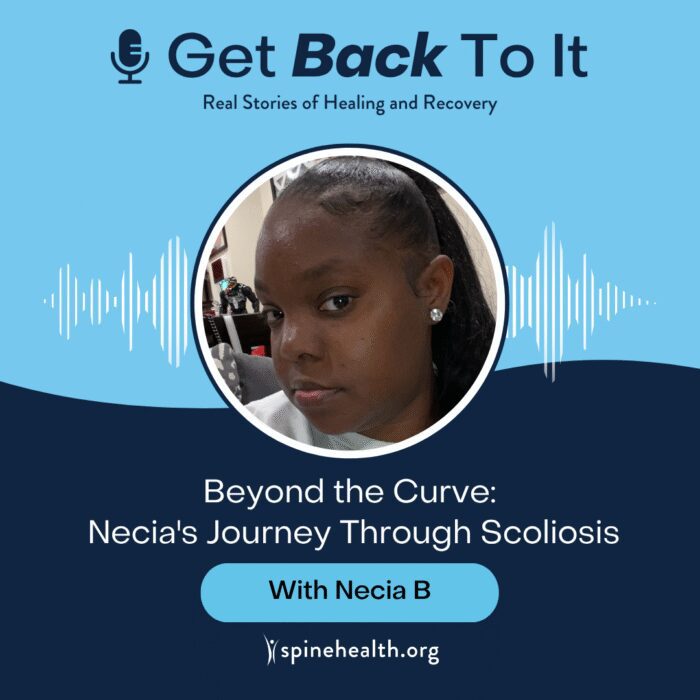
Necia B.’s journey with scoliosis began at just 12 years old after months of unanswered questions and medical testing finally revealed a severe spinal curvature. What followed was a whirlwind of doctor visits, bracing, and ultimately a complex spinal surgery to correct a 78-degree S-shaped curve, requiring the placement of five metal rods and screws that remain with her today.
But Necia’s story is about far more than surgery. As a young teenager, she faced overwhelming fear, anxiety, isolation, and the challenge of feeling different from her peers. From a panic attack moments before surgery to a difficult recovery that included unexpected complications, Necia learned resilience at an age when most children are simply navigating middle school.
In this episode, Necia shares her experiences living with chronic pain, finding strength through physical therapy, exercise, poetry, and mental health support, and learning that her condition does not define who she is. She opens up about the emotional impact of scoliosis, the importance of community, and how storytelling has become a powerful tool for healing and connection.
Today, at 32, Necia continues to prioritize her health while pursuing her education, leading community outreach through her nonprofit organization, and inspiring others to embrace their journeys with courage and hope. Her message is simple but powerful: stay positive, keep moving forward, and never let your health define who you are.
From Severe Scoliosis Diagnosis to Thriving: Necia’s Inspiring Story
Dr. Rita Roy: Hi everyone. I’m Dr. Rita Roy, CEO of the National Spine Health Foundation and host of the Get Back To It podcast. Here, we share real stories of healing and recovery from people who’ve overcome spine problems and returned to the lives they love. These success stories are powerful, inspiring, and sometimes unbelievable.
Let’s dive in.
At the Get Back to It podcast, our mission is to share the stories of spinal champions, individuals navigating spine conditions while striving for a better quality of life. Today’s guest is Necia B. Necia’s journey began at just 12 years old after months of missed diagnoses and lack of answers, what followed with hospital visits and tests.
Finally, the answer of a diagnosis of scoliosis emerged. Her childhood changed forever and hasn’t been the same. Having to wear a brace for 46 hours a day to a complex spinal surgery being done to correct a severe 78-degree curve, placing five metal rods to stabilize her spine, that’s just part of the story.
Beyond the physical challenges this caused, Necia faced something deeper: fear, isolation, and the feeling of being different at such a young age. Today, she’s still navigating pain, but she’s also found strength, purpose, and a powerful voice through storytelling, poetry, and sharing her journey to inspire others.
Her story is one of resilience, faith, and learning to embrace every part of the journey, even the scars. Necia, I want to start back at the beginning because your journey started at such a young age. Can you take us back to when everything first started and you were trying to figure out what was going on?
Necia B.: Yes. When I got diagnosed at age 12, we didn’t think nothing of it, but when the doctor asked my mom how long have I been walk- walking on my tippy toes, and she was like, “As long as I can remember.” And that’s when he was like, “Let me get some X-rays done.” And when he did the X-rays, it came back that my spine is curved, and that’s when he said, “She has scoliosis.”
Dr. Rita Roy: Wow. At 12 years old, Necia, that is a lot to process, especially when you don’t fully understand what’s happening, and for a lot of people, just the word scoliosis is a totally new word in their vocabulary. Necia, tell us what some of those early days of treatment looked like for you
Necia B.: In the beginning, it was a lot of X-rays, CAT scans, MRI scans, a lot of doctor’s appointments nonstop.
It
was, um, a lot of prep treatment for the surgery and for the back brace. I had to get fitted for a back brace that I had to wear four to six hours, sometimes longer than that. I didn’t have to wear it in the shower, thank God. After the back brace, nothing was being corrected, so the last resort was the surgery, and that was a scary thought because when you go in the operation room, it’s two things: life or death.
And my nerve … I have really bad nerves, so when I was told I had to get the surgery done, I was freaked out. I asked my mom all these questions ’cause my mom works in a … She was a EMT at the time, and so she was a, you know, familiar with the medical field and stuff like that.
Dr. Rita Roy: Yeah. Mm-hmm.
Necia B.: So when it came down to me, had to get all the medicine in my system for me to go backsta- back to the operation room.
When I got to the operation room, I panicked. I had a panic … I had a anxiety attack, and I ran out the operation room, and they had to chase me down, call my mom, let my mom know, like, “She’s running out the operation room.” When she, when they located her, they finally got me back into the operation room. I still was freaking out, and then next thing you know, I was asleep.
Dr. Rita Roy: Oh my goodness, Nisha. So Nisha, how old were you when you actually had the surgery?
Necia B.: I was, I had the surgery in June of 2006. I was 12 going on
Dr. Rita Roy: 13. Mm-hmm. So and how long were you in the brace before you had the surgery? So how long had you been dealing with it?
Necia B.: From I recall, I was in the brace at least for, I wanna say about three or four months. I think I’m supposed to have the wearer for a year, but since the curve was so severe, they went straight for the operation.
Dr. Rita Roy: Wow. Wow. So that was a lot to process all at once, um, to go from the diagnosis to just a few months later, now you’re having a big surgery. So it’s understandable why a young 12-year-old would get to that operating room and just be scared, be very, very scared. Um, and so you had that moment, you had the panic attack, you ran out the door.
They caught you, convinced you to come back, and then you went to sleep. Tell me what it was like when you woke up from the surgery.
Necia B.: When I woke up from the surgery, I was still kind of drowsy from the anesthesia, but I tried to get up out the bed, and they was like, “No,” they laid me down, “You’re connected to all these tubes, oxygen,” saying blah, blah, blah.
Um, so I was… After that, I was in the hospital for recovery for four weeks, which extended to six weeks because the nurse, when she took the tube out that was draining the blood, she didn’t take it out correctly. So when she, when it- she took it out, it left a hole in my left lung. So I had to stay in there for a extra two weeks until the hole was closed.
So that right there was another scary feeling, ’cause I knew something was wrong with my breathing. ‘Cause I was laying in a bed during the recovery room, and I couldn’t breathe, and I- there wasn’t nobody in the room with me. How I, I, I don’t know how I got… I was able to get the help that I did, but thank God I did.
But when I was laying in the bed, I was gasping for air, everything around me was spinning. Everything was… It was, I was dizzy, my head was hurting, my vision was going in and out, so I knew something was wrong. Mm-hmm. So I managed to get up out the bed, made it to the hallway. There was a nurse standing right by the door, and she said to me, “Niesha, what’s wrong?”
And I remember holding my chest, and I said to her, “I can’t breathe.” Next thing I know, everything went black When I woke back up, I was connected to a oxygen tank, and there was a X-ray technician in front of me taking pictures of my chest. And the results came back that morning that it was a hole in my left lung from which she was pulling the tube out to drain the blood.
Wow.
Dr. Rita Roy: In your lung?
Necia B.: Mm-hmm.
Dr. Rita Roy: And that had, that had nothing to do really with your surgery on your spine. This was something that had to do with anesthesia. And so that’s sometimes, you know, those are things to think about when you’re having surgery. There’s, there’s a lot going on when you go in for surgery, and that’s why people understandably have questions and concerns.
It’s, it’s a big deal to have the big, big surgery that you had. So Necia, do you know what kind of surgery you had? Did you have a fusion?
Necia B.: The, um, I, I gotta… I forgot what it was called, but it’s kinda like the spine fusion. So the curve was a S shape curve. So they went in on my left side on my ribcage. As they went in on that side, they took a piece of my rib out, and they put in five metal rods.
Those rods are to stay in my back for the rest of my life. They won’t remove it. They not gonna remove it, and it’s five screws in there as well.
Dr. Rita Roy: Mm-hmm. Wow. And so that’s pretty serious stuff to have going on with, with your spine. Um, so, so when you, you, you woke up, you had this anesthesia complication, and that required you to stay in the hospital for an extra two weeks, right?
Necia B.: Yeah. I didn’t get out the hospital until after my 13th birthday, and my birthday falls on July
Dr. Rita Roy: 8th. Okay. Well, that’s unforgettable right? I mean, that’s… You can’t forget, um, what you were doing on your 13th birthday, which is not what most 13-year-olds are doing on their 13th birthday. So, you know, that gets into a lot of the things that, that, uh, you’ve shared with us, Necia, about, you know, being a te- young teenager and feeling just alone and isolated and different than everybody else.
Um, were you having a lot of those feelings at that time in the hospital, or were you just more focused on getting through and getting, getting home, um, in those immediate days?
Necia B.: I was focused on getting home. I had enough of the hospital days.
Dr. Rita Roy: Yeah.
Necia B.: But when I got home, and I was in full recovery, that’s when the floods of fear, isolation, feeling different came on.
Dr. Rita Roy: Yeah. Necia, when you f- when you got home, and you were going into recovery, um, were you… Did you have pain in your back or in your body? What did it feel like?
Necia B.: Um, I didn’t experience the pain right off. I have a high tolerance of pain, so I don’t feel pain right off. I didn’t start feeling anything until I turned about 15 or 16 years of age.
Dr. Rita Roy: Yeah. So a couple years went along and your, your body is growing and changing and hitting puberty and all these things are happening, and now you start to feel differently in your body, and that’s kind of normal. People, you know, we all go through different changes as we’re growing, but yours was even more so because of the surgery that you had had.
And so at that time, were you, were you still feeling those feelings of isolation?
Necia B.: I still do to this day. Mm-hmm.
Dr. Rita Roy: How do you cope with that, Necia? What are some of the things you do?
Necia B.: Um, I mainly write poetry, listen to music, or I try to connect with other people that have the same health condition as me.
Dr. Rita Roy: Mm-hmm. Yeah. And Necia, did anybody in your family have something like this before? Were you the first person in your family to go through something like this?
Necia B.: Um, according to my mom, bone disease does runs in the family. She has it on her foot and her mother has it, and I have it in my
Dr. Rita Roy: back. Hmm. Yeah.
There’s, there’s a lot of times there’s a genetic component to these conditions, which, um, can help with the, those feelings of isolation because it’s like it’s nothing you did, right? It’s just something that runs in the family and everybody deals with it in different ways. Um, but nonetheless, Necia, you’ve said things like you felt like your childhood was being stolen by this, um, and that you could barely do any of the normal things that a lot of kids were doing.
Um, and so, you know, how do you keep going with that? What, what, what were some of your ways of coping?
Necia B.: When they told me that I’m gonna be in pain for the rest of my life and that physical therapy and a gym is my best friend, right there and then I knew that it was gonna be difficult, but I try not to let my health define who I am.
So I kinda like push through it the best way I can, and if I can’t, I would like kinda get depressed or something, but I try to find different ways to overpower that ’cause I’m like, “Okay, that’s what y’all saying. It’s just a prediction.” But at the end of the day, I know my body, I know my limitations, and God got the last say so.
So if I can do it and I can continue to do it, I’m gonna do it-
Dr. Rita Roy: Right …
Necia B.: until my body say, “Okay, that’s enough.”
Dr. Rita Roy: That’s amazing, and I think, you know, everybody has to figure out what their limits are. Somebody like you that’s gone through what you’ve been through and you’ve got the, the, um, you know, the scoliosis, y- you have a different set of parameters than, you know, somebody else does.
And so knowing where your limits are and finding that and accepting that is a challenge. It sounds like you managed that without saying no to the things that you wanted to do. So you can find your way to stay active or find your way to do the things that you want to do and understand better w- when and where you’ve reached your limit, and that’s really dictated by how comfortable you feel, right?
Necia B.: Yep. Totally.
Dr. Rita Roy: Yeah. What are some of the biggest things you feel like you’ve learned from the physical therapy and the recovery that you’ve been through with the physical therapy?
Necia B.: One thing I have to say physical therapy taught me is that stretching is important
And all that I have to completely say because when I do stretch and I do exercise, the pain does calm down, and then as soon as I stop, they go to pain again. So I’m like, “Okay. I get what y’all saying. I understand.”
Dr. Rita Roy: We say in, um … when we talk about musculoskeletal health, we say, you know, we have expressions, so you’ve probably heard this, motion is lotion, right?
And so-
Necia B.: I’ve heard of it.
Dr. Rita Roy: Yeah. Or, like, if you, you know, uh, what is it? What that … uh, rest is rust. You know? Like, y- if you let, if you let metal sit there, it’ll get rusty. It’s kinda like our bodies. If you just let it sit there, it gets rusty. So you gotta keep it moving, keep it lubricated, keep everything going.
And, um, so motion is lotion, staying in motion. And, you know, there’s another law of physics, right? That a body in motion stays in motion. And so, uh, body at rest stays at rest, so we wanna, we wanna keep moving. And sometimes it’s counterintuitive, because when you’re not feeling great, you don’t feel like moving, and yet movement often can be the thing that gets you out of the discomfort or helps you stay out of pain.
So, you know, the, uh, the old Nike slogan, “Just move,” right? Or, “Just do it,” um, that, that actually has medical, right, uh, uh, backing to it, because you gotta just do it. You gotta just get up and move and do your exercises. And sounds like you lived that journey at a young age. You learned that at a young age.
Necia B.: I did, and then if you said that my
the Nike slogan, “Just do it,” I’ma use that.
Dr. Rita Roy: Just do it. Know your limits, right? You don’t wanna push past a healthy limit. Um, but, but don’t let that stop you from doing the things that you wanna do. Um, a lot of times we say in spine health, Necia, we say spine health is a journey. It’s not a one-and-done thing, right?
It’s a, it’s a lifetime commitment to your health. And, um, in some ways, I guess the silver lining is that you learned that at a young age, and you know you’ve gotta just take care of yourself as you go through life. And, and I say it’s a silver lining because you get an appreciation at a young age, right?
Of what being able to move really means. Like, I’ll come to work some days, and I’ll say, “Oh, I’m tired. I’m gonna just take the elevator up three, three stories.” And then I say to myself, “Yeah, but remember when you couldn’t move? All you wanted to do was to be able to take the stairs.” And so then I’m like, “Okay, I’ll go take the stairs.”
And I just have to reframe my brain to say, “But wait- I can take the stairs. Not like I have to take the stairs, but I can take the stairs. And so it’s kind of re- retraining ourselves to think about, wait a second, I- I’m able to do this, so I’m gonna do it, even if I’m not feeling like doing it. And those are things that the younger you are in life to learn those lessons, the better off you are in, in, in the long run, because you just learn how to deal with that.
Do you feel like there’s some life lessons that you’ve learned, uh, in your teenage years that have, that are helping you now as a young adult?
Necia B.: Um, most likely to keep it moving.
Dr. Rita Roy: Yeah. Are there certain exercises that you find that you enjoy more and that you do more?
Necia B.: Definitely, um, I really enjoy, uh, bike riding, something that I haven’t done in so long, but I started to get back into it recently.
And I really enjoy group exercising.
Dr. Rita Roy: Mm-hmm.
Necia B.: Like, it’s hard for me to do it by myself ’cause I don’t have that push . But with the group exercise and a trainer, I do much better.
Dr. Rita Roy: Right. That, that sort of group, um, you know, it, it sort of gives you the, um, in- incentive, right? And kind of the encouragement and, uh, also accountability, right?
Like, everyone will be like, “Well, where’s Necia? Why isn’t she at exercise class today?” And so you feel like you show up and, and, yeah, I like the group exercises also. It’s more fun.
Necia B.: Yeah, and it’s much fun. It
Dr. Rita Roy: is fun. Um, how many, how many days a week do you exercise now, Necia?
Necia B.: Now with the group classes, um, I try to go at
least twice a week without trying to overwork my body, ’cause I still have school, and I still have my work shift at night. So I try to balance it out the best way I can.
Dr. Rita Roy: Yeah. Yeah. Necia, can you tell our audience how old you are now?
Necia B.: 32 going on 33.
Dr. Rita Roy: What? Oh my God. I’m looking at you on the screen as we’re talking here, and you look so young.
Necia B.: I get that a lot. Oh my
Dr. Rita Roy: gosh. Young h- so all that movement, learning how to manage your body, all that stuff as a young girl I think is paying off for you, because you look amazing right now. So- Thank
Necia B.: you …
Dr. Rita Roy: you’re 32 years old. That’s, that’s fantastic. Um, Necia, as you, as you think about your life and you reflect on the stages that you’ve taken, sounds like your mom was a big support, uh, played a big support role for you.
What other kind of support, uh, did you have in your life as you were going through your scoliosis journey?
Necia B.: My mom, of course. Um, my teach- my seventh grade teacher, we still keep in contact with me here to this day. And of course, all the doctors that’s on my, that’s been on my team since the diagnosis, all y’all, we still keep in contact with me.
Isn’t that
Dr. Rita Roy: amazing? That’s amazing. And Nisha, what part of the country do you live in?
Necia B.: United States.
Dr. Rita Roy: Yeah, where, where in the US do you live? In
Necia B.: Philly.
Dr. Rita Roy: In where?
Necia B.: In Philadelphia.
Dr. Rita Roy: Oh, Philly. I’m sorry. I couldn’t understand what you said. Yeah, Philadelphia. Well, the cool thing about Philadelphia, well, there’s a lot of cool things about Philadelphia, but from a healthcare standpoint, there are lots of amazing doctors and physical therapists and trainers in that area, so that’s…
It’s amazing to be in a place where you have access to really great healthcare. Um, and sounds like you have been the recipient of that for sure over your life. Uh, I, I think, uh, Nisha, wanted to ask you just a couple of questions from the early days of getting your diagnosis. Um, wanted to just touch back on something you said in the very beginning, when you were walking around on your tippy-toes and, um, one of the doctors said, “You know, that doesn’t seem right,” and they wanted to get an X-ray, and that sort of launched into this whole thing.
Did you have any indication at all that you had a curve as severe as you had?
Necia B.: No. No pain, no nothing
Dr. Rita Roy: So there were no symptoms at all other than just kinda walking in a, in a funny way to balance yourself?
Necia B.: Yep.
Dr. Rita Roy: Yeah. That’s, that’s incredible. And, and Nisha, another thing that you said is one of the things that you do to help with sort of managing your, your emotions around your scoliosis is you participate in things like this, right?
Yeah. Tell your story and share your story. Can you tell us more about that?
Necia B.: Yes. Um, it actually started out in a journal. I would write my feelings and my emotions ’cause I didn’t know how to express myself, and when I did express myself to people, I guess they didn’t have a full understanding where I was coming from, or they would just kinda negative energy with it.
So what I started doing was journaling, and then I turned my journaling to poetry, and ever since then I just been connected to poetry to express my feelings. So now with my therapist, not my physical therapist, but my mental health therapist, he like, “Um, why don’t you go to some healing support group, or try and connect with other people that have the same condition as you?
That way you won’t feel so alone, ’cause you’re not the only one in this world that’s going through that same condition.” And that’s how that came out.
Dr. Rita Roy: Yeah, that’s amazing. It’s such a powerful way to take your story and turn it into something meaningful. Um, you know, creating your poetry, sharing that with others, and then connecting with others.
Um, I feel like that is… That’s just, it’s so therapeutic for you, but it’s also therapeutic for others who meet you, uh, to, to connect in that way. Um, for, for people who are listening to us today, how can you encourage them to find support? What are, what are some places where you’ve gone to find support?
Obviously, we’re doing this today, which is amazing. Um- Tell us, tell us how you found us, and some of the other things that you do.
Necia B.: On my spare time when I’m going through something, when it comes to my health or mental health, the way you fi- I always tell people, find something that you love to do.
Something that’s creative, even if it’s just art, painting, um, crocheting, playing the piano. Do something that, that you love, that you can connect with others. There’s a lot of groups out there now than it was before when it comes to health, mental health, physical, emotional health. It’s, there’s a lot of resources now.
So I always tell people, like, if you don’t have social media, that’s fine, ’cause then, it is a lot of things that you can find on social media that you would do in person. But if it’s in person, I just say, like- Google research or walk around to the library, ’cause the library give you a lot of information too.
It’s, um, cafes. There’s a lot of cafes out here that have resources too when it comes to spine or any kind of health-
Dr. Rita Roy: Yeah …
Necia B.: that will help you connect with others so you won’t feel alone.
Dr. Rita Roy: Right. And I think you’d said that you found the National Spine Health Foundation. How, how’d you find us?
Necia B.: I found y’all through Google research.
I was Googling on, like, with some, um, spine health foundations that I could share my story, and then y’all popped up. So I was like, “Hmm, okay.” And I watched the video. So I was like, “Okay, let me go ahead and reach out.”
Dr. Rita Roy: That’s awesome. Oh, I’m so glad. I’m so glad that you found us that way. That- that’s what we’re here for.
That’s, that’s, uh, this is the heart of our mission, is getting the word out there and having people find us, connect with us, share their stories so that other people can learn from them, and again, not feel so alone. So I’m just, I’m just so thrilled that we’re having this conversation today, and that we’re going to be able to share it with the world.
And, um, of course, this is June that we are talking, and it is Scoliosis Awareness Month, so it’s great timing for us to be-
Necia B.: Ah. …
Dr. Rita Roy: this, this month. Um, just kind of as we wrap up our conversation, Necia, um, what are some of the things, I guess, some of the, the challenges that you’re faced with now, and, um, what, what are your favorite ways to manage through those challenges?
Necia B.: One of the most challenges I definitely face is the pain. Especially when it’s about to rain, I am in real bad pain, so I just relax my body during the day. If I could get to the gym or the massage therapist to get, like, some kind of pain relief-
Dr. Rita Roy: Yeah …
Necia B.: I would do that the best I can. But some days I can’t even move because I’m in so much pain.
Mm. So I would just relax the whole day.
Dr. Rita Roy: Yeah. And what are some of your, um, your favorite exercises to do? I guess, um, are you doing Pilates or, or yoga or some of those things?
Necia B.: I haven’t started Pilates yet, but I am looking into it. But my favorite is definitely the swimming pool.
Dr. Rita Roy: Swimming pool? Great.
That’s awesome. We haven’t talked about that at all. We’ve been talking about the gym and the group exercise classes, but the pool. Tell me
Necia B.: about the pool. Yes. Aqua, Aqua Zumba is so much… Oh, my, the pain relief is amazing. Wow. And the class is so fun.
Dr. Rita Roy: What… Oh, so that’s one of the group classes you do, the Aqua Zum- Aqua Zumba?
Necia B.: Yeah, that’s… And, uh, yes. It’s in a swimming pool, and it’s so much fun. And the relief, oh, my God, yes. The pain relief is amazing.
Dr. Rita Roy: That’s amazing. Oh, my gosh, I’m so excited to hear that. That’s great. So I guess, just again, as we’re closing, uh, closing down the conversation, Nisha, as you continue getting back to it, what are some of the things that you’re excited about or hopeful for about in your future?
Necia B.: One thing I’m really excited for is continue my health journey. I definitely, that’s something that I always been big on ever since I was little, is my health and my education. I wanna definitely look into partner up with a lot of health-owned companies on working on a device to prevent and… not prevent, but more to, how can I say it?
Um, early detection on symptoms or signs.
Dr. Rita Roy: That’s amazing. That’s amazing. Are you, are you in school now, Nisha, for that? Or how, what are you doing for that? What’s your plan?
Necia B.: Um, I start school next week on June the 10th for, uh, criminal justice. But I also have a nonprofit organization for the community where we give out food, clothes, health, um, information, all kind of resources.
Um, back to school drive. We, I start, I started that back in 2018. Wow. And then COVID
happened, and we had to shut it down for a little while. So now we rebranding everything back up.
Dr. Rita Roy: That’s awesome. That’s fantastic. Um, last question for you, Nisha, as we, as it, as we close out our conversation. What do you think, if you could go back and talk to your 12-year-old self, what is the, what is the one or two things you would say to that little girl who first got that diagnosis?
Necia B.: One thing I will say is that it’s okay not to be okay, and everything is gonna be okay. You’re strong, you’re brave, and you got this
Dr. Rita Roy: So sweet. That’s awesome. So awesome. Necia, anything else you’d like to share before we say goodbye to our audience today? Any last words of wisdom or pearls of knowledge to share?
Necia B.: Stay positive and continue to be who you are, and don’t let your health define you.
Dr. Rita Roy: That’s beautiful. That’s so well said.
Very well encapsulated. Don’t let your health define you. Stay positive. I love it. It’s fantastic. Necia, thank- Thank you …
Necia B.: you
Dr. Rita Roy: so much. Thank you, thank you for sharing your story with us with such honesty and courage. Um, what you’ve been through, especially starting at such a young age, is very difficult, but the strength, perspective, and purpose you found along the way is truly inspiring.
Um, your story is a reminder that even in the hardest moment, there is still growth, meaning, and a path forward
At the National Spine Health Foundation, we believe deeply in providing hope through shared stories and trusted education. Millions of people live with spine-related pain, and it can feel isolating, but you’re not alone. To hear more spinal champion stories and access spine health resources, visit us at spinehealth.org.
If you’d like to support the show financially, you may do so at the link provided. Thank you for listening.