
A Common Misconception Worth Setting Aside
If a primary care doctor, physical therapist, or friend suggests that you see a spine surgeon, your first reaction may be a wave of anxiety. Many people assume that walking into a spine surgeon’s office is the first step toward an operating room. That assumption is one of the most persistent and most misleading ideas in spine care today — and it can keep people from getting the very expertise that helps them avoid unnecessary procedures and find the treatments that actually work for them.
The reality is far more reassuring. A modern spine surgeon is, first and foremost, a spine specialist: a physician with the deepest training in how the spine works, how it ages, how it fails, and how every available treatment — surgical and nonsurgical — fits together. Surgery is just one tool in a very large toolbox. For most patients, it is not the tool that will be reached for first, and for many patients it will never be reached for at all.
This article explains how spine surgeons actually approach care, what the published data show about how often surgery is recommended, why having a spine specialist as the “quarterback” of your care matters across the long arc of a degenerative condition, and how to choose a spine surgeon who will partner with you in shared decision-making.
The Bottom Line
Most patients who see a spine surgeon do not end up having surgery. The surgeon’s most important job is to make an accurate diagnosis, explain the full range of treatment options, and guide you through them in the right order — with surgery considered only when, and if, it is truly the right choice for you.
What the Evidence Actually Shows
Estimates of how often a new spine consultation leads to surgery vary by clinic and condition, but the overall message from the published literature is consistent: nonoperative care is the rule, not the exception.
Surgery is the minority of spine care
Most people who experience back pain will not need surgery. In fact, experts estimate that only about 1 in 10 people with back pain ever require an operation. The other 90% improve with non-surgical care like physical therapy, exercise, medications, injections, and simply giving the body time to heal.
Even when patients are referred to a spine surgeon, surgery is not a given. Studies show that many people who see a spine surgeon do not end up having surgery. Depending on the clinic, anywhere from about one-third to more than 80% of patients are treated without an operation.
Real-world data supports this. In one study, nearly 60% of patients who saw a spine surgeon did not go on to have surgery. In another program designed to carefully evaluate patients before surgery, only about 1 in 8 people were ultimately recommended for an operation.
Across the board, the message is consistent: most back and spine conditions can be effectively managed without surgery, even when a specialist is involved.
What The Studies Suggest
Most people who see a spine surgeon do not end up having surgery. Depending on the situation, only about 15% of patients move forward with an operation. Across all people with back pain, it’s closer to 1 in 10. In fact, the majority of patients seen in spine clinics are treated with non-surgical care.
Second opinions usually shift toward less surgery, not more
Many people are surprised to learn that when patients seek a second opinion, spine surgeons often recommend not having surgery. In one study, nearly half of patients who were previously told they needed surgery were advised against it after getting another opinion. Even among people seeking their first consultation, surgeons recommended non-surgical care in a similar number of cases.
The takeaway isn’t that surgery is overused, it’s that a careful, thorough evaluation often shows that surgery isn’t the first option. Seeing a spine surgeon should be viewed as getting an expert opinion on your condition, not as a step that automatically leads to surgery.
Why the Spine Surgeon Knows the Whole Toolbox
Many specialists treat only a part of the spine problem. Physical therapists, chiropractors, physiatrists (physical medicine and rehabilitation physicians), interventional pain physicians, and primary care doctors all play essential roles. What distinguishes a fellowship-trained spine surgeon is depth and breadth across the entire continuum of spine disease, from the earliest signs of degeneration through the most complex reconstructive operations, and the ability to recognize when each option fits.
A fellowship trained spine surgeon trains for at least one to two additional years of fellowship after completing a full residency in either orthopedic surgery or neurological surgery. During that fellowship, they immerse themselves in disc herniations, spinal stenosis, deformity, fractures, tumors, infections, and the full range of operative and nonoperative management strategies for each. They also learn the natural history of these conditions: what tends to improve on its own, what tends to plateau, and what tends to progress.
That breadth matters because spine care is not a single decision; it is a sequence of decisions. A good spine surgeon can sit with you and lay out, in plain language, what physical therapy can and cannot do for your specific diagnosis, when an injection might or might not help, what oral medications are reasonable, where lifestyle and activity modification fit in, what minimally invasive options exist, and what major surgery would and would not address. Crucially, they can also tell you what the evidence says about each of these options for your condition, not just for back pain in general.
Shared Decision-Making is the Standard of Care
Modern spine practice is built on shared decision-making: the patient and the surgeon weigh the diagnosis, the patient’s goals, the trade-offs of each option, and the patient’s personal preferences and values together. Rather than the older paternalistic model of “here is what I am going to do for you,” the conversation becomes “here are your options, here is what each one is likely to deliver and at what cost, and here is what I recommend — what feels right to you?” Spine surgeons trained in this way actively want patients to ask questions, request a second opinion, and take time to think before committing to any major treatment, especially surgery.

The Spine Surgeon as the “Quarterback” of Your Care
Spinal conditions are usually not single events. The vast majority are degenerative — they evolve over years or decades. Discs gradually lose hydration, joints develop arthritis, ligaments thicken, and bones change shape. These changes can produce flare-ups that come and go for a long time. That long arc is why having one knowledgeable specialist who can follow you over time is so valuable.
Think of the spine surgeon as the quarterback of a team. The team includes physical therapists, primary care providers, pain specialists, radiologists, imaging technicians, and sometimes rheumatologists, neurologists, or behavioral health professionals. The quarterback’s job is not to do everyone else’s job. It is to read the situation, call the right play, hand the ball off to the right teammate at the right moment, track the result, and adjust the next play based on what worked and what did not.
In spine care, this looks like:
- Establishing a baseline — documenting your current pain pattern, neurological exam, functional ability, and imaging findings so that any future change can be measured against a known starting point.
- Sequencing treatment intelligently — starting with the least invasive approaches that are most likely to help your specific diagnosis, and reserving more aggressive options for situations where conservative care has been adequately tried and either has not worked or is no longer the best fit.
- Tracking what is working and what is not — with periodic check-ins, repeat neurological exams, and measurement-based tools so that decisions about “when to escalate” or “when to stay the course” are based on data, not guesswork.
- Knowing when to escalate — and when not to — recognizing the moments when a treatment plateau, a new symptom, or a change on examination suggests it is time to consider a different approach.
- Educating you about the disease itself — so that you understand what your spine is doing, what is normal aging versus what is pathological, and what to expect as the years go on.
Why a Baseline Matters in a Degenerative Condition
Because spine disease evolves, a single snapshot in time is rarely as useful as a series of snapshots compared against each other. Imaging in particular can be misleading without context. Studies of MRIs in adults without back pain have shown that disc bulges, herniated discs, degenerative discs, and annular tears are common findings even in people who feel fine — with prevalence rates ranging widely depending on age. Without a baseline and without someone who understands which findings actually correlate with your symptoms, it is easy to misinterpret an imaging report and either over- or under-treat.
A spine surgeon who has examined you and reviewed your prior imaging can compare a new MRI to an older one and answer the questions that actually matter: Has anything changed? Is the change clinically meaningful? Does it explain the new symptoms? Or is it just incidental aging? That kind of longitudinal interpretation is far more valuable than any single report read in isolation.
Just as important as treating today’s symptoms is preventing tomorrow’s. A spine surgeon who knows your spine over time can recommend targeted protective exercises, guide you on posture and body mechanics, flag risk factors such as smoking, deconditioning, or low bone density, and help you make the lifestyle adjustments most likely to slow the progression of degenerative changes. For patients who have already had treatment, that preventive lens extends to protecting adjacent segments and preserving the results you have worked for. Staying ahead of problems is often the highest-value care a spine specialist delivers.
The Right Test at the Right Time
Spine surgeons also know which tests to order — and, just as importantly, which tests not to order. They are also expertly trained to read each imaging study themselves. This is a distinction worth understanding: when you have an X-ray, CT, or MRI, a radiologist interprets the images and issues a formal report. A spine surgeon then reviews the actual images directly, applying their surgical and clinical expertise to correlate what they see with your symptoms and examination findings. That second, specialty-specific read is something most non-surgical providers are not trained to perform at the same level. It is not uncommon for a spine surgeon to identify findings the radiology report did not emphasize, to downplay findings that look alarming on paper but are not clinically meaningful for you, or to catch subtle changes on a comparison study that would otherwise go unnoticed. Two expert sets of eyes on your imaging — a radiologist’s and a spine surgeon’s — is a genuine advantage of being under the care of a spine specialist.
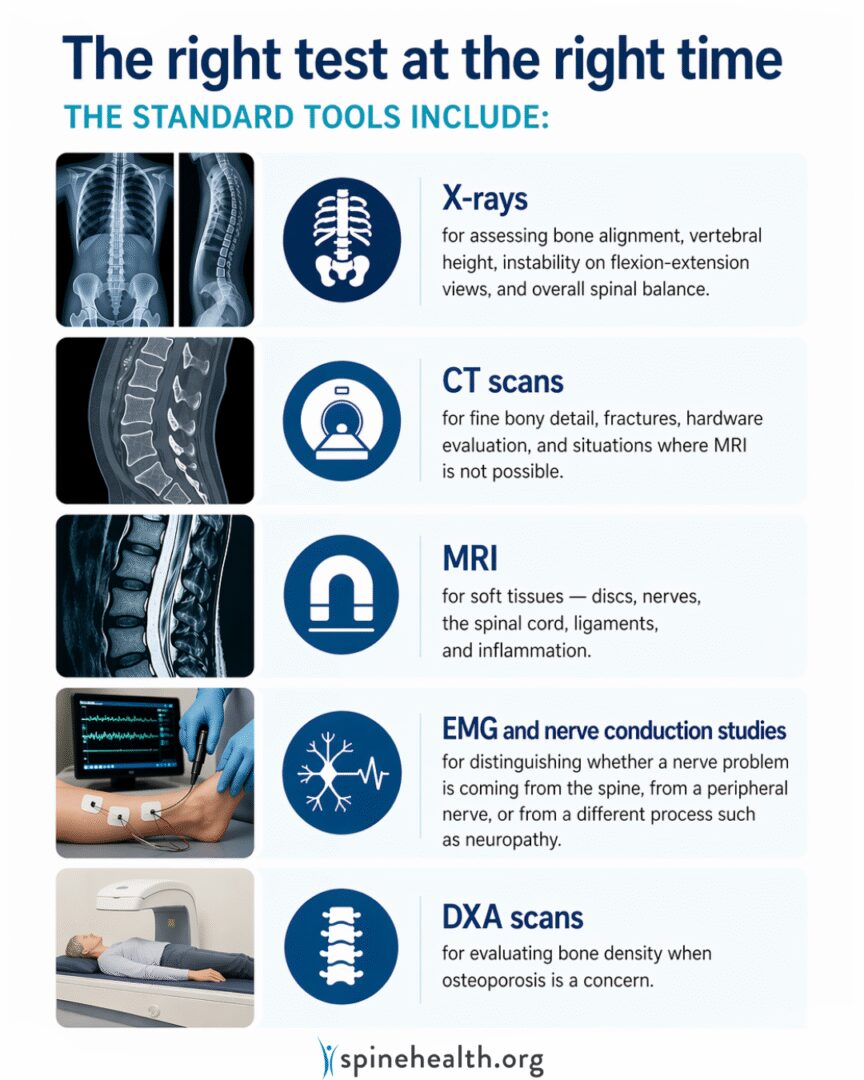
The standard tools include:
- X-rays for assessing bone alignment, vertebral height, instability on flexion-extension views, and overall spinal balance.
- CT scans for fine bony detail, fractures, hardware evaluation, and situations where MRI is not possible.
- MRI for soft tissues — discs, nerves, the spinal cord, ligaments, and inflammation.
- EMG and nerve conduction studies for distinguishing whether a nerve problem is coming from the spine, from a peripheral nerve, or from a different process such as neuropathy.
- DXA scans for evaluating bone density when osteoporosis is a concern.
Used at the right moments, these studies refine the diagnosis. Used reflexively or too early, they can introduce confusion, anxiety, and unnecessary cost. The spine surgeon’s judgment about what to order, when, and why is part of what makes them an effective quarterback.
Warning Signs to Know — and What to Do About Them
Most spine symptoms are uncomfortable but not dangerous. However, there are a small number of warning signs — sometimes called “red flags” — that should prompt urgent medical evaluation. Knowing them is part of being an informed patient. Your spine surgeon and care team should review these with you and tell you exactly when to call.
Symptoms that warrant prompt or emergency evaluation include:
- Loss of bowel or bladder control, including new urinary retention, the inability to start urinating, or new incontinence.
- Numbness in the “saddle” area — the inner thighs, groin, or area you would sit on a saddle.
- New, rapidly worsening weakness in one or both legs, such as a foot that suddenly catches when walking, difficulty climbing stairs, or trouble standing from a chair.
- Sudden onset of severe pain in both legs at once or pain that progresses from one leg to both.
- Severe pain after a significant fall, motor vehicle collision, or other major trauma, especially in older adults or those on long-term steroids.
- Unexplained weight loss, night sweats, fevers, or chills combined with new back pain, particularly with a personal history of cancer.
- Pain that is severe and unrelenting at night or at rest, and is not relieved by any position.
When in Doubt, Get Checked
If you notice new changes in bladder or bowel function, numbness in the area between your legs (sometimes called “saddle” numbness), or significant new weakness in your legs, it’s important to seek medical care right away. While these symptoms are uncommon, they can indicate a serious condition that needs prompt evaluation.
These warning signs are uncommon. The point of knowing them is not to live in fear of your back, but to be able to recognize the rare situations in which urgent action genuinely matters — and otherwise to feel confident continuing the longer-term, measured approach your care team has designed with you.
Tracking the Neurologic Exam Over Time
One of the most useful things a spine surgeon does at follow-up visits is repeat the neurologic exam: testing strength in specific muscle groups, checking sensation in specific dermatomes, evaluating reflexes, and assessing balance and gait. By comparing today’s exam against the baseline exam, the surgeon can detect subtle changes that the patient may not even notice. A small but real loss of strength in a particular muscle, for example, can be the earliest sign that a nerve is becoming more compressed and that the treatment plan should be revisited. This is another reason that continuity with one knowledgeable specialist is so valuable across the years.
How to Choose a Spine Surgeon
Once you decide to see a spine surgeon — whether for an initial opinion, a second opinion, or to find a long-term partner in your care — it is worth taking the time to choose carefully. Here is a practical, evidence-aligned approach.
1. Look them up online
Start with the surgeon’s practice or hospital website. You should be able to find their training history (medical school, residency, fellowship), board certification, areas of clinical focus, academic appointments, and any leadership roles or research contributions. Many surgeons also have profiles on hospital systems, professional societies, and physician-rating sites. Use multiple sources and treat any single rating site with appropriate skepticism.
2. Confirm board certification
In the United States, spine surgeons should be board-certified by either the American Board of Orthopaedic Surgery (ABOS) or the American Board of Neurological Surgery (ABNS). Board certification confirms that the surgeon has completed an accredited residency, has met defined practice standards, has passed a rigorous written and oral examination, and is engaged in ongoing continuing education and recertification. You can verify board certification through the American Board of Medical Specialties (ABMS) at certificationmatters.org.
3. Look for fellowship training in spine surgery
Fellowship training is the additional one to two years of focused subspecialty experience that follows residency. A fellowship-trained spine surgeon has spent that extra time exclusively learning advanced spine techniques and decision-making under the mentorship of established spine experts. Most experienced patient educators, including major spine practices, recommend choosing a fellowship-trained spine surgeon, especially for procedures such as spinal fusion, artificial disc replacement, complex decompressions, and any revision surgery.
4. Consider experience and procedure volume
It is reasonable to ask how many years a surgeon has been in practice and how often they perform the specific operation being considered. Surgeons who routinely perform a particular procedure tend to be more familiar with the nuances of patient selection, technique, and management of complications. You can also ask what percentage of the surgeon’s practice is devoted to spine — a high-percentage spine practice generally indicates focused expertise.
5. Pay attention to how they discuss treatment
Perhaps the most important sign of a good spine surgeon is the way they explain your situation. The right surgical team will:
- Take a thorough history and perform a careful physical and neurologic examination.
- Review your imaging with you, point out the findings, and explain what does and does not correlate with your symptoms.
- Lay out the full range of treatment options — not only surgery — with honest assessment of the likely benefits, risks, and alternatives for each.
- Encourage you to ask questions, take notes, and bring family members.
- Welcome a second opinion, including offering to recommend another surgeon you could see.
- Avoid pressuring you to schedule surgery on the first visit unless there is a true emergency.
If your questions don’t feel fully addressed, or if surgery is discussed very early without also reviewing non-surgical options, it may be worth asking for more information or considering another opinion. A confident, well-trained surgeon is not threatened by careful patient questions — they expect them and welcome them.
6. Ask the practical questions
Helpful questions to bring to a consultation include:
- What is your diagnosis, and how confident are you in it?
- What are all of my treatment options, including doing nothing for now?
- If we try a nonoperative path first, how will we know whether it is working, and when would we reconsider?
- If surgery is being recommended, what specific procedure, why this one, and what would happen if I waited?
- What are the realistic expected outcomes — not the best case, but the typical case — for someone like me?
- What are the potential risks and complications, and how often do they occur in your hands?
- How many of these procedures do you perform per year?
- Are you board-certified and fellowship-trained in spine surgery?
- Would you recommend a colleague for a second opinion?
7. Trust how the visit feels
Beyond credentials and answers, pay attention to how the visit feels. Did the surgeon listen? Did they explain things in language you could follow? Did they treat you as a partner in the decision? Did the office staff and team treat you with respect? You may be working with this person for years, particularly if your condition is degenerative. The relationship matters.
A Better Way to Think About Spine Care
If there is one idea worth carrying away from this article, it is this: seeing a spine surgeon is not the same as choosing surgery. It is choosing expertise. The surgeon is the specialist with the deepest understanding of your spine, the broadest view of treatment options, and the longitudinal perspective to help you navigate a condition that, for most people, will evolve over many years.
The published evidence is clear that the majority of patients seen in spine surgical clinics do not have surgery. Many are treated with physical therapy, exercise, medications, injections, and time. Others find that a watchful, well-informed approach — anchored by a baseline exam and imaging, careful tracking, and education about warning signs — lets them manage their condition for years without ever needing an operation. And for the smaller group of patients for whom surgery is the right answer, having a spine surgeon as their long-term quarterback means that the decision is made carefully, at the right moment, with the right operation, and with realistic expectations.
If you have been told you should see a spine surgeon, see one. Bring your questions. Expect a thorough evaluation. Expect a real conversation about all of your options. And expect to leave with a clearer understanding of your spine, a plan that fits your life, and a partner you can rely on as the years go on.