

Treatment of Osteoporosis in Adult Spinal Deformity Webinar Series
This four-part webinar series will cover osteoporosis management in adult spinal deformity (ASD), a common condition that raises the risk of surgical complications. With over 30% of ASD surgery patients affected—far more than in the general population—the series aims to help spine surgeons, advanced practice providers, nurses, and other health professionals better identify and treat osteoporosis to improve surgical outcomes.
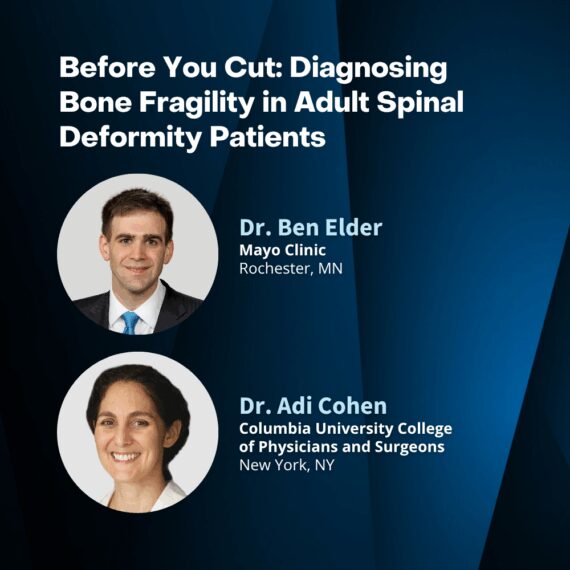
Session 1: Before You Cut: Diagnosing Bone Fragility in Adult Spinal Deformity Patients
Date: Tuesday, December 9 | 8-9 PM ET
This webinar equips spine surgeons with a practical approach to bone health screening in adult spinal deformity patients. Learn why screening matters—osteoporosis prevalence, complication linkage, and DXA pitfalls in degenerative spines—and evidence-based criteria for who to screen and when. Master decision-changing tools including proper DXA technique, VFA, FRAX with and without TBS, quantitative/opportunistic CT with Hounsfield Unit thresholds for fixation risk, and VBQ on MRI. Apply a streamlined clinical pathway incorporating essential labs (vitamin D, PTH, ALP), fracture history, and a “green/yellow/red” surgical readiness rubric to guide optimization and endocrinology referral.
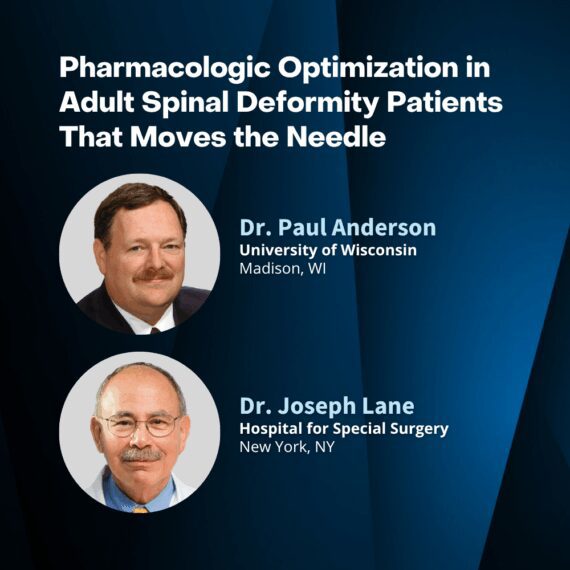
Session 2: Pharmacologic Optimization in Adult Spinal Deformity Patients That Moves the Needle (When Time Is Tight)
Date: Tuesday, December 16 | 8-9 PM ET
This session covers evidence-based pharmacologic optimization for spine surgery candidates with osteoporosis. Learn the rationale for upfront anabolic therapy, including speed of BMD change, patient selection criteria, and practical timelines relative to surgical scheduling. Understand the critical transition to maintenance antiresorptive therapy to preserve anabolic gains, including strategies to prevent rebound bone loss. Review spine-specific evidence demonstrating how osteoanabolic agents improve fusion rates, reduce screw loosening, decrease adjacent segment fractures, and mitigate proximal junctional kyphosis risk in instrumented deformity correction.
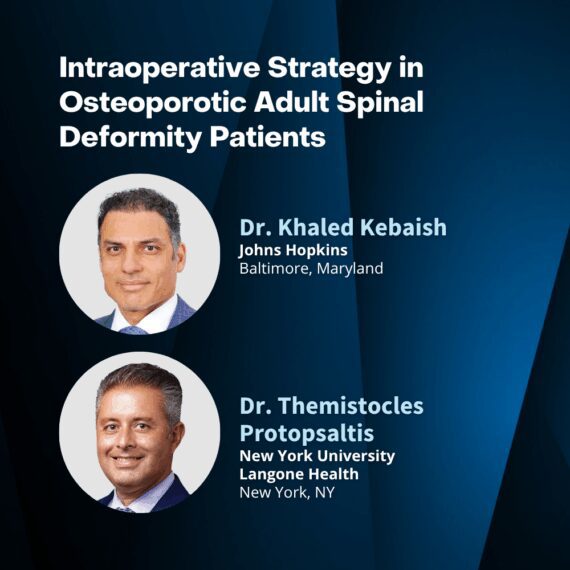
Session 3: Intraoperative Strategy in Osteoporotic Adult Spinal Deformity Patients
Date: TBD
Coming Soon
This session provides practical surgical strategies for instrumenting osteoporotic spines. Learn junctional protection techniques, including hooks versus pedicle screws at the upper instrumented vertebra (UIV), strategic cement augmentation at UIV and UIV+1, junctional tethers and ligament augmentation, and “soft-landing” construct design to minimize proximal junctional stress. Master fixation strategies for poor bone quality, including fenestrated screws with cement augmentation, sacropelvic fixation with S2-alar-iliac screws and multi-rod constructs, endplate preparation techniques to limit subsidence, and appropriate use of sublaminar wires. Understand alignment planning principles that avoid overcorrection and set realistic targets to reduce proximal junctional kyphosis risk in the osteoporotic population.

Session 4: Rescue & Revision: Salvaging Mechanical Failure in Fragile Bone
Date: TBD
Registration Link: Coming Soon
This interactive case-based session addresses challenging revision scenarios in osteoporotic spines. Analyze three real-world cases: (1) a prior T10-to-pelvis construct with preserved alignment but early upper instrumented vertebra compression fracture requiring junctional extension decisions, (2) a previous L4-S1 fusion complicated by sacral insufficiency fracture necessitating sacropelvic fixation strategies, and (3) a construct with early severe screw pullout and potential iatrogenic malalignment requiring complete revision planning. Through structured discussion, learn systematic approaches to revision decision-making, timing considerations, bone optimization prior to reoperation, and technical strategies to address failed fixation in compromised bone.